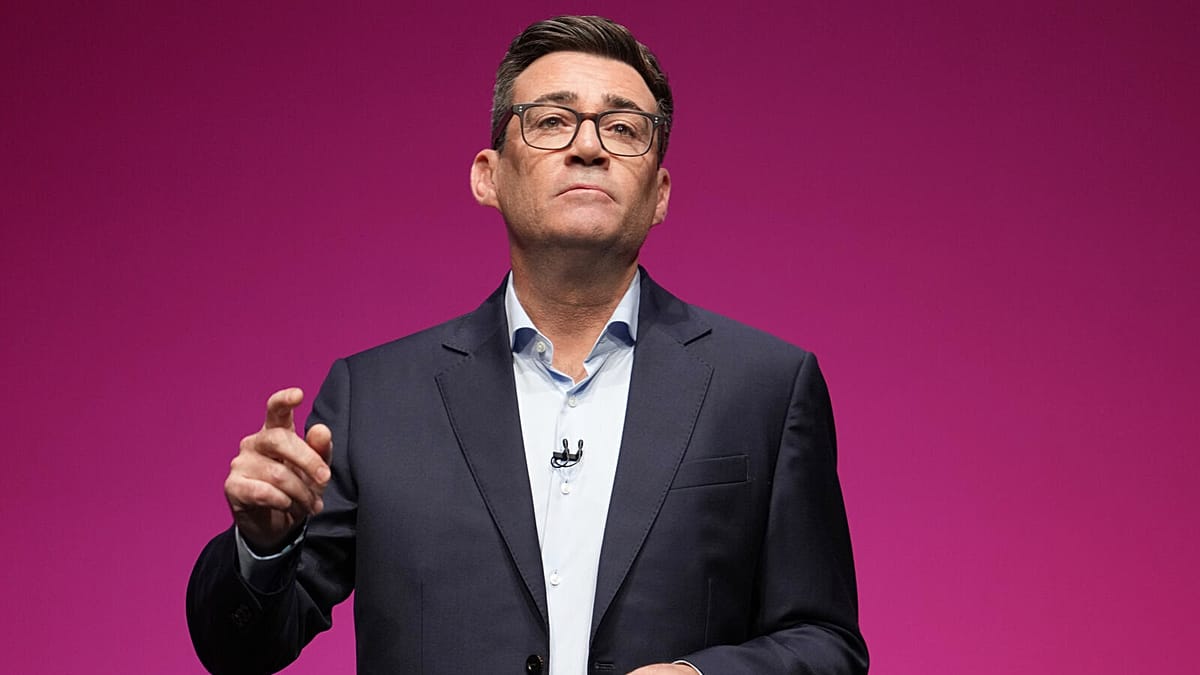
UK Prime Minister Andy Burnham has signalled a willingness to reconsider Britain's relationship with the European Union, including the possibility of rejoining the bloc. In a recent statement, he argued that Brexit has done "more harm than good" and pledged to set out "options" for a new partnership ahead of the EU-UK summit in Brussels in November.
Burnham's openness marks a departure from his predecessor, Keir Starmer, who had maintained a cautious, often ambiguous stance on Europe. Starmer had ruled out a return to the single market, customs union, or free movement, constraints that were written into Labour's 2024 electoral manifesto. Burnham has now swept those red lines aside, a move that has not gone unnoticed in European capitals.
"This was a politically bold move," one EU official told Euronews. "It now opens up the possibility of a far more ambitious approach." However, officials privately stress that much greater clarity is needed over what Britain is actually prepared to pursue, and that the principles established during the hard-fought Brexit negotiations remain non-negotiable.
Rejoining the EU: the long road
Burnham has acknowledged that the most ambitious option would be to go "all the way" and rejoin the EU, but he has also suggested that the time is not yet right to re-run the Brexit referendum. UK officials say he could use the next general election in 2029 to gauge public support, making Brexit a major dividing line in the campaign. Recent polling suggests a majority of UK voters would back rejoining if given the choice.
Yet such a pledge carries political risks. It could alienate traditional Labour voters who supported Brexit, pushing some towards the Conservatives or Nigel Farage's Reform UK, while drawing more pro-European voters to Labour from the left. Burnham came into Downing Street earlier this year as Labour sought to curb Reform UK's sharp rise in the polls.
In Brussels, the shift has been welcomed as a positive signal at a time when Eurosceptic parties are polling strongly ahead of major elections next year in countries including France and Italy. It also comes as the EU accelerates its own enlargement efforts eastwards and into the Western Balkans, and looks to negotiate a special 'associate membership' for Canada, a model that could offer a new template for partnership.
But UK re-entry is widely seen as a long-term prospect that would require a clear national mandate. Officials are wary that a change of government could quickly unravel any plans. In the meantime, Brussels wants London to clarify its shorter-term objectives.
"This will have come as a moral boost for leaders," said Charles Grant, Director at the Centre for European Reform. "But EU officials will be thinking about the work that needs to be done now, and I think many of them will be quite hostile to what the British are saying."
Halfway house: single market or customs union
Burnham has also floated the prospect of rejoining the EU's customs union, which would remove internal tariffs on goods, or the single market, a much bolder proposal that would restore the free movement of goods, services, capital, and people. Former Conservative Chancellor George Osborne, who served under David Cameron during the Brexit campaign, recently said that rejoining the customs union would be a "simple" and "straightforward" solution that could restore free trade and bolster the UK's economic outlook.
However, research suggests that most of the decline in UK exports linked to Brexit stems from leaving the single market, and that a customs union arrangement would only undo a fraction of the damage. Rejoining the single market would carry a greater political cost: the UK would be obliged to reintroduce free movement, accept European Court of Justice (ECJ) jurisdiction, and "dynamically" align its rules to EU standards – conditions Brussels considers non-negotiable.
An attempt by Starmer to sidestep those constraints by creating a single market just for goods was quickly struck down by EU officials earlier this year. Now, with the red lines removed, talks are expected to proceed with greater freedom. "I'm glad Burnham has swept away the red lines that we saw as obsolete," said Sandro Gozi, a leading MEP on relations with the UK.
Sticking with the status quo
The final option Burnham has proposed is to maintain the current arrangement. "That's definitely an option, if people think this is the right place to stay," he said. Under this scenario, the UK would continue pursuing a series of smaller, sector-specific deals to improve the post-Brexit relationship.
Deals to boost agrifood trade by aligning sanitary and phytosanitary (SPS) rules, bring the UK back into the EU's internal electricity market, and grant special visas to young Europeans and Brits under a youth experience scheme were close to completion when Starmer abruptly stepped down in June. His departure forced both sides to postpone an EU-UK summit planned for the following month.
As Burnham prepares to present his options, the coming months will reveal whether his bold rhetoric translates into concrete proposals. The EU, for its part, has signalled a willingness to engage, but the ball is firmly in London's court to define what it actually wants.