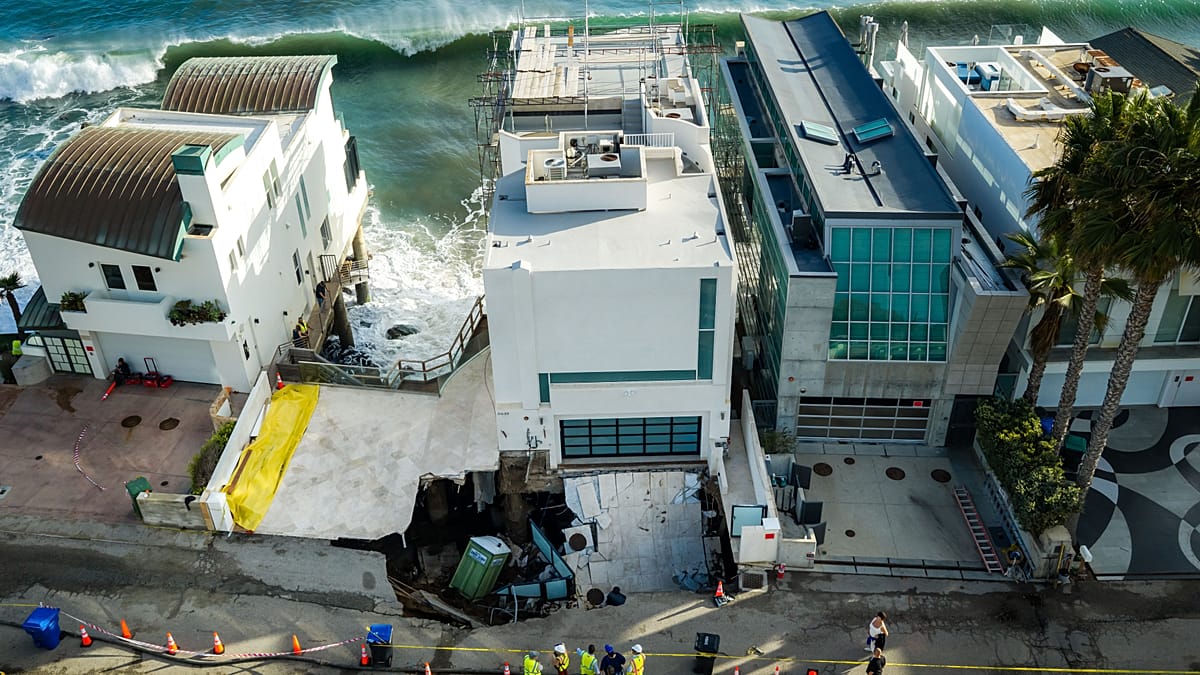
A dramatic sinkhole has opened up outside actor Nicolas Cage's Malibu mansion, swallowing the driveway and forcing road closures after remnants of Hurricane Marie battered the California coast. Aerial footage captured by local news helicopters shows a gaping chasm where the actor's driveway once stood, with debris and twisted metal visible in the hole.
The incident occurred on Monday, when coastal erosion—exacerbated by heavy surf and high tides from the remnants of Hurricane Marie—undermined the bluff on which the property sits. The collapse ruptured a gas line, prompting emergency crews to shut off the supply and cordon off the area. No injuries were reported, and Cage, who was not at the residence at the time, has not commented publicly.
Coastal erosion: a growing threat
This is not the first time Malibu's fragile coastline has given way. The region has seen a series of sinkholes and bluff collapses in recent years, driven by a combination of natural erosion, intense winter storms, and sea-level rise linked to climate change. Scientists warn that such events are likely to become more frequent as the Pacific Ocean warms and storms intensify.
For Europe, the spectacle of a celebrity's driveway vanishing into the earth is a reminder of shared vulnerabilities. Coastal communities from the Algarve to the Adriatic face similar pressures, and European researchers are increasingly studying how to adapt. In Portugal, for example, the cliffs of the Algarve have seen several collapses, prompting authorities to restrict access to certain beaches. In Italy, the city of Venice continues to battle subsidence and rising waters, while in the UK, parts of the Jurassic Coast are eroding at an alarming rate.
European coastal management strategies often serve as a model for global best practice. The Netherlands' Delta Works, a sophisticated system of dams, sluices, and storm surge barriers, is a testament to long-term planning. Meanwhile, the EU's coastal erosion projects have helped member states share data and mitigation techniques.
In California, however, the response has been more reactive. Local officials have repeatedly warned that building on bluffs is inherently risky, yet prime oceanfront properties continue to command astronomical prices. The sinkhole outside Cage's mansion is a stark illustration of the tension between development and nature.
Emergency crews worked through the night to stabilize the area, but the road remains closed indefinitely. Geologists are assessing the stability of the surrounding bluff, and it is unclear whether the actor's home is at further risk. Similar incidents in the past have led to lengthy and costly engineering solutions, including the installation of retaining walls and drainage systems.
The broader implications extend beyond celebrity real estate. As sea levels rise, coastal erosion is becoming a pressing issue for governments worldwide. In Europe, the Spanish coast has seen significant erosion, and the European Environment Agency has called for a coordinated approach to coastal management. The agency's latest report highlights that up to 50% of Europe's sandy beaches could lose significant area by 2100 under current emission scenarios.
For now, the focus in Malibu is on cleanup and safety. The gas leak has been contained, and no evacuations have been ordered. But the incident serves as a vivid example of how climate change is reshaping coastlines, and not just in far-flung places. As European readers watch the footage, they may recognize a familiar story—one that is playing out on their own shores, from the cliffs of Normandy to the beaches of the Baltic.
In the meantime, Cage's driveway remains a hole in the ground, a surreal sight that has captured global attention. It is a reminder that even the most glamorous locations are not immune to the forces of nature.