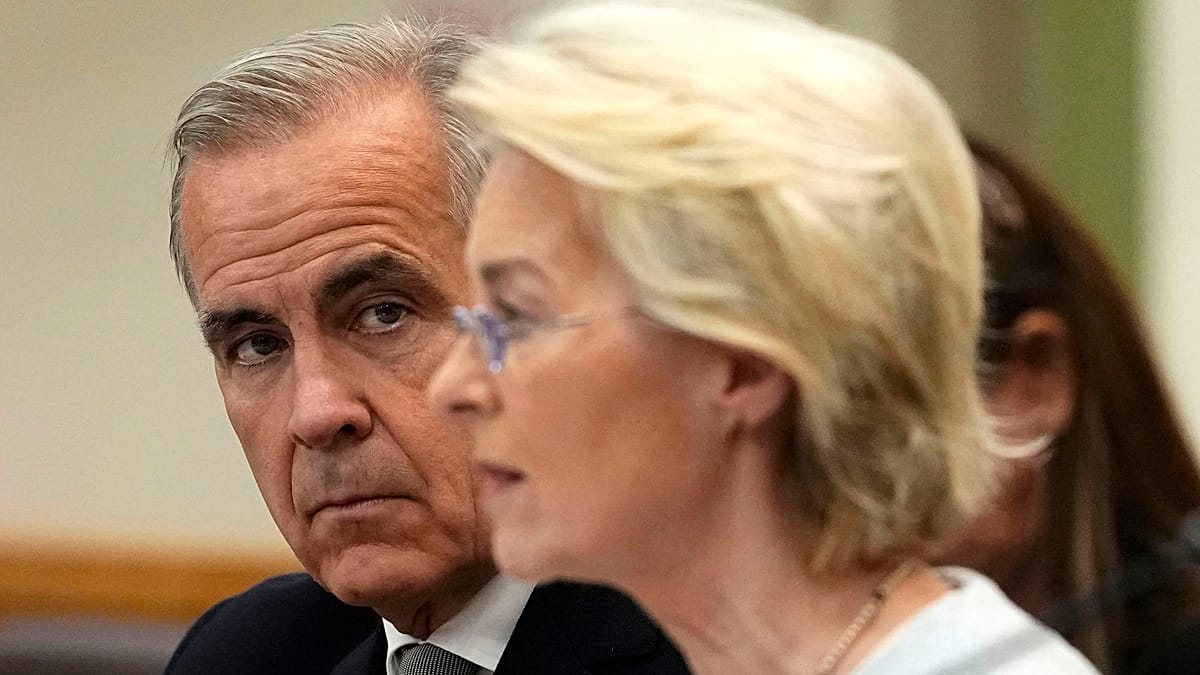
In a speech to the European Parliament in Strasbourg, European Commission President Ursula von der Leyen formally invited Canadian Prime Minister Mark Carney to become the EU's first-ever “associate member”. The proposal, framed as a response to an “openly hostile world”, aims to elevate the EU-Canada relationship “to the highest level possible” without offering full membership.
The concept of “associate membership” does not exist in the EU treaties, so its legal and institutional contours are still being sketched out. “What exactly will it be? That will gradually be defined from a legal point of view,” said Javier Moreno Sánchez, the Spanish MEP who chairs the European Parliament's delegation for relations with Canada. Unlike a standard free-trade partner, Canada would be integrated into Europe's defence industrial base, participate in joint Arctic projects, and cooperate on artificial intelligence, cyber resilience, and quantum computing. It would not, however, gain voting rights in the European Parliament or a say in core EU laws.
A pre-existing partnership
The EU and Canada already have a solid foundation. In 2016, they signed the Comprehensive Economic and Trade Agreement (CETA) and the Strategic Partnership Agreement (SPA). CETA removed tariffs on 98% of goods, boosting bilateral trade in goods and services by over 80% to €130 billion. The SPA established a framework for dialogue on foreign policy, climate change, research, and human rights.
Relations have warmed further since Carney took office in 2025, with the launch of the “New EU-Canada Strategic Partnership of the Future”. The two sides have aligned on critical mineral supply chains, electric vehicle batteries, clean energy, and Arctic projects. Canada is also an active participant in Horizon Europe, the EU's flagship research programme. In February 2026, Canada became the first non-European country to join the €150 billion SAFE Instrument, allowing its defence firms to bid on joint European military procurement. It also became a third-party contributor to PESCO, the EU's permanent structured cooperation on defence.
Yet the relationship is not without friction. CETA remains unratified by 10 of the EU's 27 member states, including Italy, France, and Poland, which cite concerns over Canadian environmental and production standards, particularly in agriculture. The pact's future is a key sticking point in the broader partnership.
Why now?
The immediate trigger for this proposal is the collapse of trade talks between Canada and the United States in August 2026, followed by aggressive US tariffs of 25% to 50% on Canadian goods. President Donald Trump's threats to absorb Canada as the “51st US state” have profoundly shaken Ottawa. “They explained that geography cannot be changed. They felt betrayed because it was their neighbour, the brother at their doorstep, and then one day it says to them: ‘I don't want you anymore.’ It affected them very badly,” Moreno Sánchez told Euronews.
For the EU, the motivation is strategic. With the loss of cheap Russian energy and rising tensions with China, the bloc needs reliable sources of critical materials. “Canada has everything,” Moreno Sánchez said. “It is the second-largest country in the world. Energy, gas, critical raw materials. Obviously, it is in our interest to trade with them.” Canada holds major reserves of lithium, nickel, cobalt, and rare earths, all central to the EU's energy transition and battery supply chains.
The proposal is not about full membership. “We know it's a deeper partnership, but less than full membership. Where exactly it's going to be on that spectrum will have to be negotiated. The expectation is that it's more than a free trade agreement,” said Fabian Zeleeg, Chief Executive and Chief Economist at the European Policy Centre.
Von der Leyen has suggested building on CETA to create an “Alliance for the Future” that would foster “common prosperity and economic security”. The partnership is expected to cover manufacturing, energy, minerals, AI, quantum computing, and cybersecurity, with a joint Arctic flagship project and an integrated defence industrial base. Carney has floated the idea of “seamless, digital trade in non-agricultural goods and a wide range of services”, as well as a more integrated financial services market.
For Zeleeg, the partnership is primarily about geopolitical cohesion. “It's about like-minded countries coming together, finding common solutions to the big challenges which we are all collectively facing, including a rather difficult situation with the US,” he said. The move also comes as the EU explores similar arrangements with other partners, such as the UK's access to EU procurement plans, though Canada is the first to be offered this specific status.
The proposal is a pragmatic response to a shifting global order. As Moreno Sánchez put it, “Until now, with Russian gas and with China, things worked differently. But now that international relations have become tenser, and we don't know how this world order will result. It seems like it could become the law of the strongest, that makes you wake up and say: ‘We need to look at this differently.’” He pointed to Germany's reliance on Russian gas as a cautionary tale: when supplies were cut, Berlin had to restart coal plants. The EU and Canada are now seeking to avoid such vulnerabilities by building a more resilient partnership.