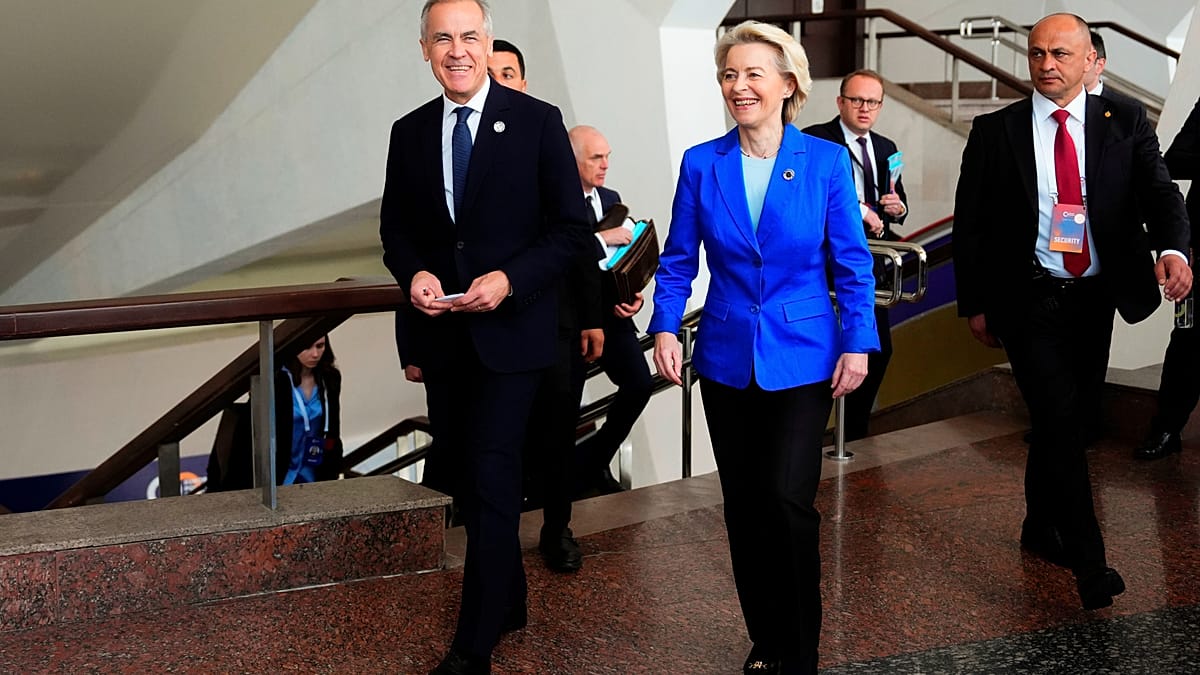
Canadian Prime Minister Mark Carney is pushing for a closer relationship with the European Union, including the creation of a new 'associate member' status, according to a report in the Wall Street Journal. The status is not currently part of the EU's legal framework, but officials in Brussels and Ottawa are said to be open to designing a special arrangement that would deepen ties without full membership.
The report, citing unnamed EU and Canadian officials, comes ahead of Carney's address to the European Parliament in Strasbourg on Thursday. He is expected to lay out a vision for Canada-EU cooperation in a geopolitical environment marked by rising protectionism and transatlantic friction.
Ottawa is locked in a bitter trade dispute with Washington, with steep tariffs on both sides and no immediate sign of de-escalation. The trade war has already hit Canadian dairy and alcohol exports, and Ottawa has retaliated with tariffs of up to 50 percent on US goods.
What would associate membership mean?
The concept of associate membership has been floated before, most notably by German Chancellor Friedrich Merz, who suggested it as a way to deepen ties with Ukraine without full accession. The model could be adapted for Canada, offering closer integration in areas such as trade, energy, and security while stopping short of EU membership.
According to the Wall Street Journal, Canada and the EU are exploring joint projects in energy, artificial intelligence, defence, and critical minerals. They are also discussing investments in undersea cables, data centres, cloud infrastructure, and satellite networks. Canada hopes to expand energy exports to Europe, particularly liquefied natural gas, as the continent seeks to diversify away from Russian supplies.
However, creating a new status would require changes to EU treaties or at least a significant political agreement among member states. The EU has strict rules on membership and a lengthy process for amending its existing arrangements, making any quick deal unlikely.
Yet the pressure from Washington under President Donald Trump, who has imposed tariffs and made territorial threats against allies, could encourage a more flexible approach. The economic uncertainty generated by these tensions is already affecting markets across Europe.
Macron and Carney to visit Saint-Pierre-and-Miquelon
In a separate but related development, French President Emmanuel Macron and Carney will visit the French overseas territory of Saint-Pierre-and-Miquelon next week, just off Canada's Atlantic coast. The Élysée Palace said the visit underscores the shared values of France and Canada, including 'freedom, democracy, the rule of law and respect for the sovereignty of nations'.
The visit is a direct response to Trump's social media post showing a map of North America with US flags over several French territories, including Saint-Pierre-and-Miquelon, Guadeloupe, and Martinique. The map also included Canada, Greenland, and Mexico, reflecting what many see as expansionist rhetoric from the White House.
In a statement, the Élysée said that in a world marked by 'the return of power politics, geopolitical tensions and new forms of dependency', France and Canada share a common ambition to strengthen their ability to act independently.
Carney's outreach to Europe is part of a broader strategy to reduce Canada's reliance on the United States. The retaliatory tariffs and the search for new partners are central to that effort. The EU, with its own concerns about US trade policy and security guarantees, appears a natural ally.
Whether the associate membership idea gains traction remains to be seen. But the fact that it is being discussed at the highest levels signals a significant shift in transatlantic relations, one that could reshape Canada's place in the world and Europe's role as a geopolitical actor.