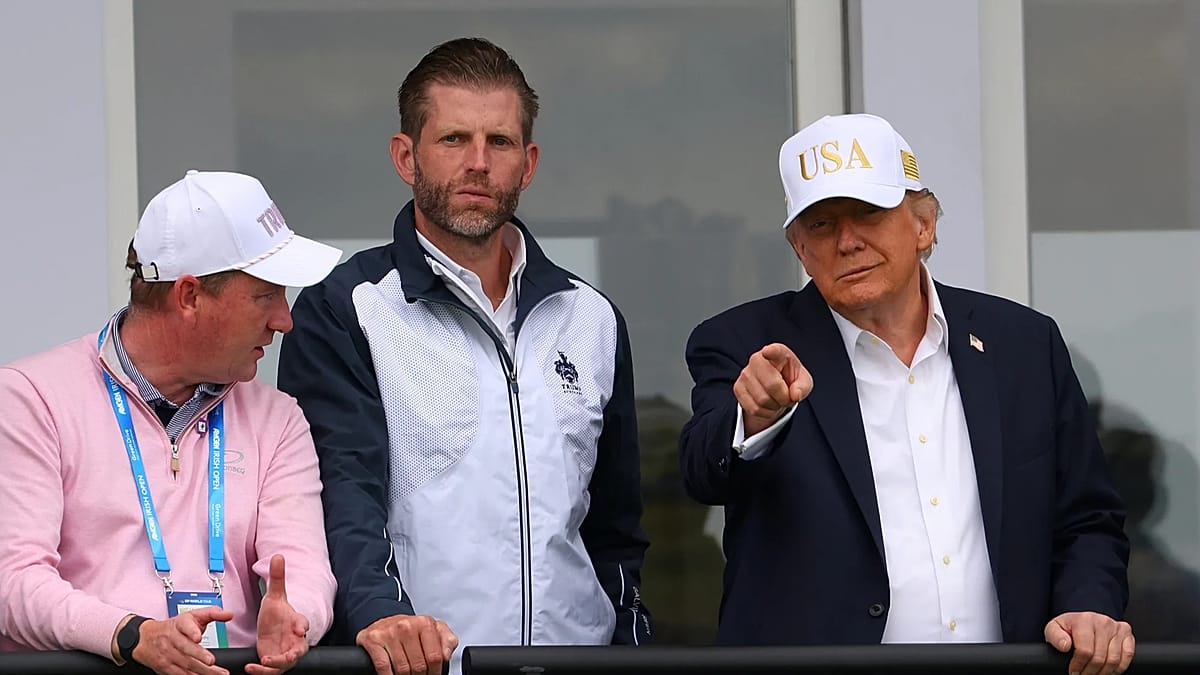
US President Donald Trump used a two-day visit to Ireland to call on Ukraine to halt its strikes on Russian diesel refineries, arguing that the attacks are pushing up energy prices worldwide. Speaking at his golf resort in Doonbeg, County Clare, Trump said: “Zelenskyy has to do one thing. He has to stop knocking out diesel fuel in Russia. Let him go after targets, but not diesel, because he's causing a shortage of diesel.”
The comments came as Trump blended diplomacy with leisure, attending the Irish Open Golf Tournament at his own hotel. He suggested that Ukraine had “plenty of other targets” and that Kyiv’s strategy of hitting Russian oil and gas infrastructure, in response to Moscow’s full-scale invasion since 2022, was “hurting the world.”
However, energy analysts and several European officials have challenged that framing. They note that the most significant factor behind recent diesel and crude price spikes is the closure of the Strait of Hormuz, through which about 20% of global oil passes, following US and Israeli military action against Iran. Trump’s remarks also come as US inflation data shows a monthly surge that many attribute to energy costs.
Diplomatic rounds in Dublin
Trump’s Irish itinerary included a meeting with Taoiseach Micheál Martin at Government Buildings, a 45-minute address at the US ambassador’s residence in Phoenix Park, and a private audience with President Catherine Connolly. The Irish president, a left-wing politician who has previously criticised Trump as a “bully,” presented him with a book of poems by Belfast-born Michael Longley. Her press team noted that Longley’s sonnet “Ceasefire,” inspired by Homer, is considered one of Ireland’s defining poems about forgiveness.
Trump repeatedly raised the prospect of a united Ireland, telling reporters that “it seems to me that one of the naturals of all time is to put them together.” He described a unified island as “fantastic” and predicted it would “happen eventually.” Irish government sources say Trump often brings up the issue in diplomatic settings, despite its constitutional sensitivity under the 1998 Good Friday Agreement, which allows for a border poll if a majority in Northern Ireland favours it.
UK Prime Minister Andy Burnham, newly appointed, has pushed back, saying a referendum on Irish reunification is “off the table” for now. Speaking earlier, Burnham said: “I'm here, as I said earlier, to listen, and I will take a collaborative approach, but some issues will be off the table, and that is one issue that will be off the table.” Sources close to Burnham confirmed that Trump’s declarations have not shifted that position.
The timing of Trump’s comments coincides with tensions between Washington and London over the war in Iran. Trump has repeatedly criticised European NATO allies for not joining the conflict, and was particularly scathing about former UK Prime Minister Keir Starmer, who initially refused US access to British military bases before relenting for “defensive purposes.” Trump has also questioned British sovereignty over the Falkland Islands after Argentine President Javier Milei renewed his claim.
Meanwhile, Ukraine continues its campaign against Russian fuel infrastructure. Russia has responded with record drone barrages, and deadly strikes across Ukrainian cities have been reported. The EU has committed €6.1 billion to support Ukraine with Patriot interceptors and drones, but the debate over targeting refineries remains contentious.
Trump is due to present the winner’s trophy at the Irish Open on Sunday evening before returning to Washington. His visit has drawn mixed reactions in Dublin, with some welcoming the attention to Irish affairs and others wary of his unpredictable statements on sensitive issues.