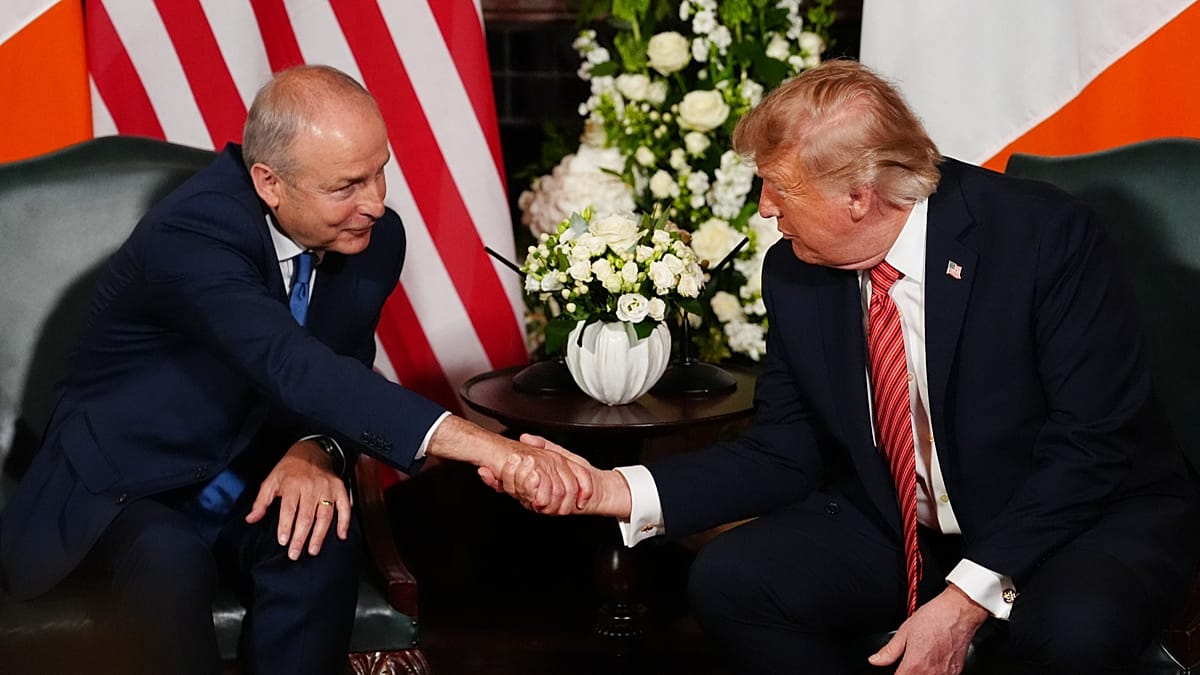
US President Donald Trump used a two-day visit to Ireland to wade into one of the continent's most delicate constitutional questions, telling Taoiseach Micheál Martin that he would welcome the reunification of the Republic with Northern Ireland. Speaking at a joint press conference in Dublin on Saturday, Trump said a united Ireland would be “fantastic” and predicted it would happen “eventually”.
“I don’t want to cause any problems, but I’d love to see it unified,” Trump said when asked by a reporter. “It’s going to happen eventually. It may as well happen now.” He added that “the UK will have something to say about it, obviously.”
The comments mark a rare direct intervention by a US president on the issue, which has historically been treated with caution by Washington. Even Joe Biden, who often spoke of his Irish heritage, avoided explicit endorsements of reunification during his presidency. The 1998 Good Friday Agreement, which ended three decades of sectarian violence known as the Troubles, left the question of Northern Ireland's status open, allowing for a referendum if it appears likely that a majority would vote for change.
Newly appointed UK Prime Minister Andy Burnham responded firmly on Wednesday, ruling out a border poll unless there is clear public demand. “I am not aware that there is majority public support for another referendum, and until that changes, there will not be one,” Burnham said.
Trump's remarks come as he also used his Dublin platform to criticise European allies. “I hate to see what's happening with Europe. I hate to see what's happening on trade, energy, and immigration,” he said, adding that European nations were “killing yourselves” with their migration policies. He described transatlantic relations as “disappointing” following the reluctance of many European countries to support his military actions against Iran, which led to the closure of the Strait of Hormuz.
The US president met with Irish President Catherine Connolly at Áras an Uachtaráin, her official residence, where he inspected a guard of honour. Connolly, a left-wing politician who had protested against Trump's 2019 visit, has previously criticised his foreign policy and called him a “bully”. Despite the frosty history, the meeting proceeded cordially, with Trump emerging alone to salute as the US national anthem played.
Trump's itinerary also included a business roundtable with US and Irish executives at the ambassador's residence, and a trip to his golf resort in Doonbeg, County Clare, to watch the Irish Open. The visit underscores how Trump continues to blend official duties with his personal business interests, a pattern seen during his presidency and beyond.
European reaction and implications
Trump's comments on Irish unity have stirred debate across the island and in Brussels. While some nationalists welcomed the endorsement, unionist leaders in Northern Ireland expressed concern about outside interference. The UK government, already grappling with post-Brexit arrangements, faces renewed pressure on the issue.
For the European Union, the visit highlights the delicate balance of managing relations with Washington while upholding the Good Friday Agreement's principles. The bloc has consistently supported the peace process and the current power-sharing arrangements in Belfast.
Trump's broader criticism of Europe on trade and energy resonates with ongoing disputes, such as the EU's planned English-only trade deal, which has faced resistance from France. Meanwhile, European citizens are feeling the pinch of high energy bills, a topic Trump touched on indirectly.
As Trump departed Dublin, the lasting impact of his words on Irish unity remains to be seen. But his willingness to break with precedent has injected new uncertainty into a question that many hoped was settled for the foreseeable future.