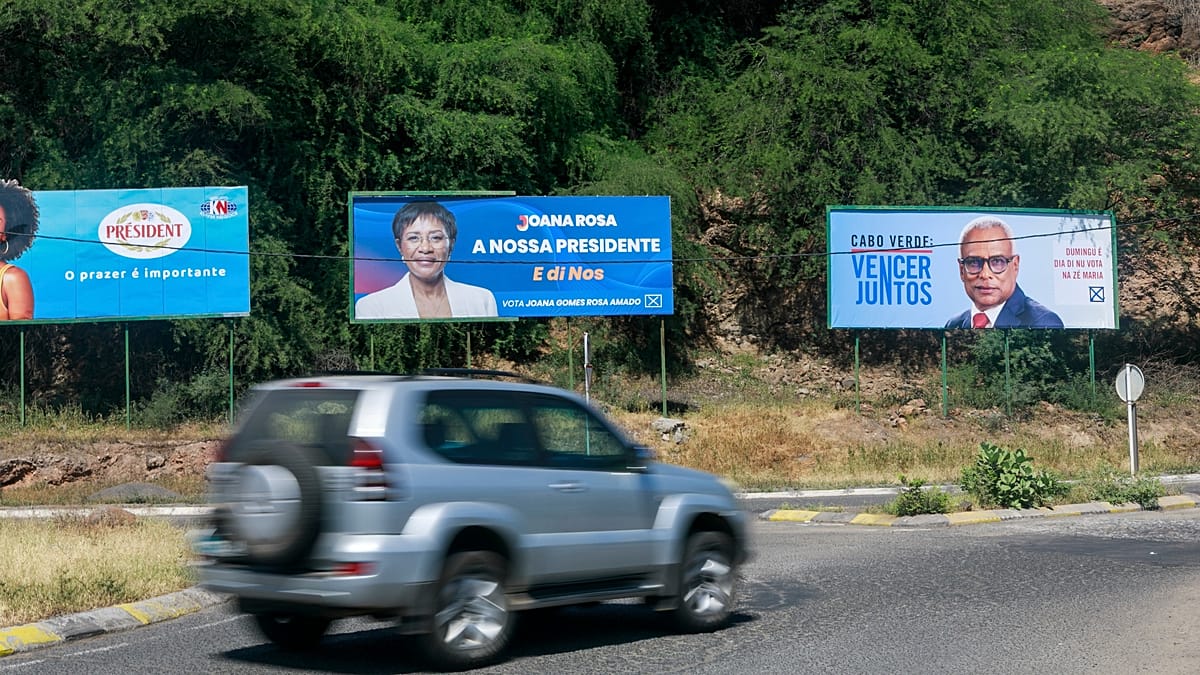
Cape Verdeans are casting their ballots on Sunday in a presidential election that could extend the rule of incumbent José Maria Neves or make history by electing the country's first female head of state. Polls opened at 8 a.m. and will close after ten hours, with provisional results expected overnight. If no candidate wins more than half the votes, a second round will be held on 29 November.
Neves, who won the 2021 election with about 52 percent of the vote, is widely seen as the frontrunner. The 66-year-old former prime minister has pledged to build cross-party consensus to tackle housing, healthcare, and education, and to create jobs and raise wages. His main challenger is Joana Rosa Amado, a 61-year-old lawyer backed by the opposition Movement for Democracy (MpD). Running under the slogan “Listen to Cabo Verde,” Amado says her campaign is about understanding the real concerns of the population rather than making empty promises.
Amado, who served as justice minister, has made the case for a political counterweight to the African Party for the Independence of Cape Verde (PAICV), which supports Neves and controls the government and most municipalities. She argues that the presidency should act as a check on the ruling party's dominance. In an interview, she said that electing a woman would send a powerful signal: “The election of a woman to the presidency would show many young women and young girls that no government job is barred from them.”
The field also includes surgeon Gilson Alves, a 45-year-old who has taken a hardline stance, promising to fight corruption, legalize gun ownership, and reinstate the death penalty. His candidacy has stirred debate in a country known for its democratic stability and peaceful transfers of power.
A small island nation with a big democratic reputation
Cape Verde, an archipelago of about half a million people located roughly 600 kilometers off the coast of Senegal, has long been regarded as a model of democratic governance in Africa. It has a history of competitive elections and orderly changes of leadership, a record that stands out in the region.
The country's economy has been buoyed by tourism, and in July the World Bank upgraded Cape Verde to upper-middle-income status, citing a 16.8 percent increase in gross national income per capita between 2023 and 2024. Yet the nation still grapples with persistent social inequality, geographic isolation, and the high cost of inter-island travel, which limits opportunities for many citizens.
The election comes at a time when the broader region is watching closely. While Cape Verde is not a member of the European Union, it maintains close ties with Europe through historical links, development cooperation, and migration patterns. The outcome could influence perceptions of democratic resilience in West Africa, a region that has seen a wave of military coups in recent years.
For many voters, the choice is between continuity under Neves and a potential shift with Amado. Neves, who previously served as prime minister from 2001 to 2016 and led the PAICV, argues that his experience is needed to steer the country through economic challenges. Amado, meanwhile, presents herself as a fresh voice who can bring balance to the political system.
Analysts note that the presidency in Cape Verde is largely ceremonial, with executive power resting with the prime minister and parliament. Still, the office carries moral authority and the ability to shape national discourse. A victory for Amado would be historic, breaking a gender barrier in a country where women remain underrepresented in top political roles.
As the votes are counted, the eyes of the region and beyond will be on this small island nation. The result will not only determine who occupies the presidential palace in Praia but also signal whether Cape Verde's democratic traditions remain robust in the face of new challenges.