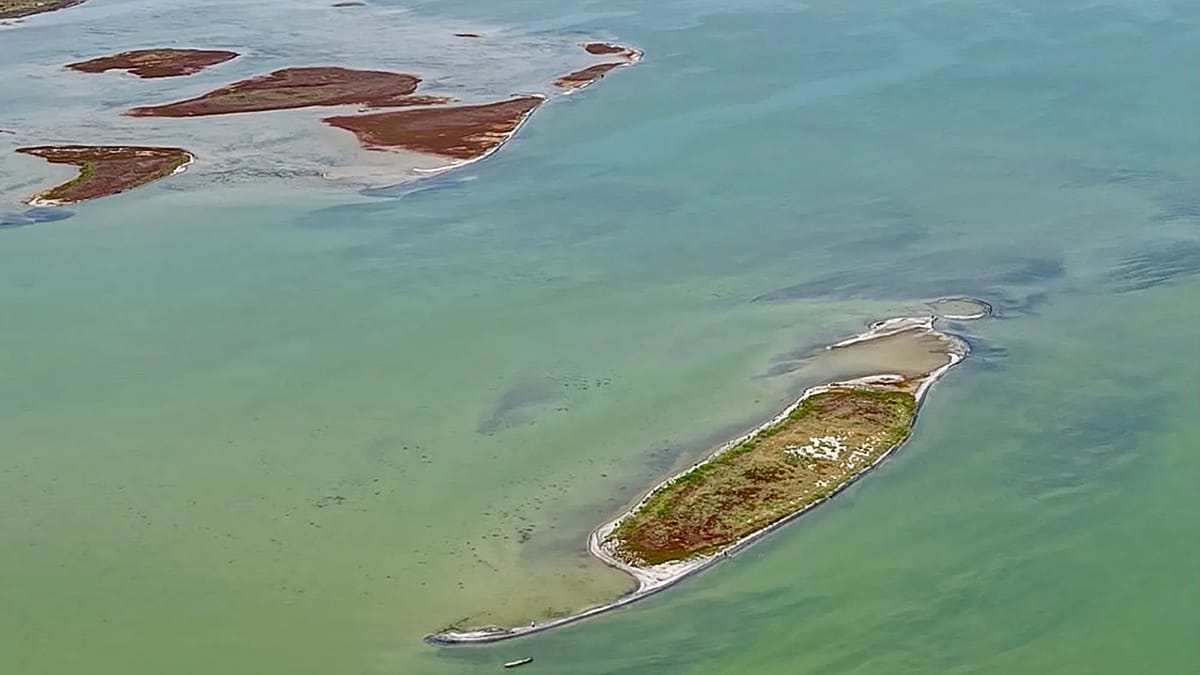
The Caspian Sea, the largest inland body of water on Earth, has been steadily retreating for decades. Now, the effects are becoming visible in the form of new islands emerging along Kazakhstan's coast, a stark reminder of the region's changing hydrology.
Recent aerial surveys near Kulaly Island, part of the Tyuleniy Archipelago, have revealed a newly formed island. Daniyar Akimzhanov, an environmental activist who participated in the survey, says this is not an isolated event. Over the past four to five years, he has documented several such islands in the northern Caspian.
“The one in the photo I sent you is the smallest. There are much bigger new islands,” Akimzhanov told European Pulse. Some of these landmasses stretch up to a kilometre in length and 200 to 300 metres in width. Wildlife has already begun to colonise them; Akimzhanov has spotted wild boar and wolves crossing the ice to reach the new terrain.
A shrinking sea
The Caspian Sea is bordered by five countries: Kazakhstan, Russia, Azerbaijan, Iran, and Turkmenistan. More than 80% of its river inflow comes from Russia's Volga River. The sea's water balance is simple: inflow from rivers and precipitation, outflow only through evaporation. But that balance is tipping.
According to instrumental observations, the sea level in the Kazakh sector fell from -26.82 metres in 1996 to -29.27 metres in 2025, a decline of 2.45 metres over three decades, or roughly 8–9 centimetres per year. The trend continues: by July 2026, the average level at the Kulaly Island monitoring station stood at -29.42 metres, the lowest recorded during the entire study period.
The north-eastern Caspian, particularly the coast of Kazakhstan's Atyrau region, is especially vulnerable. With an average depth of around six metres and a very gentle seabed slope, even a small drop in water level causes the shoreline to retreat over long distances. Satellite images analysed by the Kazakh Research Institute of the Caspian Sea show that between 2000 and 2025, the water-covered area in the studied part of the north-eastern Caspian decreased by approximately 16,384 square kilometres.
The institute, which began work in September 2025 following a directive from President Kassym-Jomart Tokayev, expects more land to emerge. However, not all new land will become permanent islands. “The future of each newly exposed area depends on the seabed topography, waves, wind-driven changes in water levels and the subsequent dynamics of the Caspian Sea level,” the institute said.
Climate and human pressure
While the Caspian has historically experienced fluctuations—dropping by three metres from the 1930s to 1977, then rising by 2.5 metres before declining again—scientists say climate change and human activity are now intensifying the problem. Increased evaporation due to rising regional temperatures is the primary driver, with reduced precipitation playing a smaller role.
Human actions also matter. Dams regulate the rivers flowing into the sea, and water is extracted for irrigation and other uses across the basin. Reservoir management can further reduce river flows reaching the sea.
Dr. Sifan Koriche, a hydroclimate scientist at the University of Alabama who has studied the Caspian extensively, explains: “It's like a simple water balance. The incoming water is from river inflow and precipitation, while the outgoing water is only through evaporation.”
Impact on wildlife
The retreating sea is also affecting the Caspian seal, a species found nowhere else. Its population has plummeted from around one million a century ago to roughly 100,000 today. The loss of island haul-out sites is a major threat. According to seal researcher Assel Baimukanova, the area of island haul-out sites has decreased more than 15-fold since 1995.
The emergence of new islands is a visible symptom of a broader transformation. As the sea continues to shrink, the region faces an uncertain future, with some scientists warning that parts of the northern Caspian could eventually resemble the Aral Sea, a once-vast lake that has largely dried up. The Trans-Caspian corridor is becoming a focus of geopolitical interest, but the environmental challenges are equally pressing.
For now, the new islands remain unnamed, but they serve as a stark indicator of the changes underway. As Akimzhanov notes, “There are much bigger new islands,” and more are likely to appear.