The Spanish government is facing its most acute political crisis in years after a leaked police report suggested that the mass migrant crossing into the North African enclave of Ceuta last July was not a spontaneous event but a coordinated operation steered by Moroccan authorities. The document, dated July 29 — one day before over 80,000 people surged across the border — warned of an “extreme risk” of a “coordinated” arrival, and reportedly includes photographs of plainclothes and uniformed Moroccan security officers on the ground.
Prime Minister Pedro Sánchez has consistently exonerated Morocco, blaming people-smuggling networks and alleging that Russia and Israel were spreading disinformation about the incident. But the leak has thrown his narrative into doubt and exposed deep fractures within his own administration. The Director-General of the Spanish National Police has told Interior Minister Fernando Grande Marlaska — who had requested an internal probe — that there is no evidence “whatsoever” of Moroccan orchestration, a statement that clashes with the leaked documents now circulating in the press.
Political fallout in Madrid
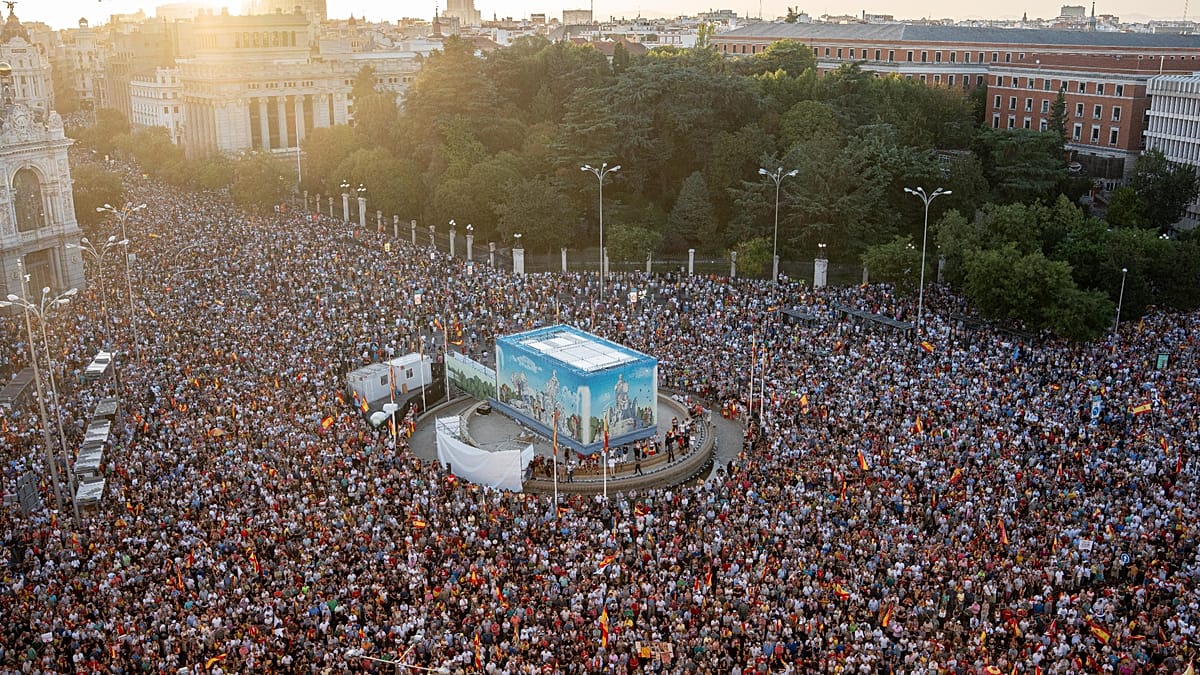
The interior ministry, one of the most sensitive portfolios in the government, is now under intense scrutiny over its oversight of the police and its handling of intelligence. Opposition leader Alberto Núñez Feijóo, of the conservative Partido Popular, told reporters that the government “knew it — and covered it up.” Protests erupted in several Spanish cities on the night of Ceuta’s anniversary, with demonstrators demanding answers.
Even within Sánchez’s own circle, unity is cracking. Juan Fernando López Aguilar, a former socialist justice minister and now a member of the European Parliament, told Europe Today that the Ceuta incident “couldn't have happened without some overlooking by the Moroccan authorities.” His comments signal that the prime minister can no longer count on unquestioning support from his own party’s ranks.
Sánchez is expected to appear before parliament later today to reiterate his position that there is no compelling evidence incriminating Morocco. But the political stakes are high: with a general election due in 2027, this crisis threatens to define his premiership. The opposition is already framing the affair as a test of governmental credibility, and the right-wing backlash is gaining momentum.
Brussels watches, but stays quiet
The European Commission has declined to comment on the leaked documents, with a spokesperson saying: “We do not comment on leaks. We understand there is an investigation ongoing by the Spanish authorities. This is a matter for the national authorities.” Conservative and far-right MEPs gathered outside the European Parliament in Brussels on Wednesday to protest Sánchez’s handling of the crisis, adding a European dimension to the domestic turmoil.
The Ceuta episode has also reignited broader questions about the EU’s external border management and the bloc’s relationship with Morocco. As Schengen checks spread and solidarity falters, the incident underscores how a single member state’s border crisis can ripple across the continent.
NATO and the Baltic threat
Meanwhile, Lithuania’s Foreign Minister Kęstutis Budrys has warned that Russia is considering “options” to “escalate towards the direction of NATO.” In an exclusive interview with Euronews, Budrys said that both Lithuania and the Alliance were alert and ready: “We are prepared, we know what you are cooking there, and believe it, it will be then considered within the NATO alliance as activities against all of us.”
His remarks follow CIA Director John Ratcliffe’s recent visit to Moscow, reportedly aimed at dissuading the Kremlin from escalating its confrontation with the Baltic nation. They also come after Germany attributed an attempted drone attack on Leipzig airport to Moscow — an incident Budrys described as close to “catastrophe.” He suggested Lithuania would respond firmly if a similar attack were to succeed on its territory: “If there is the attribution, there is intention, there is damage then it falls under UN Charter definition of the conditions for self-defence: of course we would go for it.”
The Leipzig attack has also revived debate over tightening Schengen entry rules for Russian tourists and fully banning former Russian combatants. Reports indicate that one of the suspects is a Belarusian national with a criminal record in the Baltic states, who allegedly entered the Schengen area on an Italian-issued tourist visa. EU foreign policy chief Kaja Kallas said there was “broad support” for both measures during an informal meeting of foreign ministers in Wicklow, Ireland. Lithuania’s Budrys was blunt: “We should stop this schizophrenia and just (…) solve it.”
Belgium, however, has pushed back against a separate proposal to use immobilised Russian Central Bank assets to support Ukraine. The EU holds €210 billion in these assets, mostly at Euroclear in Brussels. Belgian Foreign Minister Maxime Prévot said the debate “generated little enthusiasm or appetite among colleagues,” despite a joint letter from Sweden, the Netherlands, Spain and Poland urging action.
As Spain’s government reels from the Ceuta leak, the episode is a stark reminder of how quickly a border incident can escalate into a full-blown political crisis, with implications for European solidarity and security. The coming days will test whether Sánchez can weather the storm or whether the fallout will reshape Spain’s political landscape ahead of the next election.