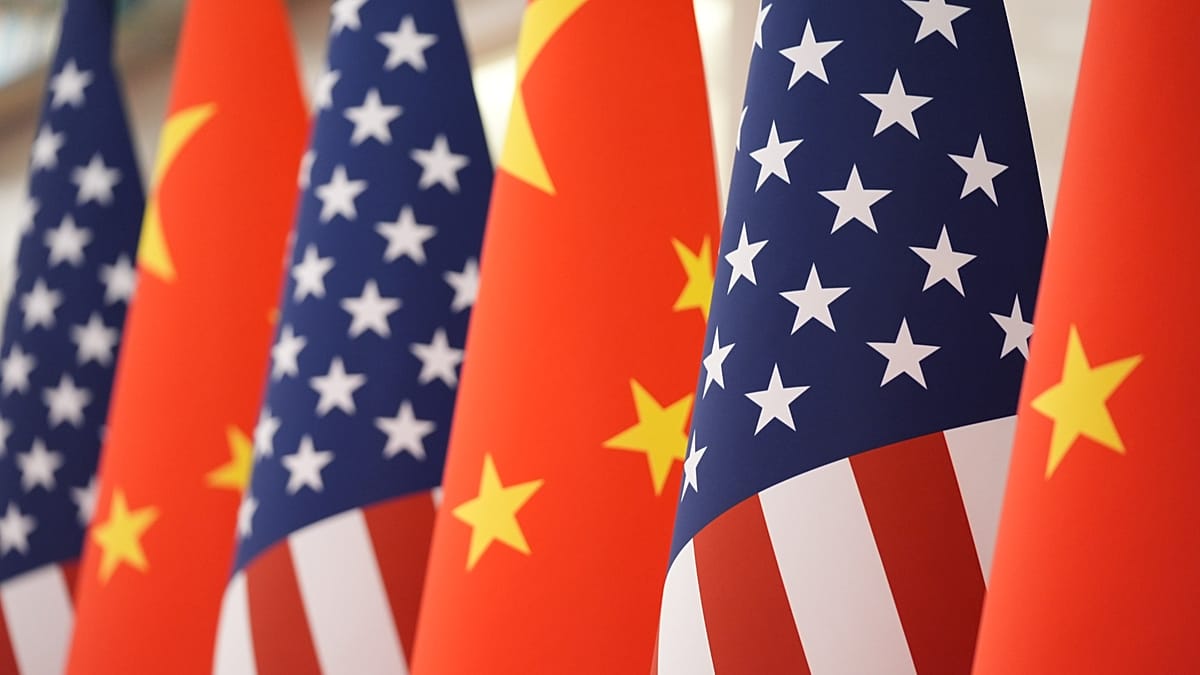
Beijing has escalated its trade and technology confrontation with Washington by imposing export controls on ten American companies active in defence, aerospace, and rare earth mining. The measures, announced on Monday by China's Commerce Ministry, prohibit Chinese exporters from supplying so-called dual-use items—products with both civilian and military applications—to the listed entities.
The ministry stated the decision was taken "in response to the US government's egregious act of adding to its so-called 'Chinese military enterprise list'" and was intended to "safeguard national security." Separately, China's Finance Ministry barred government agencies from purchasing goods from 46 US companies, including subsidiaries of Lockheed Martin, Raytheon, and General Dynamics.
Background of Rising Tensions
The sanctions come just a month after US President Donald Trump visited Beijing for talks with Chinese President Xi Jinping, aimed at stabilising relations between the world's two largest economies. Although both sides agreed to work toward reducing tariffs, friction has resurfaced over technology and defence issues. Earlier this month, the US Defense Department added several major Chinese companies—including Alibaba, Baidu, and BYD—to a list of firms it claims have links to the Chinese military, effectively barring them from US military contracts. Baidu rejected the accusation, calling it "totally baseless."
This tit-for-tat dynamic has direct implications for Europe, which maintains deep trade ties with both powers. The yuan undervaluation deepens EU's record trade deficit with China, and any further disruption in transatlantic or Sino-European supply chains could affect European manufacturers reliant on rare earths and dual-use components. The EU has been developing tools to diversify its sourcing, as highlighted by the EU's plan to create a diversification tool to address unsustainable trade imbalances.
China's Commerce Ministry also warned that the restrictions would extend beyond Chinese exporters to "organisations or individuals in any country or region... transferring or providing dual-use items originating in China to said entities." This extraterritorial reach could complicate compliance for European firms that handle Chinese-origin components.
List of Sanctioned US Companies
The ten companies subject to China's new export controls are:
- AVEOX (Simi Valley, California)
- Red Cat Holdings (South Salt Lake, Utah)
- Teal Drones (South Salt Lake, Utah)
- IMSAR (Springville, Utah)
- Jaia Robotics (Bristol, Rhode Island)
- Ball Aerospace & Technologies (Broomfield, Colorado)
- Oshkosh Defense (Oshkosh, Wisconsin)
- L3Harris Maritime Services (Norfolk, Virginia)
- MP Materials (Las Vegas, Nevada)
These firms span drone manufacturing, satellite technology, and rare earth processing—sectors where China dominates global supply chains. The inclusion of MP Materials, a rare earth producer, underscores Beijing's leverage over critical minerals essential for defence and green technologies. European capitals, particularly Berlin and Paris, are watching closely as they seek to secure their own supply chains amid the US-China rivalry.
The broader context of this dispute is a global realignment of technology and defence partnerships. The Five Eyes intelligence alliance recently warned that AI-driven cyber threats are months away, urging European action to bolster cybersecurity. Meanwhile, the EU's own trade deficit with China has reached record levels, prompting Brussels to explore new diversification strategies. The sanctions announced Monday are likely to accelerate these efforts, as European policymakers recognise the risks of over-reliance on either superpower.
As the US and China continue to trade retaliatory measures, Europe finds itself navigating a precarious position—seeking to maintain open trade with both while safeguarding its strategic autonomy. The coming months will test whether the EU can forge a coherent response that protects its economic interests without being drawn into a binary confrontation.