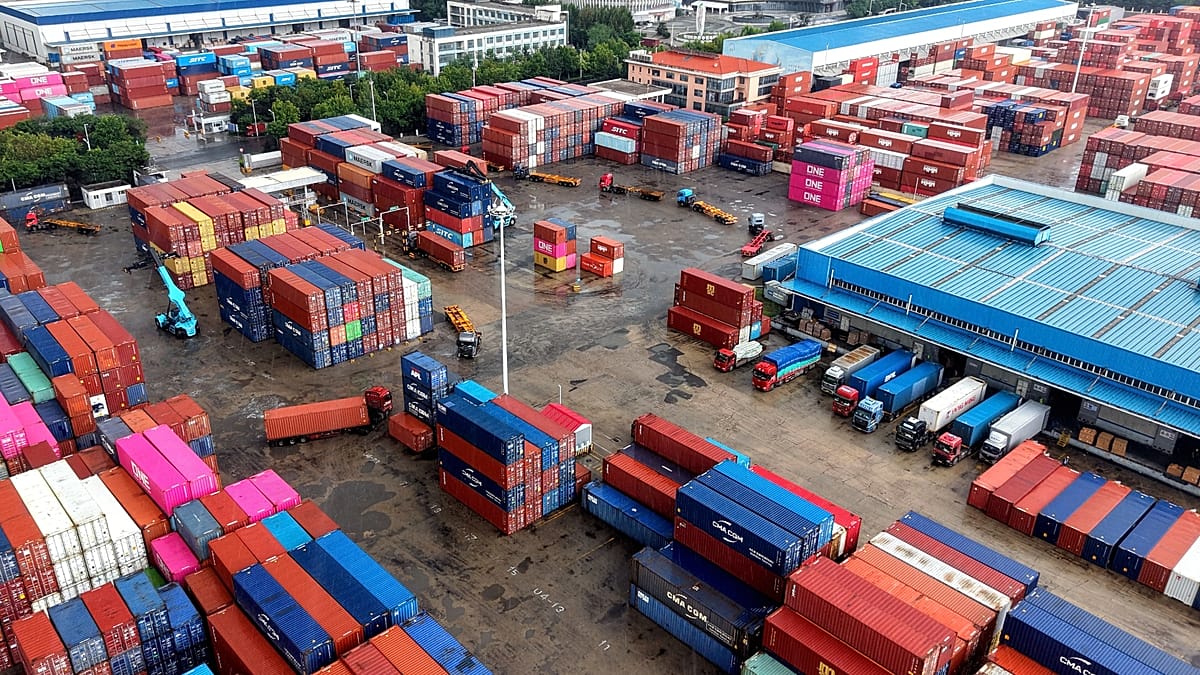
China's export machine showed no signs of slowing in August, with shipments jumping 25% from a year earlier, according to customs data released on Tuesday. The surge was powered by strong global demand for Chinese-made automobiles and high-tech goods, including electric vehicles, industrial machinery, and semiconductors.
The latest figures mark an acceleration from July's 23.9% year-on-year growth, underscoring Beijing's success in moving up the value chain. Imports also climbed 28.2% year-on-year, up from 27.5% in July, resulting in a trade surplus of $119.1 billion (€102.4 billion) — a widening from the previous month's $112.5 billion (€96.8 billion).
“China is very competitive in its tech goods exports,” said Chi Lo, senior market strategist for Asia Pacific at BNP Paribas Asset Management. “China has moved aggressively up the value chain and has become a major player in AI infrastructure and industrial automation.”
The robust export performance comes as Chinese President Xi Jinping prepares to meet US President Donald Trump in late September, though Beijing has yet to confirm the exact date. Trade is expected to dominate the agenda, with Washington and Brussels increasingly alarmed by the scale of China's surplus, which hit a record $1.2 trillion (€1.0 trillion) last year.
Europe's trade dilemma
For European policymakers, the data reinforces a familiar headache: the EU's trade deficit with China, which runs at roughly €1 billion a day. Brussels has already taken steps to shield domestic industries, including safeguard measures on steel introduced in July and limits on tax-exempt imports of Chinese e-commerce parcels. Ministerial-level trade talks between the EU and China are scheduled for the autumn, with the bloc pressing for concrete results.
“Both sides hold each other hostage in some strategic products, with the US withholding high-end tech goods from being sold to China and China withholding rare-earth exports to the US,” Lo noted, highlighting the strategic stalemate that is likely to persist despite the upcoming summit.
China has also diversified its export markets, shipping more to Southeast Asia, Latin America, and Africa, which has cushioned the impact of elevated US tariffs. The country has largely weathered disruptions from the Iran war better than many other nations, according to analysts.
At home, however, the economy remains under pressure. Consumption and investment have stayed sluggish following a prolonged downturn in the real estate sector. On Sunday, Beijing announced a $54 billion (€46 billion) injection into state banks and insurers to help lift growth — a move that echoes previous stimulus efforts but has yet to fully revive domestic demand.
The widening trade surplus is likely to remain a point of contention in transatlantic relations as well, with the US and EU both seeking to rebalance their economic ties with China. As the autumn trade talks approach, European officials will be watching closely whether Beijing offers any concessions on market access and intellectual property — issues that have long frustrated Western negotiators.