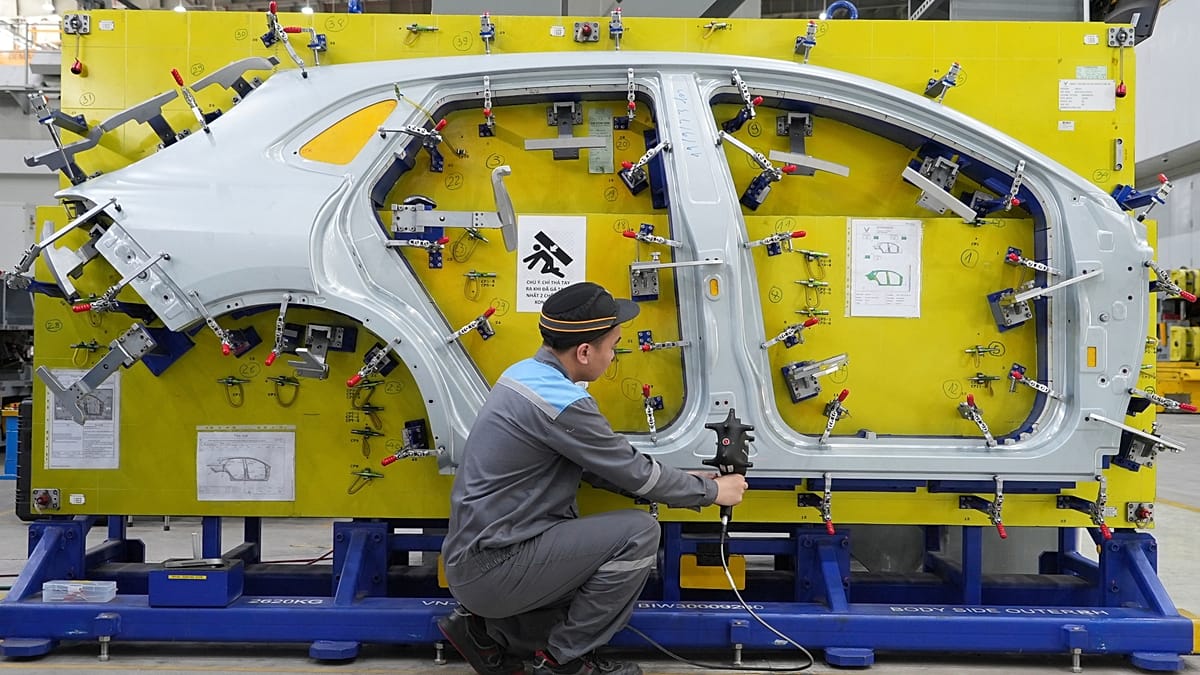
China's vast manufacturing sector lost momentum in May, with the official purchasing managers' index (PMI) slipping to exactly 50—the threshold between expansion and contraction—according to data released Sunday by the National Bureau of Statistics (NBS) and the China Federation of Logistics and Purchasing. The reading, down 0.3 points from April, marks the weakest performance in three months and raises fresh questions about Beijing's ability to meet its 2026 growth target of 4.5% to 5%.
The headline figure masks deeper concerns. New orders fell to 49.9, back into contraction territory from 50.6 in April, while production edged down to 51.2 and raw material stockpiles dropped to 48.6. However, one pocket of strength emerged: the PMI for high-tech manufacturing reached 52.9 and for equipment manufacturing 52.1, both up from the previous month, according to NBS chief statistician Huo Lihui.
Energy Shock and Domestic Weakness
The global economic landscape in 2026 has been dominated by the Iran war and the closure of the Strait of Hormuz since March, through which roughly a fifth of the world's oil once flowed. The disruption has sent oil prices soaring, described by the International Energy Agency as one of the largest supply shocks in history. For most Asian countries, the consequences have been severe, but China has been comparatively sheltered, thanks to an estimated 1.4 billion barrels in strategic and commercial oil reserves—enough for about 220 days of imports—along with increased coal use, rapid investment in renewables, and diversified supply lines.
“Though the energy crisis remains the dominant headwind for Asia, China is relatively more shielded given its robust energy security set-up,” wrote Frederic Neumann, chief Asia economist at HSBC, in a research note last week. Nonetheless, as the conflict drags on, risks to the Chinese economy are rising.
Where cracks are most visible is domestic demand. A years-long property sector slump has eroded consumer confidence, and HSBC sharply cut its 2026 forecast for China's retail sales growth to 2.8% from 5.2% after April figures came in at just 0.2% year-on-year—the softest reading since the pandemic era. “Domestic demand is lagging, but high-end manufacturing and exports are holding the line,” said Robin Xing, chief China economist at Morgan Stanley.
Beijing set an annual growth target of 4.5% to 5% for 2026, the lowest since 1991. Morgan Stanley sees the target as within reach but flags global oil market conditions as the decisive wildcard. Exports to the US have fallen year-on-year for much of the past twelve months, though global sales remain robust, particularly to Europe and Southeast Asia. Some optimism around bilateral trade has returned since US President Donald Trump met Chinese leader Xi Jinping in Beijing in mid-May, with both sides agreeing to establish a US-China Board of Trade and a Board of Investment.
For European readers, China's economic trajectory carries direct implications. The EU has been grappling with its own strategic autonomy push, seeking to reduce dependence on Chinese manufacturing in critical sectors. Recent reports highlight EU considerations to cap Chinese parts in supply chains, while efforts to reduce dependence on China have gained urgency. Meanwhile, Beijing's industrial push threatens German manufacturing dominance, a sector long seen as a pillar of the European economy.
As China's factory activity flatlines, the broader question for Europe is whether this slowdown will ease competitive pressures or, conversely, prompt Beijing to flood global markets with exports to compensate for weak domestic demand—a scenario that could reignite trade tensions with Brussels.