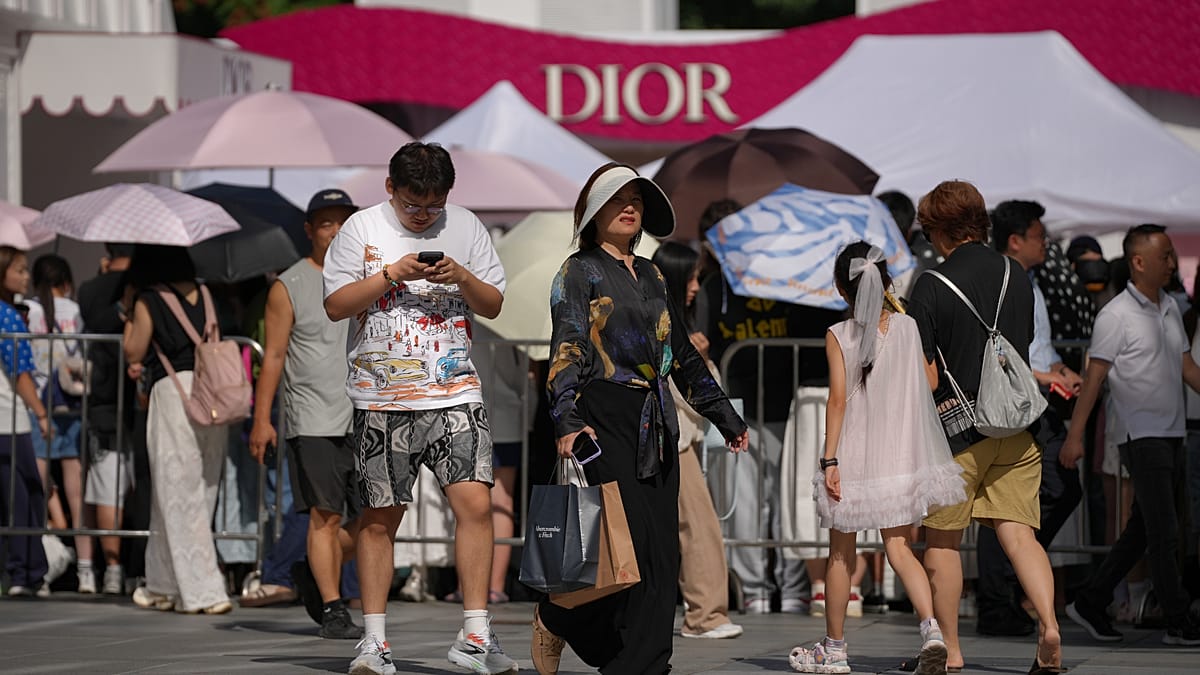
Chinese consumers are still holding back. Official data released on Tuesday showed retail sales rose just 0.4% in August from a year earlier, the slowest pace since growth resumed and a second consecutive monthly slowdown. Economists had expected 0.8%, and the figure marks a clear retreat from July's 0.6% and June's 1.0%.
The numbers, published by the National Bureau of Statistics, underline how little progress Beijing has made in reviving domestic demand, even as factory output accelerates. While the reading is positive—retail sales had contracted 0.6% in May—it leaves consumption barely above flat at a time when the government has made boosting spending a top priority.
Since the end of the Covid-19 pandemic, household spending has been sluggish, dragging on economic growth even as exports have boomed. The latest data show the divergence is widening: industrial production expanded 5.2% in August, up from July's 4.5% and comfortably ahead of the 4.8% forecast. Fixed-asset investment, however, contracted 7.2% year-on-year in the first eight months of 2026, in line with expectations.
Strong supply, weak demand
The statistics bureau described the economy as “operating steadily” but conceded that “adverse external factors are intensifying.” It went further, stating that “the domestic imbalance between strong supply and weak demand remains pronounced, some firms face operational difficulties, and the foundation for steady economic improvement requires consolidation.”
Analysts see the same split. “China's economy continues to show diverging signals, as consumption and investment remain weak while industrial production maintains the momentum,” wrote Zhiwei Zhang, president and chief economist at Pinpoint Asset Management.
Beijing is targeting economic growth of between 4.5% and 5.0% this year—its lowest goal in decades. The latest figures suggest that target is under pressure, with the domestic engine sputtering even as the external sector performs.
The data come days after Beijing moved to shore up its financial system. The finance ministry is leading a 360 billion yuan (€46.1bn) capital injection into eight state-owned banks and insurers, with around 290 billion yuan (€37.2bn) going to banks specifically to preserve their capacity to keep lending as the government presses them to support economic activity.
Whether that filters through to household spending remains an open question. Zhang expects continued weakness in the near term precisely because fiscal support takes time to reach the economy. “The economy faces downside risk in [the third quarter] as the fiscal support takes time to be implemented and transmitted to the economy,” he wrote.
That leaves Beijing leaning on the one part of the economy still performing—industrial output and exports. Indeed, China's exports surged 25% in August, driven by autos and tech demand, but the domestic consumption gap remains a structural challenge.
The next move is diplomatic. Xi Jinping is expected to travel to Washington on 24 September and is reportedly preparing to bring a large delegation of Chinese business executives—a departure for a leader who rarely travels with corporate figures and has not done so on this scale since 2015. Many of those executives lost standing during the regulatory crackdowns on technology, education and property that began in 2020.
Bringing them to meet US President Donald Trump would signal a willingness to invest and trade, though expectations for the summit remain modest, with the two sides still divided over which products should count as non-sensitive under existing trade arrangements.
For Europe, the implications are twofold. A sluggish Chinese consumer means less demand for European luxury goods and services, while Beijing's push to boost domestic spending could reshape global supply chains. As the EU debates its own trade strategy, the largest political bloc is seeking a balanced approach to China, balancing economic ties with strategic concerns. Meanwhile, MEPs are pushing for stricter investment rules as trade tensions rise, a sign that Europe is watching Beijing's economic management closely.