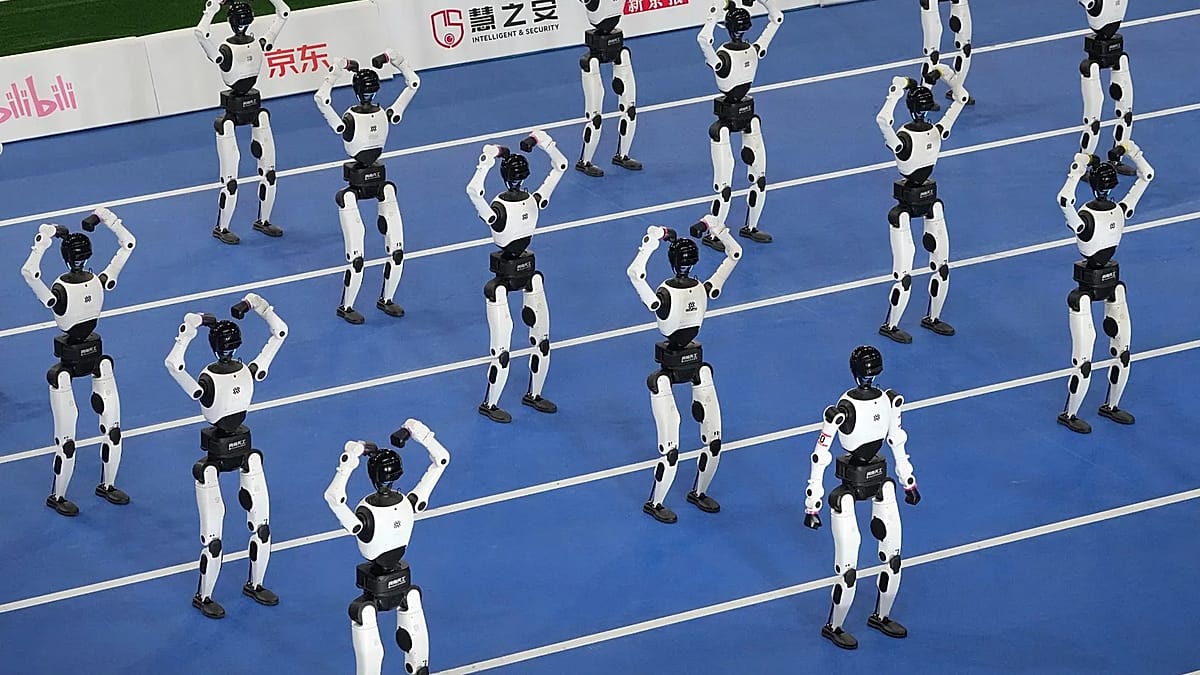
At the World Humanoid Robot Games in Beijing, a Chinese-built robot named TienKung has clocked 9.39 seconds for the 100 metres, shaving nearly two-tenths of a second off Usain Bolt's human world record of 9.58, set at the Berlin Olympiastadion in 2009. The feat, achieved on Saturday at the city's 'Ice Ribbon' stadium, marks a dramatic leap in bipedal robotics.
The Beijing Centre for Humanoid Robotics, which developed TienKung, has not disclosed the robot's exact specifications, but the performance has stunned observers. Organisers of the games, which run until late August, noted that last year's winning time was a comparatively sluggish 21.50 seconds. In a post on X, they wrote: 'In 1 year alone the robots competing have become twice as fast. This highlights the pace of advancement both in the market, and specifically in Chinese robotics.'
The event brings together 666 teams and 2,056 robots from 16 countries, competing in athletics, boxing, football, weightlifting, and gymnastics. Video clips of the humanoids—some stumbling, others slamming into crash mats after crossing the finish line—have gone viral on social media. While the footage is often comical, the organisers insist the progress is no laughing matter. 'It shows a pace of technological advancement that almost beggars belief,' they said. 'Only a year ago, at the last WHRG, robots were slow, ponderous machines that struggled to complete a track sprint. This year they are expected to obliterate world records. The pace that the Chinese robotics industry is advancing at, much like the robot in the video, shows no sign of deceleration.'
China's humanoid push
Beijing has made humanoid robotics a strategic priority, pouring state funding into research and development. The sector has attracted significant investor interest, with Morgan Stanley Research estimating the global humanoid market could reach $5 trillion by 2050, with more than a billion units potentially in use. That projection has helped fuel a surge in Chinese robotics stocks, including a 600% jump for Unitree on its Shanghai debut, driven partly by viral videos of its dancing robots.
The implications extend beyond track and field. Humanoid robots are being developed for manufacturing, healthcare, and domestic assistance, and Europe is watching closely. Several European companies and research institutes are collaborating with Chinese counterparts, while the EU has launched its own initiatives to bolster robotics competitiveness. The pace of Chinese advances has prompted calls for increased European investment in the sector, as the continent seeks to avoid falling behind in a technology that could reshape labour markets and industry.
While the 100-metre record is a symbolic milestone, the real significance lies in the underlying engineering. TienKung's performance suggests that bipedal locomotion, balance, and power management have improved dramatically in a single year. The robot's ability to maintain speed and stability over a sprint distance is a testament to advances in actuators, sensors, and control algorithms.
For European observers, the event offers a glimpse of a future where robots are not just industrial tools but athletic competitors. The World Humanoid Robot Games, now in its second edition, is becoming a showcase for the state of the art. As one robotics engineer from Munich noted, 'The gap between what we saw last year and this year is astonishing. If this pace continues, we will see robots performing tasks in our homes and workplaces far sooner than many predicted.'
The organisers are already looking ahead to next year's games, promising even faster times and more complex events. For now, TienKung's record stands as a benchmark—and a warning that the race for robotic supremacy is accelerating, with China firmly in the lead.