For hop farmers across central Europe, this year's harvest is a sobering reminder of how quickly climate change is reshaping agriculture. In Austria's Mühlviertel, one of the country's most important hop-growing regions, scorching temperatures and parched soils have left many plants stunted or ruined.
“The heat and the drought have taken a heavy toll on us. Some of my plants are completely ruined,” Stefan Hofer, chair of the Mühlviertel hop growers' co-operative, told Austrian broadcaster ORF. Even the plants that survived the dry spell have not developed properly, he added: “The others simply haven't been able to form cones in the same way. Everything is about half the size of a normal year.”
The problem is not confined to Austria. Germany, one of the world's leading hop producers, is also feeling the strain. In Bavaria, the Franconian town of Spalt and three other German growing regions together supply around 40% of global hop output. There, longer dry periods are not only hampering plant growth but also encouraging pests such as spider mites, which can cause considerable crop losses when infestations are severe.
No beer shortage at Oktoberfest – yet
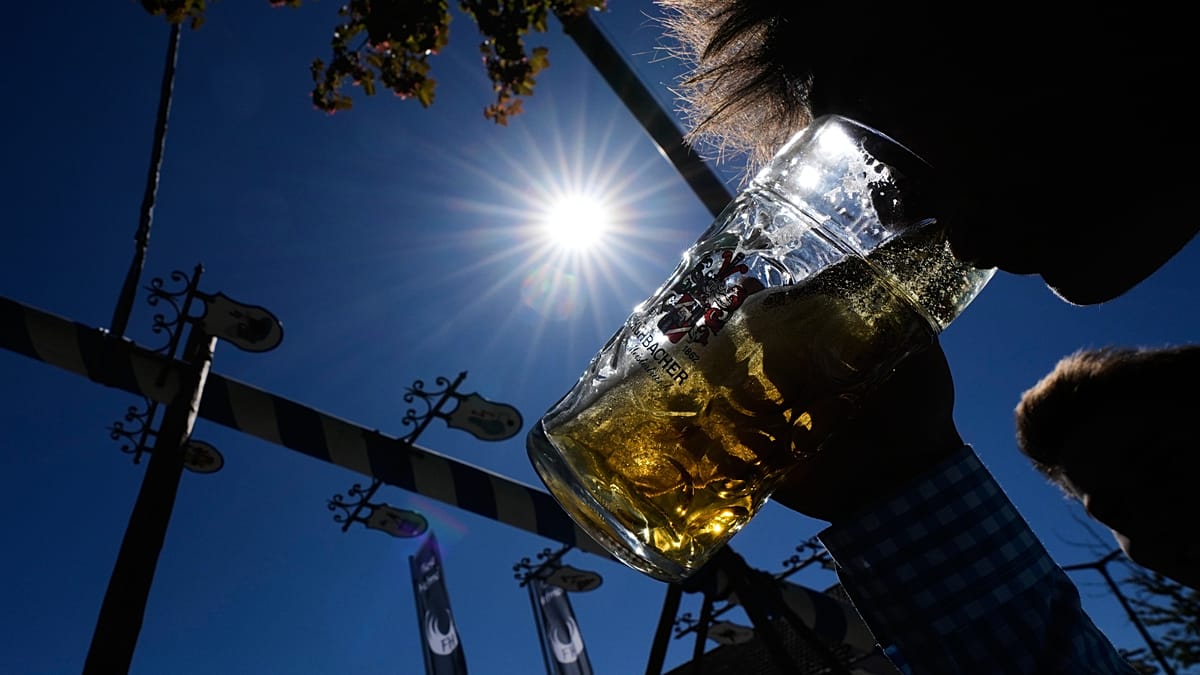
For this year's Oktoberfest in Munich, beer lovers need not panic: there have been no warnings of a shortage at the festival. But the underlying problems in the hop fields could eventually reach breweries. Hops are one of beer's key raw materials, responsible for its bitterness and much of its aroma.
How this year's harvest will affect prices and production remains uncertain, as existing stocks, long-term supply contracts, and the expansion of cultivated areas all play a role. What is clear is that the sector must find ways to grow its raw materials under drier conditions.
One obvious response is irrigation. In the Mühlviertel, irrigation systems have already been installed on about 20% of hop acreage, and demand is likely to rise. In Bavaria, larger projects are being planned. In the Spalter Hügelland, a system would pump water in winter from a bank filtration well on the River Fränkische Rezat into a new storage basin, irrigating around 400 hectares of hop fields during dry months. The cost is estimated at up to €20 million, with the Free State of Bavaria covering about half and participating farmers financing the rest.
In the Hallertau, Germany's largest hop-growing region, the local irrigation association brings together 461 farms covering around 12,000 hectares. Bavaria is supporting new irrigation infrastructure there with €9.5 million.
But irrigation alone is unlikely to be enough. “Simply turning on the tap is not sufficient,” said Manuel Starlinger, managing director of the Mühlviertel hop growers' cooperative, speaking to ORF.
Winter barley as a climate adaptation
The brewing industry is also looking beyond hops. Spring barley, another essential ingredient, is struggling with drought. On average, about 60 to 75 grams of spring barley are needed for half a litre of beer, but this variety “has a big problem; it only ripens under stress and does not grow properly,” brewmaster Jörg Kirchhoff told broadcaster rbb.
A brewery in Potsdam is therefore experimenting with winter barley in the Uckermark, with initial trials on two hectares to test its suitability for cultivation and brewing. The key difference lies in the sowing date. “Winter barley is drilled in October and thus benefits from all the moisture of autumn and early winter,” Kirchhoff explains. “By January it is generally already green and has a huge head start in terms of growth.” While spring barley develops largely during the increasingly dry spring and summer months, winter barley makes better use of cooler-season moisture.
The experiment is part of the Terrathesis project at the Film University Babelsberg, funded by the Volkswagen Foundation, which examines the concrete consequences of climate change in Brandenburg. “Everyone talks about the weather changing and things getting drier. But what does that actually mean? Among other things, it means that your local brewery is running into problems,” said project leader André Nebe.
As Europe's brewers and farmers adapt, the challenge is not just about saving this year's harvest. It is about ensuring that the continent's beer culture – from Munich's Oktoberfest traditions to the craft breweries of Berlin and beyond – can survive a hotter, drier future. The search for resilient crops and smarter water use is becoming as essential as the hops themselves.