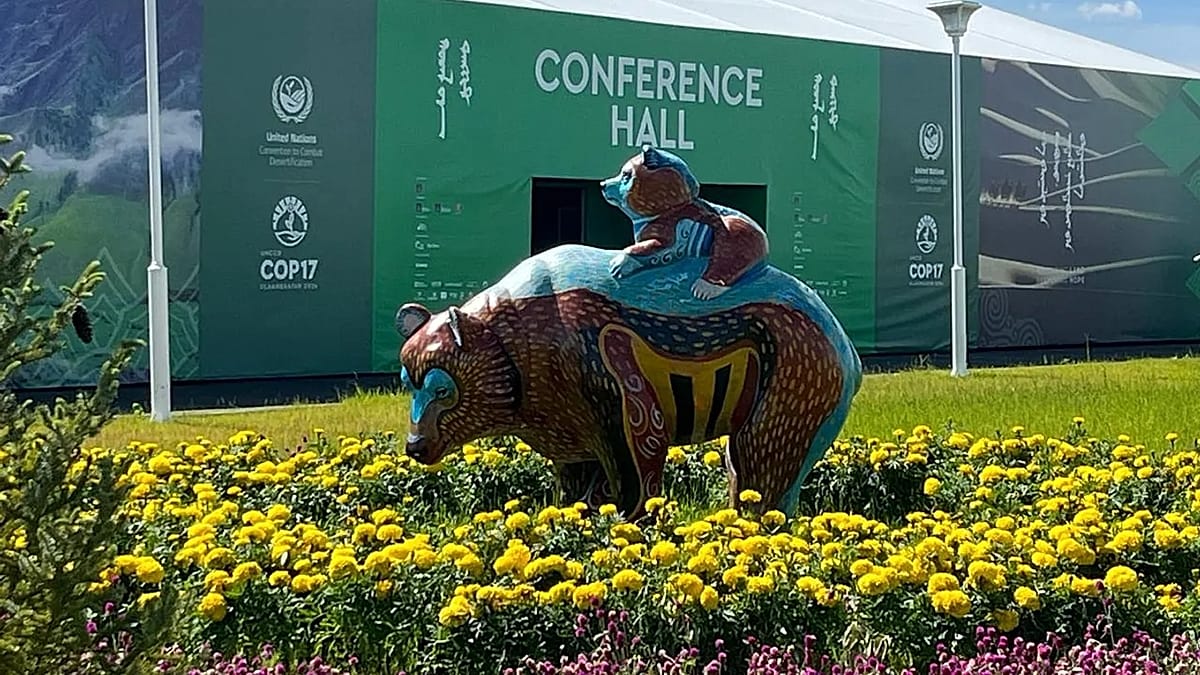
After twelve days of intense negotiations in Ulaanbaatar, the 17th session of the Conference of the Parties (COP17) to the United Nations Convention to Combat Desertification (UNCCD) concluded with a significant financial commitment: $1.3 billion in new and pipeline financing for land restoration and drought resilience. The announcement, made on the final day, marks one of the most tangible outcomes of the summit, which brought together 197 parties (196 countries plus the European Union).
The summit, hosted by Mongolia, was framed from the outset as a call to move beyond declarations. Mongolian Prime Minister Nyam-Osoryn Uchral set the tone in his opening remarks: “Today, the time has come for us to ask ourselves a bold and candid question – we have spoken at length and made many declarations, but have we been able to turn our words into action? The previous events all brought meaningful outcomes. But, the truth is that the world has never lacked goals and commitments. What we need more urgently are the resources, financing, technology and institutional environment to turn those commitments into tangible results.”
The urgency of the issue is stark. According to UNCCD data, 40% of the planet’s usable arable land is already degraded, affecting 3.2 billion people. Delegates repeatedly stressed that land degradation is not a distant environmental problem but a direct driver of food insecurity, water scarcity, migration, and even wildfires. Yasmine Fouadh, Executive Secretary of the UNCCD, explained: “Desertification can simply be a food crisis because once your land is degraded you will not be able to plant and you will have both food and water security problem and migration and displacement. Here, the people are not being given a choice whether they will leave their land, yes or no, but they have nothing to sustain their livelihood and give them resilience.”
The financial package announced at COP17 includes $644.5 million in new finance, with $216.4 million already confirmed and moving toward implementation. The funds will support projects in 23 countries across five continents, ranging from sustainable agriculture to water management and reforestation. The announcement comes against a backdrop of a massive funding gap: the UNCCD estimates that $355 billion is needed annually for land restoration, but current investment stands at only about $70 billion.
Mongolia’s Deputy Prime Minister, Togmid Dorjkhand, who chaired the ministerial session on finance, highlighted the scale of the challenge: “There is a huge gap in the funding for land preservation. Annually, about 355 billion dollars is needed but we have only about 70 billion, so we miss around 280 billion.” He added that the summit had succeeded in mobilizing over $2.1 billion when private sector commitments are included, calling COP17 “a success in that financial part.”
The role of private investment was a central theme. Dr. Osama Faqeeha, advisor to COP16 in Riyadh, pointed out that land stores three times more carbon dioxide than the atmosphere and that 90% of our food comes from the land. Yet, as Gim Huay Neo, Managing Director at the World Economic Forum, noted, “If you look at how much money goes into artificial intelligence, it is the same amount of money that goes into climate financing – 2 trillion dollars a year. But, when you double-click on climate financing, less than 3% goes into land and water. It is way under-invested.” She added that every dollar invested in land restoration can yield returns of $8 to $30, making it an attractive opportunity for businesses.
Mongolia’s pitch as a data centre hub
Beyond the global financing pledges, Mongolia used the summit to promote itself as a future hub for data centres. The country offers low energy costs, a 40% saving on cooling thanks to its harsh winters, and the fact that 98% of land is state-owned, which simplifies construction. Prime Minister Uchral also highlighted a new “data law” that guarantees data sovereignty, a move designed to attract foreign tech investment. This pitch aligns with broader regional trends, as Mongolia positions itself as Asia's next data centre hub.
The summit also underscored the importance of linking land restoration to other global challenges. As Dr. Faqeeha warned, “We will not be able to resolve any of our issues without working on the land. 90% of our food comes from the land, 99.8% of our calories come from the land, our cities and on land, our villages and farms are on land, rivers, lakes, all the freshwater lie on the land.”
While COP17 did not produce a legally binding global agreement—a familiar outcome in multilateral climate talks—the financial commitments represent a step forward. The UNCCD estimates that inaction on land degradation costs the world nearly $900 billion annually, while healthy land could generate up to $1.8 trillion through food production, water provision, and carbon storage. The challenge now is to ensure that the pledged funds are disbursed efficiently and that projects deliver measurable results on the ground.
For Europe, the outcomes of COP17 carry indirect but significant implications. European countries are major contributors to international climate finance, and the EU’s own Green Deal emphasizes land restoration and sustainable agriculture. The success of these projects in Africa, Asia, and Latin America will affect global food prices, migration flows, and climate stability—issues that resonate directly with European policymakers and citizens. As the world grapples with the twin crises of climate change and biodiversity loss, the investments pledged in Ulaanbaatar offer a glimmer of hope, but as the summit’s own rhetoric made clear, the real test lies in implementation.