Guimarães, a historic city in northern Portugal, is using its tenure as European Green Capital to show how centuries-old urban fabric can be adapted for a hotter climate. The city, which beat Heilbronn in Germany and Klagenfurt in Austria for the 2026 title, has spent more than a decade weaving green corridors, restoring waterways, and cutting waste. The result: measurable cooling in a place where summer temperatures routinely hit 40 degrees Celsius.
The European Commission evaluates candidates on seven criteria, from air quality and noise to biodiversity, waste, and climate adaptation. Guimarães’ success reflects a long-term commitment that began well before the award. The city’s Landscape Laboratory, set up in 2014 with the University of Minho and the University of Trás-os-Montes and Alto Douro, has become the hub for this work.
A public health response to rising heat
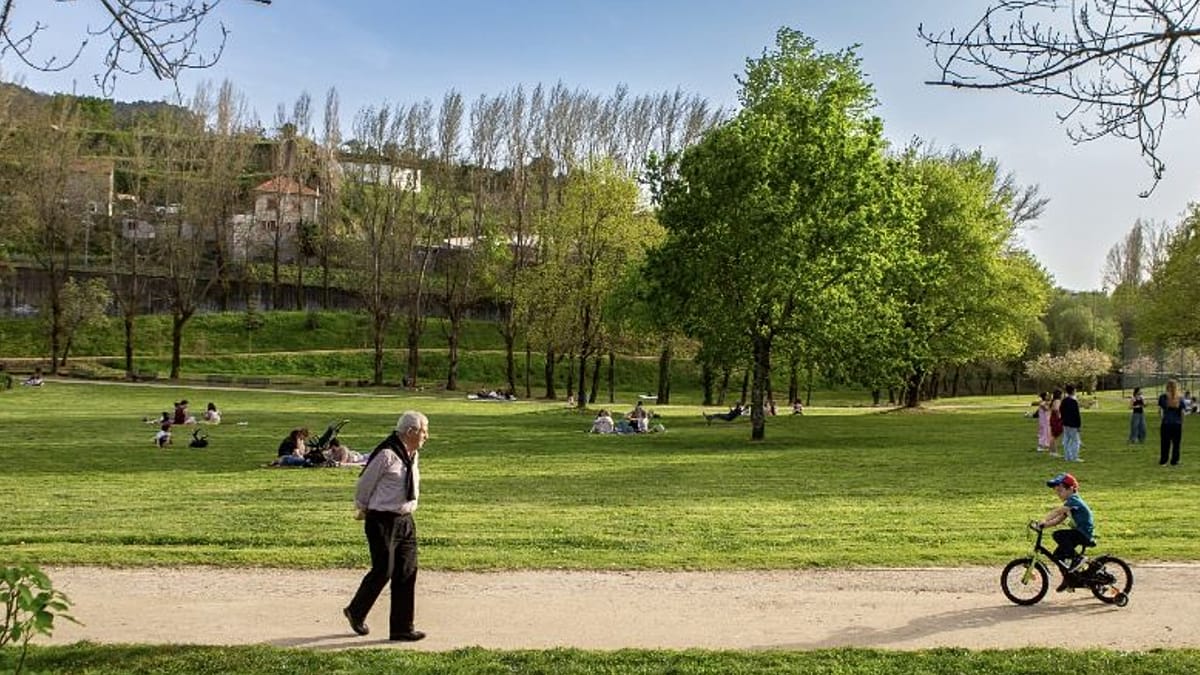
For Carlos Ribeiro, head of the Landscape Laboratory, redesigning the city is no longer just an environmental matter. “We are seeing an increase in diseases linked to heatwaves. So we need to transform our cities,” he says. “We need to design cities with a better quality of life. And these cities are cities with strong connectivity between green areas but, more importantly, they are cities where people actually use those green areas, the parks.”
The strategy is built on a radial model: a network of green corridors that stretches from the centre outward, linking parks, waterways, farmland, and forests. The goals are clear: increase green cover, support biodiversity, and reduce the urban heat island effect that makes stone-built historic districts particularly oppressive.
Water plays a central role. The rivers Ave and Vizela, which run through the municipality, have been opened up for leisure and cooling. Low-impact pedestrian paths now follow their banks, encouraging residents to move through the landscape rather than just look at it.
“We know we are facing climate change and we need to act on it,” Ribeiro explains. “That is why in recent years we have been preparing the city for climate change and trying to improve connectivity in order to enhance green areas and bring temperatures down. We have managed to reduce temperatures by two degrees. So we know we need to create more green parks, more green areas, and then we need to improve this kind of solution.”
The two-degree figure is not anecdotal. Researchers from the Landscape Laboratory and the University of Minho, working with colleagues in Texas and Colombia, analysed a decade of satellite imagery to measure the impact of the city’s interventions. Their study, published in September 2025, found that land surface temperatures fell by up to 2.49 degrees Celsius in areas where green roofs and urban gardens were introduced.
But the authors caution that sustaining these gains will require stronger environmental policies. The city’s efforts are part of a broader European trend. Eight EU cities are already competing for the 2028 titles, and Zaragoza has been named Green Capital for 2028, showing that the competition is pushing cities to innovate.
Guimarães’ approach offers a template for other historic centres across Europe, where narrow streets and dense stone construction amplify heat. The city’s experience shows that even in a UNESCO World Heritage Site, built in the Middle Ages, meaningful adaptation is possible.
As Ribeiro puts it, the challenge is not just about planting trees. It is about creating spaces that people actually use, so that green infrastructure becomes part of daily life. That, he argues, is what turns a climate strategy into a public health measure.