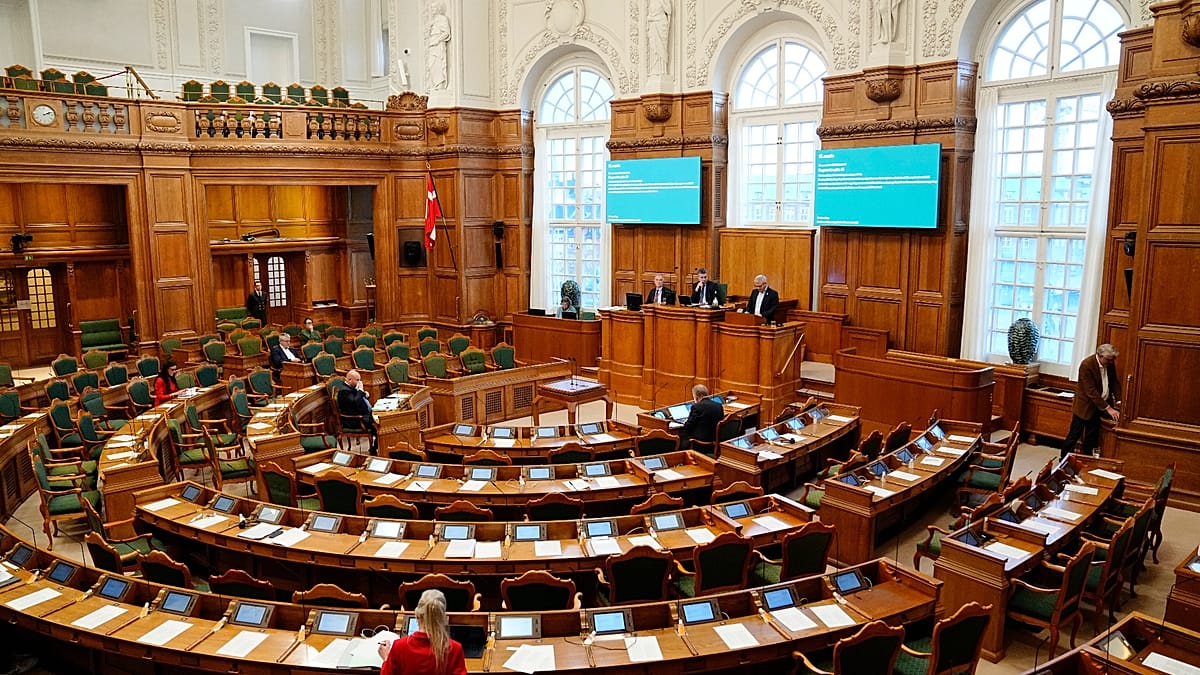
Copenhagen has formally endorsed a defence agreement with Washington and Nuuk, clearing the way for an expanded American military footprint on the world's largest island. The Folketing voted without opposition on Thursday, with all 109 lawmakers present backing the text after its second reading. No debate preceded the vote, reflecting broad cross-party consensus on Arctic security.
The pact, signed in New York on 22 September, supplements the 1951 agreement that has governed the US military presence in Greenland, an autonomous territory of the Kingdom of Denmark. It permits the construction of two new American bases on the island, a move that has drawn attention given President Donald Trump's repeated statements about acquiring Greenland for strategic reasons.
Greenland's own parliament, the Inatsisartut, had already approved the deal in early November by 16 votes to seven abstentions. The Danish ratification now completes the domestic legal process, though the agreement remains in force even if Greenland were to become independent—a scenario that has gained traction in recent years.
Strategic restrictions and Arctic competition
The accord also introduces restrictions on foreign investment in Greenland's strategic sectors, effectively barring countries outside the EU and NATO from gaining a foothold. The measure is widely seen as a response to growing Chinese and Russian interest in the Arctic, particularly in mining and infrastructure projects. By limiting access, Copenhagen and Nuuk aim to prevent external actors from leveraging economic ties into political influence.
President Trump's comments since returning to the White House in January 2025 have unsettled European allies, including Denmark, a founding NATO member. His insistence that the US must control Greenland has been met with firm rebuttals from Danish officials, who stress the island's autonomy and the importance of international law. The unanimous vote in the Folketing sends a signal of unity, even as the broader debate over Arctic governance intensifies.
For Denmark, the deal balances security needs with sovereignty concerns. The country has long managed Greenland's defence and foreign affairs, but the island's push for greater self-determination—and potential independence—adds complexity. The agreement's durability beyond independence suggests a forward-looking approach, but it also raises questions about future negotiations.
European observers note that the pact aligns with broader efforts to bolster NATO's northern flank. The Arctic has become a theatre of heightened competition, with Russia modernising its bases and China declaring itself a 'near-Arctic state'. The new US bases could serve as a counterweight, though some analysts caution against militarising the region.
In Brussels, the deal has been welcomed as a step towards greater transatlantic burden-sharing. However, it also highlights the EU's limited role in Arctic security, a gap that some member states are keen to address. The bloc's recent focus on turning security partnerships into industrial reality may eventually extend to defence cooperation in the High North.
For Greenlanders, the pact is a double-edged sword. While it promises investment and infrastructure, it also cements a foreign military presence on their soil. The island's government has insisted that any independence bid would be accompanied by a new security arrangement, and this agreement provides a framework for that transition.
The unanimous vote in Copenhagen is a rare moment of political harmony in a country often divided over immigration and welfare policy. It underscores the gravity of Arctic security and the shared interest in maintaining stability. As the ice melts and shipping lanes open, the strategic value of Greenland will only grow, making this pact a cornerstone of future defence planning.
With the ratification complete, attention now turns to implementation. The US military is expected to begin site surveys and construction planning in the coming months, with the first base potentially operational within a few years. For Denmark, the challenge will be to ensure that the agreement serves both its security interests and its commitment to Greenlandic self-rule.