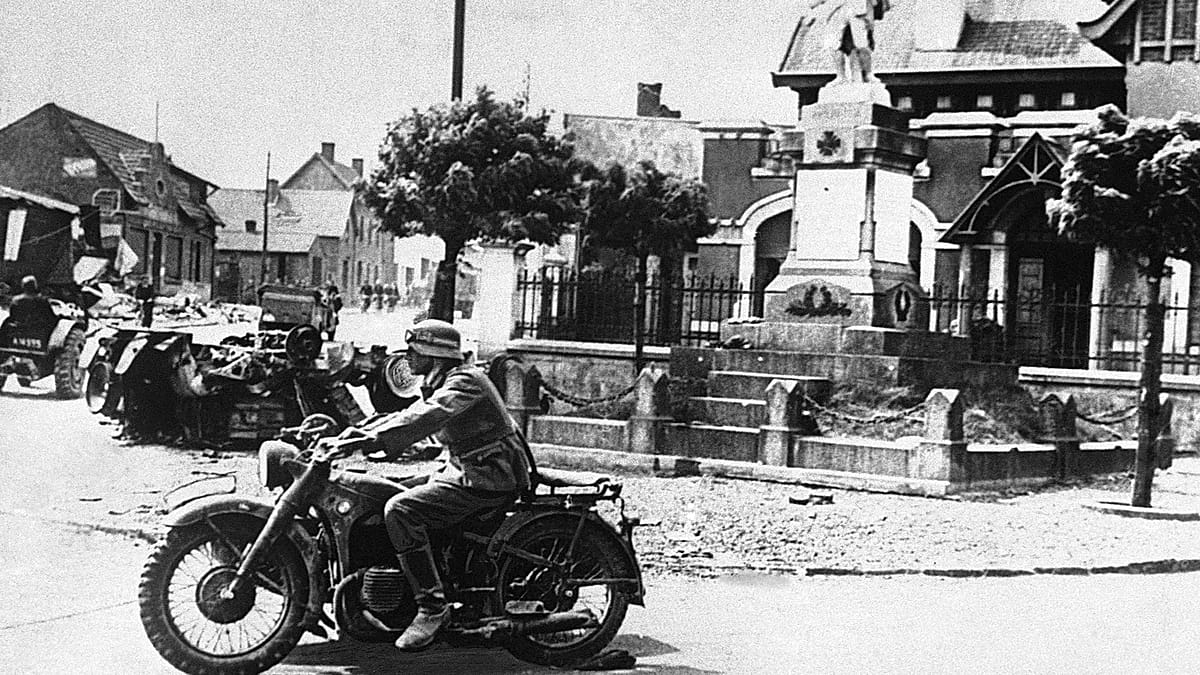
Budapest's Danube has dropped to levels not seen in decades, and the receding water has brought history back to the surface. In early August, a team from the Hungarian Institute and Museum of Military History discovered a nearly intact Wehrmacht motorcycle embedded in the riverbed, just off the Buda side of the Parliament building. The find, described by the institute as a once-in-a-century event, has now been identified as a DKW NZ 350-1, a model built specifically for wartime use from 1944 onward.
The motorcycle's preservation is remarkable. Sealed in the Danube's mud, it retains its metal side pannier, a defining feature of the NZ 350-1. Powered by a single-cylinder two-stroke engine producing 11.5 hp, these machines were known for their robustness and reliability, making them popular among troops. Around 12,000 units were produced before the war ended in 1945. The predecessor model, the NZ 350, could reach 105 km/h, according to the ADAC, and was used for dispatch, reconnaissance, and courier duties—carrying orders, reports, and maps.
From Zschopau to the Danube
The motorcycle was manufactured by Auto Union AG, a company formed in 1932 through the merger of several brands, including Audi. Based in Zschopau, Saxony, Auto Union was the second-largest German car and motorcycle maker after Opel. The NZ series introduced welded frames, a departure from the bolted construction of earlier models. Welding required a high power supply, so production was scheduled at night to avoid straining the electricity grid.
The discovery is not isolated. The same stretch of riverbed has yielded German Tellermine 35 anti-tank mines, hand grenades, and artillery shells, leading the Hungarian institute to suggest the area may have served as a wartime debris dump. The presence of the motorcycle and the soldiers' remains, however, points to a more personal story.
Human remains and a soldier's fate
Beneath the motorcycle, the recovery team found human remains. The Volksbund Deutsche Kriegsgräberfürsorge, the German War Graves Commission, took charge of the recovery and confirmed that the remains belong to two Wehrmacht soldiers. Their identity tags are well preserved, so identification should be possible. The two men are to be buried at the German war cemetery in Budaörs, west of Budapest, where more than 16,000 German soldiers are already interred.
The timeline fits the Battle of Budapest, fought between October 1944 and February 1945. German troops had occupied the city since March 1944. The battle, one of the bloodiest of the Eastern Front, claimed the lives of around 30,000 German, 17,000 Hungarian, and 80,000 Soviet and Romanian soldiers. The remaining German units surrendered on 13 February 1945.
After the war, DKW's production facilities were dismantled and shipped to the Soviet Union as war reparations. In Moscow and other locations, the largely identical ISCH-350 was built in large numbers until 1951.
The Volksbund, a non-profit association acting on behalf of the German federal government, searches for, recovers, and buries war dead abroad. In 2025 alone, it handled more than 5,500 cases. The Budapest discovery is a poignant reminder of the war's human cost, and the low water levels that made it possible are a consequence of the same climate pressures affecting rivers across Europe. As Balkan rivers hit record lows, similar relics may emerge elsewhere.
The motorcycle itself will be preserved and displayed at the Hungarian Institute and Museum of Military History, offering a tangible link to a turbulent past. For now, the mystery of its final ride is closer to being solved, thanks to the careful work of historians and the receding waters of the Danube.