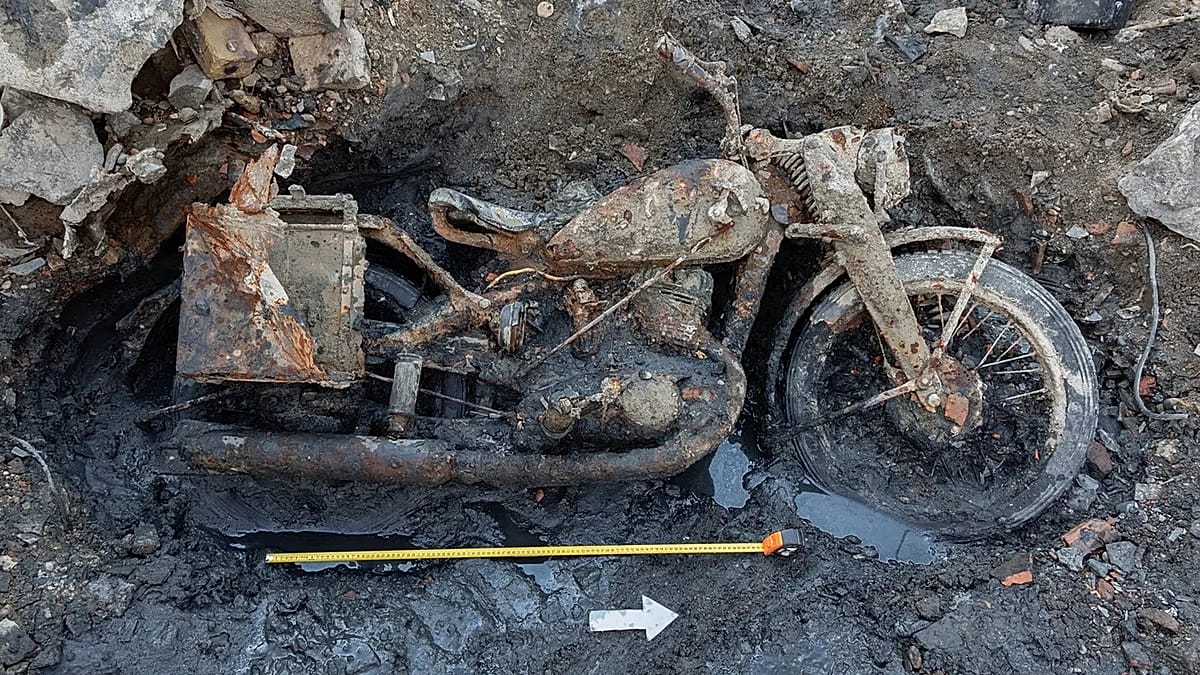
Budapest's Danube has dropped to levels not seen in generations, and with the water gone, the riverbed is giving up its secrets. Among the mud and debris, staff from the Institute and Museum of Military History have recovered a remarkably preserved motorcycle used by the Wehrmacht during the Second World War.
The machine, a DKW NZ 350-1, was found in the riverbed directly opposite the Hungarian parliament building. According to the institute, the vehicle is almost completely intact, having been sealed in the Danube's fine sediment for decades. For historians, it is a once-in-a-century find.
A wartime workhorse emerges
The NZ 350-1 was developed specifically for military use and entered production in 1944. By the end of the war in 1945, around 12,000 units had been built. Its predecessor, the DKW NZ 350, could reach a top speed of 105 km/h, according to Germany's ADAC motoring club.
The motorcycle was manufactured by Auto Union AG, the company formed in 1932 through the merger of several brands, including Audi. The NZ range, comprising 250cc and 350cc models, was ready for mass production by autumn 1936, but a competing line sold so well that series production only began in 1938.
Earlier DKW models had bolted frame sections; the NZ series used welded frames. That welding required substantial electricity, so production was scheduled at night when the power grid was less strained.
The discovery is not isolated. German anti-tank mines, hand grenade fragments, and artillery shells have also been pulled from the riverbed. The Hungarian Institute of Military History suggests this stretch of the Danube may have served as a "war rubble dump" during the final months of the conflict.
From March 1944, German troops occupied Budapest. The Battle of Budapest raged from October 1944 to February 1945, pitting the Soviet Red Army against German and Hungarian forces. Casualties were staggering: roughly 30,000 German, 17,000 Hungarian, and 80,000 Soviet and Romanian soldiers died. The city was liberated on 13 February 1945.
The motorbike's recovery adds a tangible link to that turbulent period. Similar finds have been reported elsewhere along the Danube as low water levels expose wartime relics, and the river's shrinking flow has also stranded boats and revealed sandbanks in Serbia.
For now, the motorcycle is being conserved at the military history museum, where it will eventually be displayed. The find underscores how climate-driven drought can unexpectedly rewrite our understanding of the past.