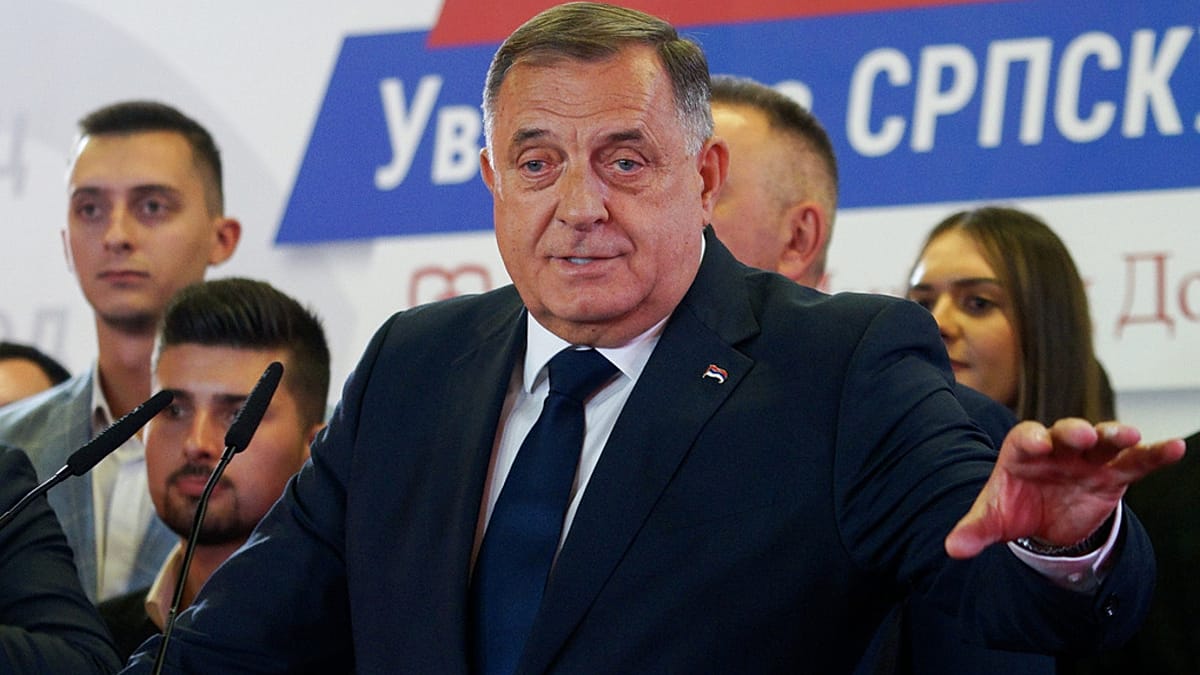
Bosnian Serb leader Milorad Dodik has claimed a sweeping victory in Sunday's general election, thanking both Donald Trump and Vladimir Putin for what he called his party's political survival. Although Dodik himself was barred from standing, his Alliance of Independent Social Democrats (SNSD) is projected to retain power in the Republika Srpska entity and its seat in Bosnia's tripartite presidency.
With 95 percent of ballots counted, SNSD candidate Željka Cvijanović was comfortably ahead in the race for the Serb seat on the national presidency, according to electoral officials. Dodik, addressing supporters in Banja Luka, framed the result as a vindication of his hardline nationalist agenda.
"If it had not been for Donald Trump's magnificent victory, we would probably be political corpses today," he said. "But now, thanks to the new environment, we are political winners."
The 67-year-old, who is serving a six-year ban from public office for defying rulings by Bosnia's international envoy and the Constitutional Court, remains the dominant figure in Republika Srpska. His party also looks set to keep its majority in the entity's parliament and the local presidency.
A system built on compromise, strained by nationalism
Bosnia's complex post-war structure, created by the 1995 Dayton agreement, divides the country into two semi-autonomous entities: the Serb-run Republika Srpska and a Muslim-Croat federation, linked by a weak central government. The arrangement ended the 1992–95 conflict but has often produced political paralysis.
Sunday's vote saw turnout drop to around 42 percent, nearly ten points lower than in 2022. Analysts attribute the decline to widespread disillusionment with a political class that has failed to deliver meaningful reform or progress toward European Union membership.
In the Bosniak camp, incumbent Denis Bećirović of the Social Democrats claimed victory in a tighter race for his seat on the presidency. "A freedom-loving, anti-fascist and civic Bosnia and Herzegovina is alive," he told supporters in Sarajevo.
Bosnian Croat nationalist Darijana Filipović also declared victory in her bid for the Croat seat, though final results are still pending.
Bećirović has campaigned on a platform of closer integration with the EU and NATO, but if Dodik's party retains its influence, the political deadlock that has blocked necessary reforms for years is likely to persist. Dodik and his allies have repeatedly clashed with central authorities and vocally oppose EU membership, preferring closer ties with Moscow.
The election outcome is being closely watched in Brussels, where officials have long urged Bosnia to implement constitutional and electoral changes. The country's stalled EU bid was already a central theme in the run-up to the vote, as Bosnia votes amid stalled EU bid and Dodik's shadow.
Dodik's overtures to Trump and Putin reflect a broader trend among nationalist leaders in the Western Balkans who see Washington and Moscow as counterweights to Brussels. His comments echo the Kremlin's narrative that Western liberal democracy is in decline, a message that resonates with some voters in Republika Srpska.
For now, the SNSD's projected victory suggests that Dodik's strategy of confrontation with the international community has not cost him support at home. But the low turnout and the country's deep divisions raise questions about the sustainability of a system that many Bosnians feel no longer serves them.