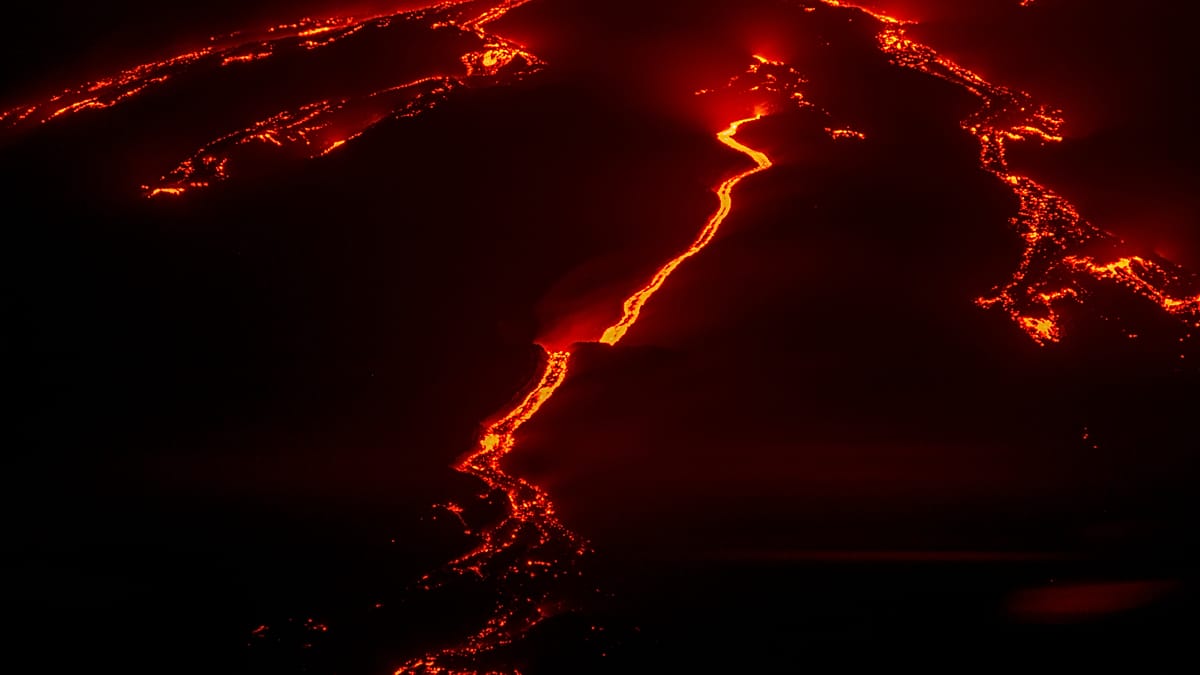
A drone has provided a rare aerial perspective of molten lava streaming down the flanks of Mount Etna, Europe's most active volcano, located on the Italian island of Sicily. The footage, released this week, shows vivid orange rivers of lava cutting through the snow-covered summit, illuminating the night sky as they cascade toward the uninhabited Valle del Bove.
The eruption, which began on Sunday evening, is the latest in a series of paroxysmal events that have characterized Etna's activity over the past year. Italy's National Institute of Geophysics and Volcanology (INGV) reported that the eruption originated from the Bocca Nuova crater, one of the volcano's four summit craters, and produced a lava flow that extended several kilometers down the southeastern slope.
Volcanic Activity and Safety Measures
While the spectacle has drawn crowds of onlookers to nearby towns such as Catania and Taormina, authorities have maintained a cautious stance. The Italian Civil Protection Department has issued a yellow alert for the region, advising residents and tourists to avoid the immediate vicinity of the eruption. No evacuations have been ordered, and Catania's Fontanarossa Airport continues to operate normally, though passengers are advised to check for potential ash-related disruptions.
Etna's eruptions are a regular occurrence, but the volcano's unpredictable nature means that even minor events can pose risks to aviation and local infrastructure. In 2021, a major eruption forced the temporary closure of Catania's airport and blanketed nearby towns in ash. The current event, while visually dramatic, has not yet caused significant damage, though scientists are monitoring seismic activity closely.
The drone footage, captured by a local filmmaker, offers an unprecedented view of the lava's path. It shows the incandescent material flowing like a river, with steam rising as it meets the snow. Such imagery is not only captivating but also valuable for researchers studying volcanic behavior and lava flow dynamics.
This eruption comes amid broader discussions about climate risks in Europe. As temperatures rise across the continent, extreme weather events—including volcanic eruptions—are being scrutinized for their potential to exacerbate existing vulnerabilities. A recent report highlighted that construction and agriculture top Europe's heat-exposed jobs as climate risks mount, underscoring the need for adaptive measures in sectors affected by environmental changes.
Etna's activity also intersects with geopolitical developments in the region. The volcano's location off the coast of Sicily has strategic importance, as evidenced by recent naval operations. In a separate incident, Macron confirmed that the French Navy intercepted a Russian shadow fleet tanker off Sicily, highlighting the Mediterranean's role in European security.
For now, the eruption remains a natural wonder, drawing scientists and tourists alike to witness one of Europe's most dynamic landscapes. The drone footage serves as a reminder of the raw power beneath the continent's surface, and the ongoing need for vigilance in the face of geological hazards.