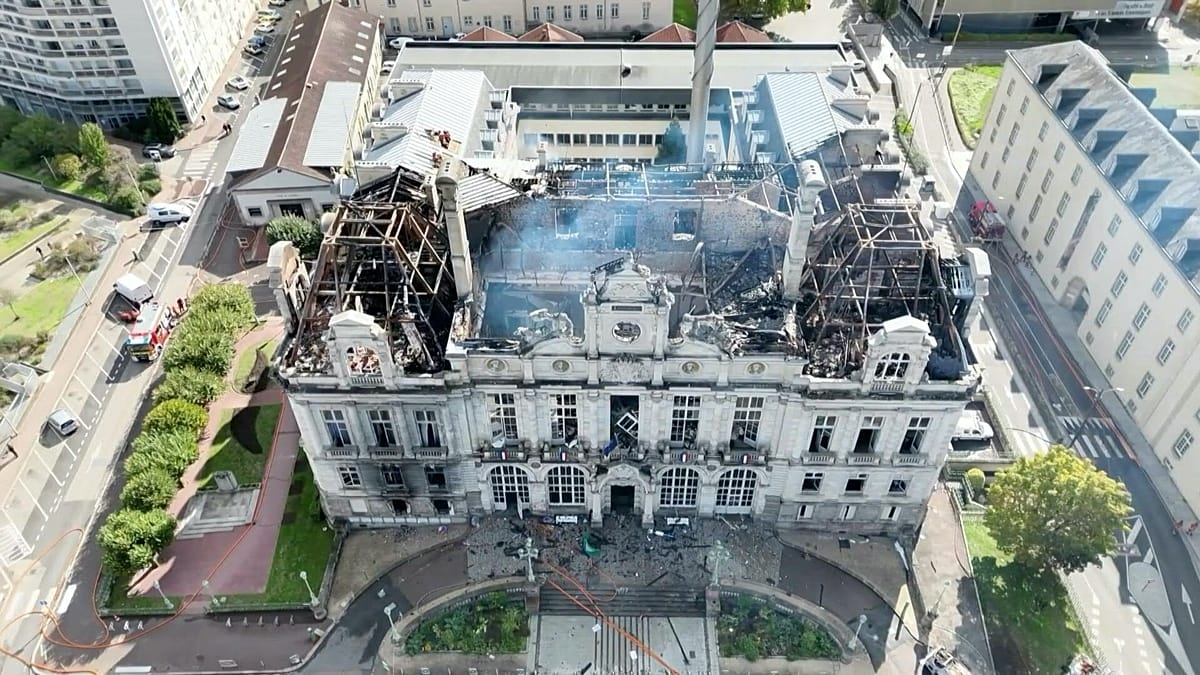
New drone footage has laid bare the devastation wrought on Limoges' 19th-century town hall, a landmark of the central French city, after protests over the rising cost of living spiraled into violence. The aerial images show the building's roof partially collapsed and its interior gutted by fire, a stark symbol of the anger that has swept across France in recent weeks.
The unrest in Limoges, a city of about 130,000 in the Nouvelle-Aquitaine region, erupted during a demonstration that drew thousands of residents frustrated by soaring prices for food, energy, and housing. What began as a peaceful march on Saturday descended into chaos when a group of protesters broke away from the main route and clashed with police near the town hall, setting barricades alight and hurling projectiles at officers.
Local authorities confirmed that the fire, which broke out in the early evening, quickly engulfed the town hall's upper floors. Firefighters battled the blaze for hours, but the building—a neo-Renaissance structure completed in 1883—suffered extensive damage. No casualties were reported, but several officers sustained minor injuries, and at least 45 people were arrested, according to the prefecture.
The footage, captured by a police drone the following morning, offers a sobering overview of the aftermath. Charred beams, shattered windows, and debris litter the interior, while the ornate facade, once a source of local pride, is now blackened by smoke. The town hall's clock tower, a familiar silhouette on Limoges' skyline, appears intact but the surrounding square is strewn with remnants of the protest.
National unrest and political response
Limoges is not alone in witnessing such scenes. Similar protests have erupted in cities including Paris, Lyon, and Marseille, where demonstrators have targeted symbols of state authority. The damage across France has prompted comparisons to the gilets jaunes movement of 2018, though the current wave is driven by a broader sense of economic insecurity.
President Emmanuel Macron, speaking from the Élysée Palace on Monday, condemned the violence and vowed to restore order. “We will not tolerate attacks on our public buildings or on the safety of our citizens,” he said. “Those responsible will be held accountable, and we will strengthen our security forces to prevent such scenes from recurring.” Macron's remarks came as his government faces mounting pressure to address the affordability crisis that has fueled the protests.
The unrest has also spread beyond France's borders, reflecting a continent-wide phenomenon. In Italy, over 200 arrests were made in Milan during similar demonstrations, while in Albania, police deployed water cannon and tear gas in Tirana. Analysts point to a common thread: a wage-price squeeze that is eroding living standards across Europe, as highlighted in recent analyses.
In Limoges, the immediate focus is on recovery. Mayor Émile Roger Lombertie has pledged to rebuild the town hall, calling it “the heart of our city.” But the emotional toll is evident. “This building has stood for over a century, through wars and crises,” said Marie Dupont, a local shopkeeper who watched the fire from her doorstep. “To see it reduced to this is heartbreaking. We understand the anger, but this is our heritage.”
The government has announced an emergency fund for municipalities affected by the protests, and Limoges is expected to receive significant support. However, the deeper challenge remains: addressing the economic grievances that have driven so many to the streets. As France and its neighbors grapple with inflation and stagnant wages, the question is whether tougher security alone can quell the discontent.
For now, the drone footage serves as a powerful reminder of the stakes. The images have circulated widely on social media, drawing reactions of shock and sympathy from across the country. They also underscore the fragility of public trust in institutions when citizens feel left behind by economic policy.
As Limoges begins the long process of restoration, the town hall's charred shell stands as a monument to a moment of crisis—and a test of whether Europe's leaders can respond with more than just force.