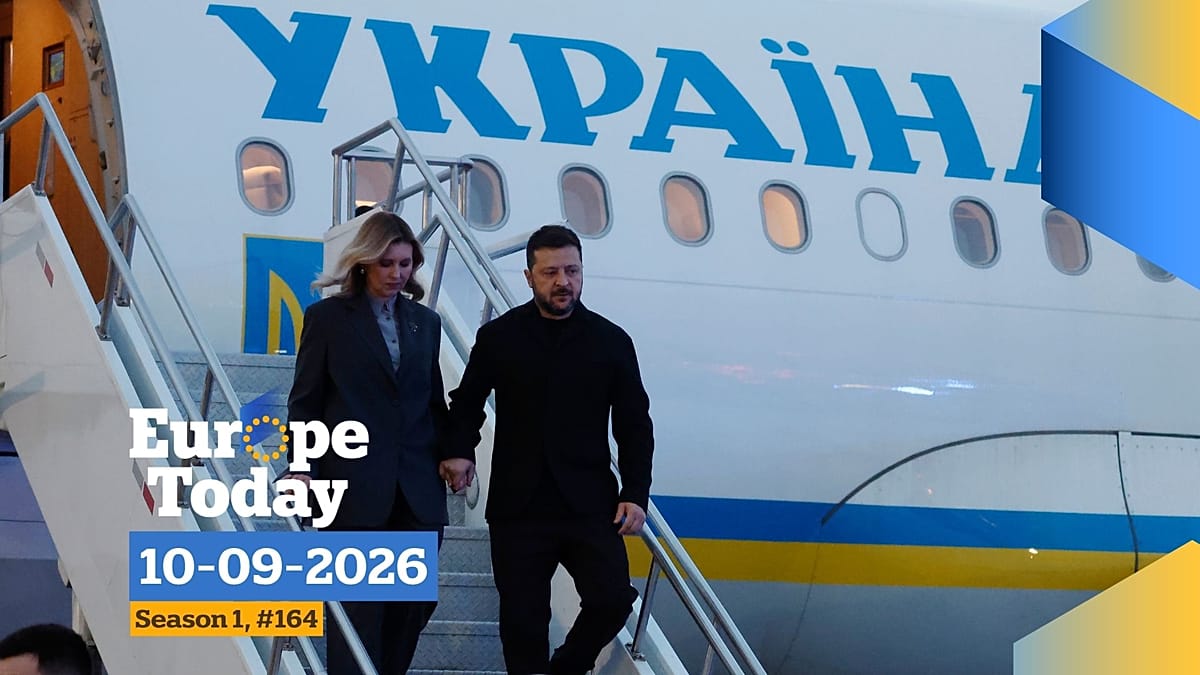
A drone came dangerously close to Volodymyr Zelenskyy's aircraft as it departed Moldova for Oslo, where the Ukrainian president was to attend the funeral of King Harald V. The incident, reported by Ukrainian officials, underscored the persistent aerial threats facing the country's leadership. It occurred just hours after Vladimir Putin, in a call with Donald Trump, sought to play down any Russian military threat to Europe.
The near-miss was the latest in a series of drone-related incidents affecting Ukrainian officials. Earlier, a drone incursion had delayed Zelenskyy's departure from Chișinău, where he had held talks with Moldovan President Maia Sandu. The Ukrainian air force did not confirm whether the drone was Russian, but the episode highlighted the porous nature of the region's airspace and the constant danger posed by unmanned aerial vehicles.
The incident set the tone for the annual Rīga Conference in Latvia, where this year's agenda is dominated by the Russian threat. Maria Tadeo, reporting from the Latvian capital, interviewed Finland's Foreign Minister Elina Valtonen, whose country shares a 1,340-kilometre border with Russia. Valtonen stressed that Helsinki's recent decision to complete a 200-kilometre border fence was a direct response to Moscow's hybrid tactics, including the weaponisation of migration.
"We have to be prepared for all kinds of hybrid attacks," Valtonen said. "The fence is not just about physical barriers; it's about sending a signal that Finland will not be intimidated." Her remarks echoed a broader sentiment among Baltic and Nordic officials that Europe must bolster its defences below the threshold of open war, a theme also explored in Germany's approach to hybrid threats.
Baltic resolve and European unity
The Rīga Conference, which brings together policymakers, military leaders, and analysts from across the continent, has become a key forum for discussing European security. This year, the focus is squarely on Russia, with many participants arguing that the threat is not hypothetical. The recent overnight strikes on Kyiv, which killed at least five people and wounded dozens, served as a grim reminder of Moscow's willingness to escalate.
Latvia's Prime Minister, Evika Siliņa, opened the conference by calling for a "united and robust" European response. "We cannot afford complacency," she said. "The security of every European nation is interconnected." Her words were echoed by Estonian and Lithuanian officials, who have long warned that Russia's aggression in Ukraine could spill over into the Baltics.
The conference also touched on the broader geopolitical landscape, including the upcoming US presidential election. Zelenskyy has expressed hope for a meeting with Trump by late September, as Kyiv seeks additional air defence systems. European leaders are watching closely, aware that a change in Washington could alter the dynamics of support for Ukraine.
Beyond security: housing, trade, and AI
While security dominated the agenda, the conference also addressed other pressing European issues. Dan Jørgensen, the European Commissioner for Housing and Energy, spoke about the continent's housing crisis, which has become a political flashpoint in many member states. Jørgensen argued that the EU needs a coordinated strategy to tackle affordability, including investment in social housing and better regulation of short-term rental platforms.
On the economic front, Alicia García-Herrero, an economist at the Bruegel think tank, discussed EU-China trade relations. She noted that while the EU is keen to maintain economic ties with Beijing, it must also protect its strategic interests, particularly in technology and green energy. "We need a balanced approach," she said, "one that fosters trade but also safeguards our competitiveness."
The conference also turned to the risks of artificial intelligence, following the resignation of an Anthropic researcher who warned that AI "is gambling with our lives." Andrea Renda, Director of Research at the Centre for European Policy Studies (CEPS), discussed the implications of this resignation for European tech policy. "The EU's AI Act is a step in the right direction," Renda said, "but we need to move faster to ensure that AI development is safe and aligned with human values."
The near-miss involving Zelenskyy's plane served as a stark reminder that the war in Ukraine is far from over, and that its consequences reach far beyond the battlefield. As European leaders gathered in Riga, the message was clear: the continent must remain vigilant, united, and prepared for the challenges ahead.