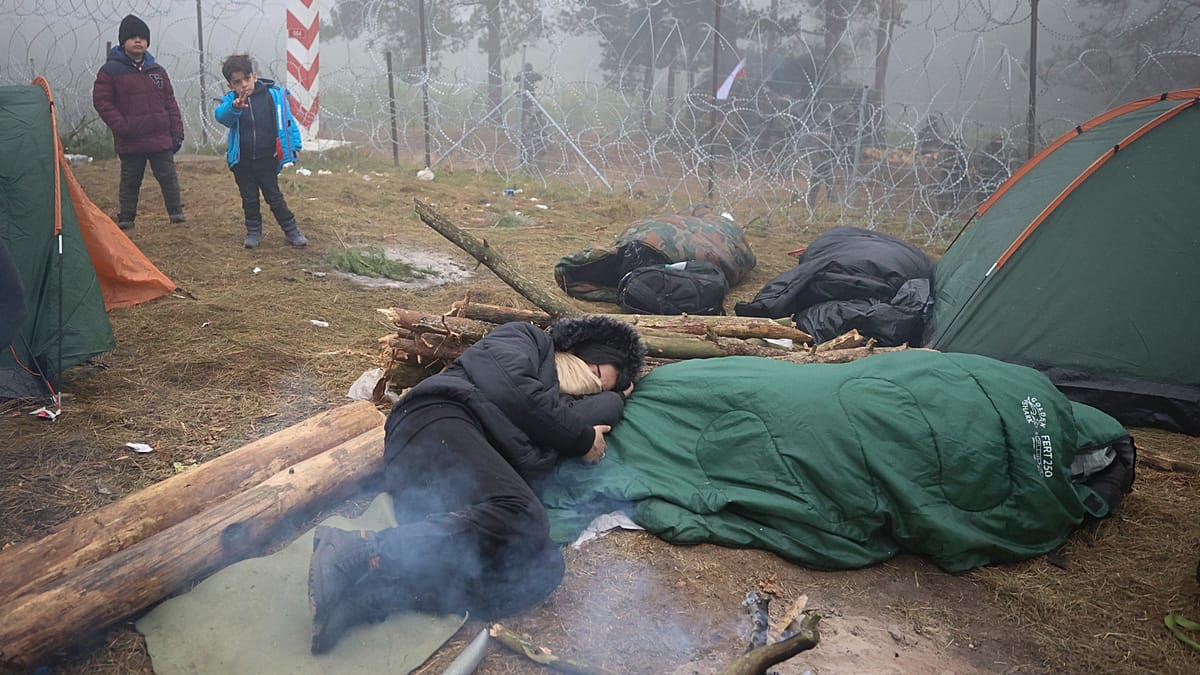
In a landmark ruling on Tuesday, the European Court of Human Rights (ECHR) found that Polish and Latvian authorities violated the European Convention on Human Rights when they summarily pushed back migrants who had crossed from Belarus in 2021. The judgment, the first of its kind to examine the protection of individuals caught up in the deliberate instrumentalisation of migration, could have far-reaching implications for border management across the European Union.
The cases date back to the summer and autumn of 2021, when Belarus, under Alexander Lukashenko, encouraged and facilitated the movement of thousands of migrants from the Middle East and Africa towards the EU's eastern borders. Minsk's actions were widely seen as a hybrid attack designed to destabilise neighbouring states, particularly Poland, Latvia, and Lithuania. In response, Warsaw and Riga authorised border guards to intercept irregular migrants and return them to Belarus without assessing their individual circumstances.
The Strasbourg-based court examined two separate applications. The first concerned two Afghan nationals who crossed into Poland from Belarus in August 2021. They were left stranded in a makeshift camp on Polish territory for several weeks before being pushed back across the border. The second involved 19 Iraqi nationals of Kurdish origin, including six children, who were returned to Belarus by Latvian authorities after an irregular crossing in August 2021.
In its judgment, the ECHR acknowledged that states have the sovereign right to control the entry of foreign nationals into their territory. It also accepted that removing irregular migrants to the instrumentalising state would not, in itself, breach Article 3 of the convention, which prohibits torture and inhuman or degrading treatment. However, the court stressed that national authorities must identify individuals who are particularly vulnerable to ill-treatment, such as the elderly, disabled, or sick, as well as anyone facing a clear and immediate risk of such treatment.
Applying this standard, the court found violations only in respect of some applicants. One Afghan national who entered Poland was deemed to have been subjected to inhuman treatment. In the Latvian case, the court held that all the children, along with their accompanying family members, had their rights breached. The court emphasised that children must be treated as an extremely vulnerable group with specific needs, and therefore cannot be pushed back, even in situations of instrumentalisation.
A precedent for future border crises
The ruling is being closely watched by EU member states and human rights organisations alike. It is the first time the ECHR has addressed the legal protections owed to migrants used as pawns in state-sponsored pressure campaigns. The judgment could set a precedent for similar situations, such as the mass arrival of irregular migrants in the Spanish enclave of Ceuta from Morocco in July 2021, or the ongoing tensions on the EU's eastern frontier.
Legal experts note that the court's reasoning carefully balances state security concerns with fundamental rights. By rejecting the blanket application of Article 3, the court avoids undermining the ability of states to respond to hybrid threats. Yet by insisting on individual assessments, especially for vulnerable groups, it sends a clear signal that summary pushbacks are not acceptable under the convention.
The ruling also comes at a time when the EU is debating reforms to its asylum and migration policies. Several member states, including Poland and Latvia, have advocated for tougher border measures, arguing that the 2021 crisis exposed the inadequacy of existing rules. Human rights groups, however, have consistently warned that such measures risk violating international law.
In a separate case against Lithuania, the ECHR rejected the application of four Cuban nationals who repeatedly crossed the Lithuanian-Belarusian border in 2022. The court found no violation of Article 3, noting that the applicants had not demonstrated a real risk of ill-treatment upon return to Belarus. This aspect of the ruling may offer some reassurance to governments concerned about the broader implications of the decision.
The Polish and Latvian governments have not yet commented on the judgment, but they are expected to face pressure to adjust their border procedures. The Council of Europe, which oversees the ECHR, will monitor compliance with the ruling. Meanwhile, the EU's executive arm, the European Commission, has been working on a new regulation to address instrumentalisation, which would allow member states to derogate from certain asylum rules in emergency situations.
For the migrants involved, the ruling is a belated recognition of the hardships they endured. Many of them spent weeks in makeshift camps, exposed to cold and hunger, before being forcibly returned to a country where they had no legal status. The court's decision underscores that even in times of crisis, the protection of human dignity must remain a cornerstone of European policy.
As Europe continues to grapple with migration challenges, this judgment serves as a reminder that the rule of law applies at all borders. Whether it will lead to concrete changes in national practices remains to be seen, but the legal precedent is now firmly established.