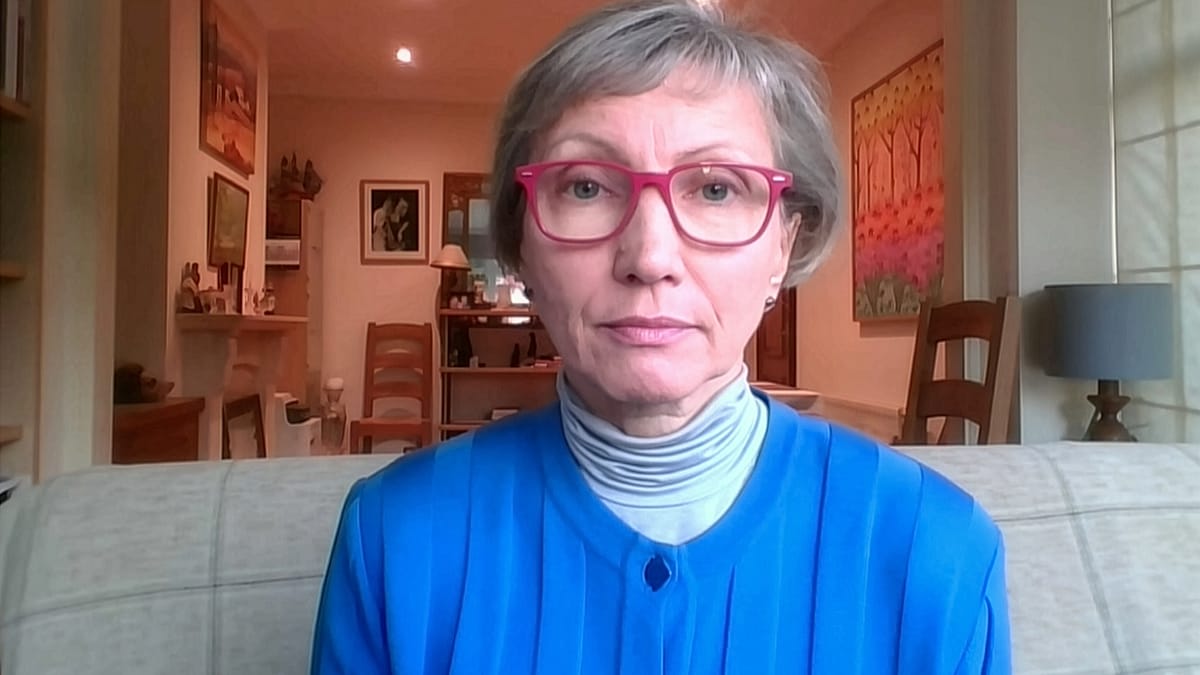
Twenty years after the assassination of former Russian intelligence officer Alexander Litvinenko in London, his widow Marina Litvinenko has warned that the West's muted response emboldened Vladimir Putin and set the stage for Russia's full-scale war against Ukraine. In an interview with Euronews, she described the killing as "the first act of nuclear terrorism in London" and criticised the international community for failing to react with sufficient seriousness.
"And what was the reaction? It was not a very serious reaction at all. And what we have now? We have a war in Ukraine," she said. Litvinenko's comments come as Western governments, led by the United States, debate the terms of any future negotiations with Moscow over Ukraine.
A murder that shocked the world
Alexander Litvinenko, a former FSB officer turned outspoken Kremlin critic, fled Russia with his family in 2000 and received political asylum in Britain the following year. From exile, he investigated alleged corruption within Russian intelligence and its links to organised crime. He became a British citizen in October 2006, just weeks before his death.
On 23 November 2006, Litvinenko died at the age of 44 after being poisoned with radioactive polonium-210. Photographs of him lying in a London hospital bed, bald and ravaged by radiation, appeared on front pages worldwide and became a symbol of the dangers facing Putin's opponents even in exile.
Marina Litvinenko recalled her refusal to give up hope: "I still believe to last moment, Sasha will survive and he will continue to fight against this monster who is the president of Russia still now. And I believed he will survive and we will have a future life, but it did not happen. And I always remember how Sasha was strong to last minute of his life."
The assassination exposed the reach of Russian intelligence services and foreshadowed later attacks on European soil, including the 2018 poisoning of Sergei and Yulia Skripal in Salisbury and the 2019 murder of Zelimkhan Khangoshvili in Berlin.
A British public inquiry concluded in 2016 that the murder was carried out by Andrei Lugovoi and Dmitry Kovtun, and that the operation was probably approved by then-FSB chief Nikolai Patrushev and Putin himself. In 2021, the European Court of Human Rights ruled that Russia was responsible for Litvinenko's death and had failed to conduct an effective investigation. Moscow has consistently denied involvement.
Europe's 'business as usual' approach
Marina Litvinenko argued that the weak response in 2006 stemmed from Britain acting alone. "It was not a strong reaction in 2006 because United Kingdom was alone," she told Euronews. Despite the EU's economic strength, European governments were reluctant to jeopardise relations with Moscow, preferring to continue doing business with Putin.
Now, as diplomatic efforts to end the war in Ukraine intensify, she cautioned against repeating past mistakes. Asked whether the West should negotiate with Putin, she said: "Of course you have to negotiate, but not in a way what you allowed Putin to have what he wants. You need to be much stronger and believe in yourself."
She pointed to Ukrainian President Volodymyr Zelenskyy as an example for European leaders. "You can see the Ukrainian president who is very strong in his small country and fighting against this huge country and what everybody believes like a second army in the world. European Union, it's much bigger and stronger. And you just trust yourself."
Her warning resonates with recent developments, including Zelenskyy's sharp criticism of Putin and concerns that some European politicians, such as Marine Le Pen, could fracture support for Ukraine, as noted by campaigner Bill Browder.
Justice must come from Russia
Neither Lugovoi nor Kovtun has faced trial in the UK. While Marina Litvinenko regards the legal proceedings in London and Strasbourg as significant achievements, she believes ultimate accountability must come from within Russia itself. "But justice only happened after Russia will have their own trial against this regime," she said.
She sees the end of the war in Ukraine as a potential turning point, expressing confidence that her husband's case would form a central part of any future prosecution of Putin's government for crimes she attributes to it over the past two decades.
Reflecting on how her husband might view Russia and Europe today, Litvinenko recalled his opposition to Putin's second war in Chechnya and his support for the Chechen independence movement. She described his support for exiled Chechen leader Akhmed Zakayev as part of his efforts to bring about change in Russia. "It was a part of his Russian duty to make Russia possible to change," she said.
Twenty years after his murder, Marina Litvinenko has no doubt where her husband would stand today.