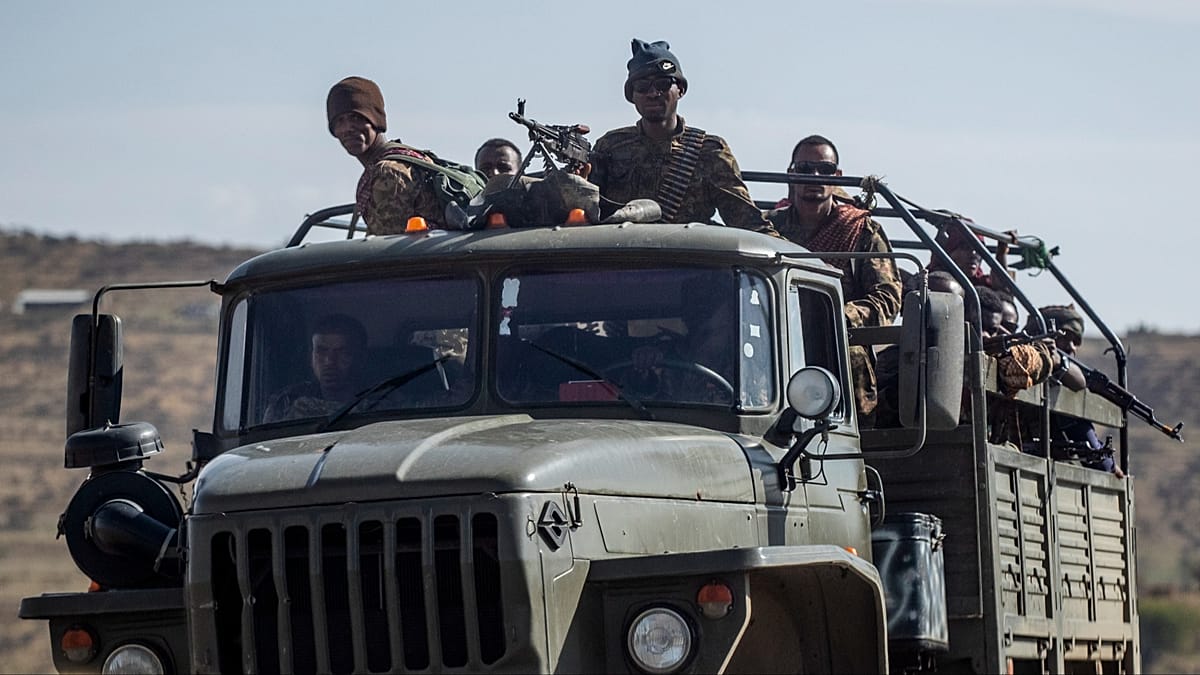
Ethiopian drone strikes have targeted Eritrean military units that had advanced into the northern Tigray region, according to a conflict monitor and local witnesses. The attacks, which took place overnight near the city of Adigrat, destroyed several lorries and prompted Eritrean troops to pull back, escalating tensions between the two Horn of Africa neighbours.
The strikes come as a coalition of seven rebel groups, led by the Tigray People's Liberation Front (TPLF), continues its offensive against Ethiopian federal forces across the north. Fighting has been reported in the Afar and Amhara regions since the coalition announced its latest push last week.
Multiple sources confirmed that Eritrean troops crossed the border earlier this week and took up positions around Adigrat, a strategic town in northern Tigray. The Armed Conflict Location & Event Data Project (ACLED) reported that "Eritrean troops and ammunition" in the Adigrat area were hit by "multiple drone strikes" between Wednesday and Thursday.
One witness, speaking on condition of anonymity, told AFP: "There were many, many drone strikes yesterday. Some Eritrean lorries have been destroyed. They are no longer in the streets." Another resident described hearing a "massive explosion during the night" and seeing Eritrean military vehicles that had been struck by a drone. A third witness said Eritrean troops appeared to be retreating northward.
A fragile peace unravels
The relationship between Ethiopia and Eritrea, which fought a bitter border war from 1998 to 2000, has deteriorated sharply in recent months. Ethiopia accuses Eritrea of backing the rebel coalition in Tigray, while Eritrea denies the charge and in turn accuses Addis Ababa of supporting Eritrean opposition groups and seeking a pretext to invade and seize direct access to the Red Sea.
Last week, Ethiopia expelled Eritrean diplomats, and Eritrea severed diplomatic ties. Eritrean Information Minister Yemane Meskel wrote on X that Ethiopia was "openly working to bring about regime change in Eritrea by providing shelter and support to certain mercenaries who claim to be opposition." Neither government has responded to questions about the latest fighting.
The current crisis marks a sharp reversal from the brief period of rapprochement that followed Prime Minister Abiy Ahmed's rise to power in 2018. Abiy's peace overtures to Eritrea earned him the Nobel Peace Prize in 2019, and Eritrean forces even fought alongside the Ethiopian military during the 2020–2022 civil war against the TPLF.
But the alliance soured quickly. Eritrea was angered by the terms of the peace agreement that ended that conflict, and later by Ethiopia's claims that it has a right to sea access. Abiy's rhetoric escalated to the point of calling Eritrea's independence a "mistake," while Ethiopia accused Eritrean troops of committing atrocities against civilians during the Tigray war.
Eritrea responded by accusing Ethiopia of "floating false flags to justify the war that it has been itching to unleash for two long years." Tensions spiked again in February when Addis Ababa alleged that Eritrea had sent troops across the border, a claim Asmara dismissed as "false."
In the latest escalation, Ethiopia has also pointed fingers at Sudan and Egypt, accusing them of supporting the TPLF-led alliance. The wider regional dimension is worrying observers, who fear the conflict could draw in multiple states and destabilise the Horn of Africa.
For European policymakers, the unfolding crisis is a reminder of the fragility of peace in a region where the EU has invested in development and migration cooperation. The bloc has previously mediated in Ethiopian affairs, and any escalation could have knock-on effects for refugee flows and security in the Red Sea corridor, an area already tense due to Yemeni forces pushing toward Bab el-Mandeb.
As the situation develops, the international community is watching closely. The African Union has called for restraint, but with both sides seemingly unwilling to back down, the risk of a full-scale regional war remains high.