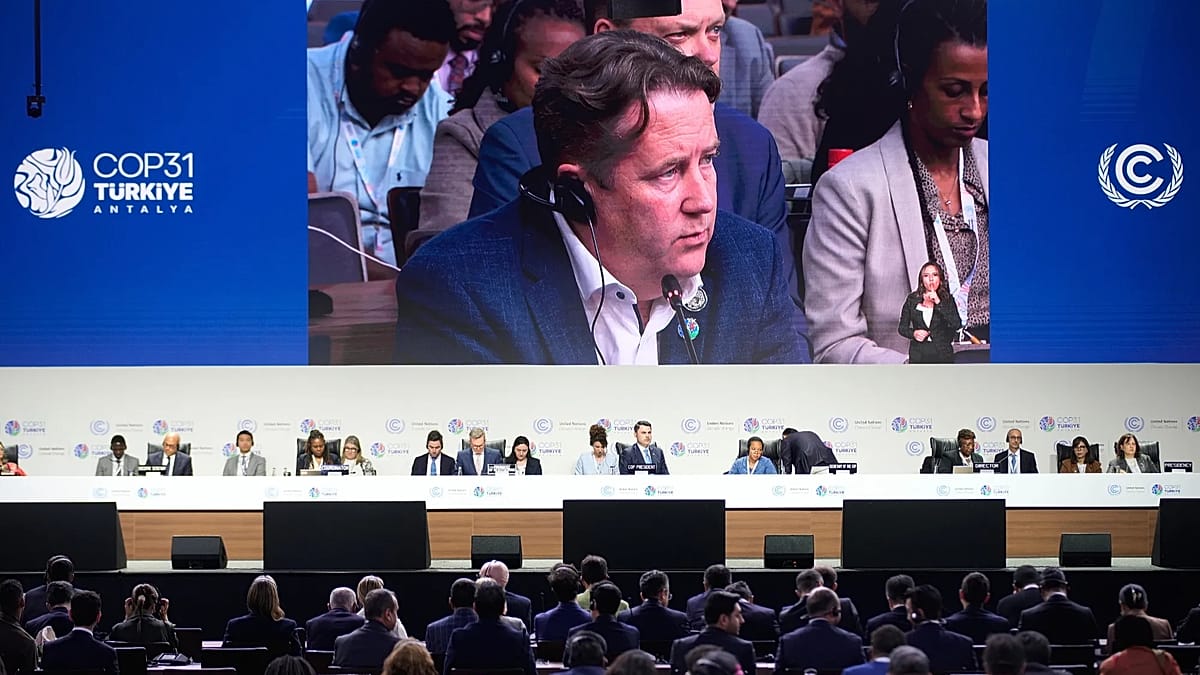
The COP31 climate summit in Antalya, Turkey, concluded on Sunday without an agreement, after the European Union and a coalition of nations rejected a final draft proposal that omitted any reference to fossil fuels. The breakdown marks a significant setback for global climate diplomacy and leaves the fight against rising emissions in a precarious state.
Murat Kurum, Turkey's Environment Minister and President of COP31, acknowledged the failure in the closing session. "I understand that there is no agreement on this text. For that reason, these decisions have not been adopted," he told delegates, bringing an end to talks that had already stretched two days beyond their scheduled finish, making it the longest UN climate conference on record.
The core dispute revolved around the treatment of fossil fuels. A draft released early Sunday had been intended as a compromise, but it followed a turbulent week in which an earlier version calling for an accelerated phase-out of coal, oil, and gas was replaced by a second text that removed all such language. That reversal prompted a group of countries, including France and Panama, to issue a letter on Friday insisting that any final deal must include "a clear transition away from fossil fuels."
Ireland's climate minister Darragh O'Brien, whose country currently holds the rotating EU presidency, was unequivocal in his rejection. "The EU will not endorse a cover decision, or an Antalya Pact, that does not even mention fossil fuels, which is the key driver of climate change," he said. He added that the EU and its member states "object" to the draft because it "does not meet the moment."
The EU's stance reflects a broader frustration among many delegations that the final text had been watered down to appease fossil fuel producers. The fossil fuel dispute that blocked a deal had been brewing for days, with negotiators from small island states and European nations alike pressing for stronger commitments.
UN Secretary General António Guterres did not hide his disappointment. "I share the very profound frustration of all those who expected governments to rise to the moment the climate crisis demands," he said in a statement. "Those who profit from the destruction of our planet must never dictate the terms of the fight to save it. Fossil fuels are driving the climate crisis."
Australian Climate Minister Chris Bowen, who led the negotiations, also expressed regret. "Unfortunately, we were unable to reach agreement on a cover decision... And that's disappointing. Very disappointing," he said. Bowen's role had been seen as crucial in bridging the gap between major emitters and vulnerable nations, but the final push proved unsuccessful.
What went wrong in Antalya
The collapse of COP31 is a stark reminder of the deep divisions that persist in global climate politics. While the EU and many other parties insisted on a clear commitment to move away from fossil fuels, a bloc of oil- and gas-producing nations resisted any language that could be seen as a binding commitment to phase out their primary revenue sources. The draft that omitted fossil fuels was seen by many as a capitulation to those interests.
Observers noted that the failure is particularly damaging given the urgency of the climate crisis. The Intergovernmental Panel on Climate Change has repeatedly warned that global emissions must peak by 2025 and decline sharply thereafter to limit warming to 1.5°C. Without a strong signal from COP31, the world risks falling further behind on its Paris Agreement commitments.
Despite the overall failure, there were some signs of progress on climate action in the margins of the talks. Several countries announced new national climate plans, and there were breakthroughs on financing for adaptation in vulnerable regions. However, these were overshadowed by the lack of a consensus on the central issue of fossil fuels.
The EU's role in the talks was closely watched, given its self-appointed leadership in global climate policy. The bloc had pushed for a strong outcome, but its refusal to accept a weak text was a calculated risk. Some analysts argue that walking away was better than endorsing a deal that would have set a dangerous precedent. Others, however, point out that the absence of any agreement leaves a vacuum that could be exploited by those seeking to delay action.
As delegates left Antalya, the mood was sombre. The next COP, scheduled for 2027, will be held in a yet-to-be-determined location, and the task of rebuilding trust will be formidable. For now, the world is left with the uncomfortable reality that the most important climate talks in years have ended in failure, and the window for meaningful action is closing fast.