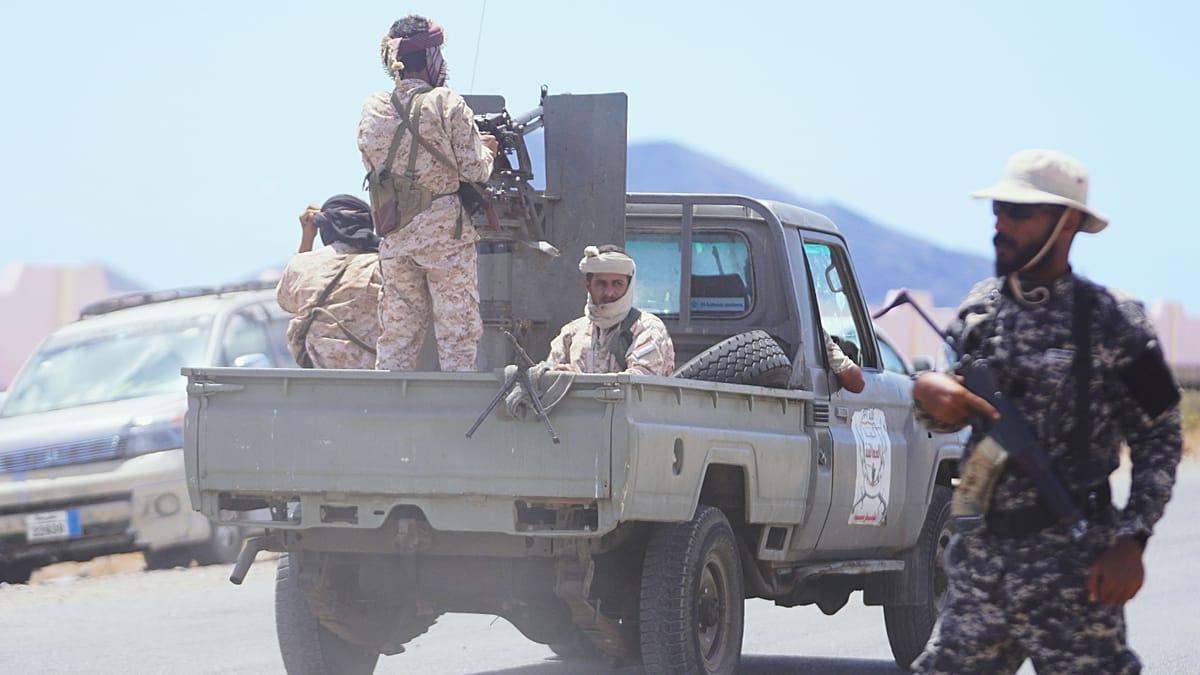
Yemeni government forces, backed by a Saudi-led coalition, have launched a major offensive to reclaim territory around the strategic Bab el-Mandeb strait, a vital chokepoint for global maritime trade. The push, dubbed Operation Yemen Dawn, comes amid a sharp escalation in the long-running conflict, with Houthi forces claiming strikes on Saudi Arabia and regional powers moving to bolster Riyadh's defenses.
On Monday, Yemeni officials said government troops recaptured the town of Dhubab, located just north of the strait, as well as the towns of Bab and Hadeid. Witnesses reported seeing tanks and military convoys entering the areas. The operation was conducted under heavy air cover provided by the Saudi coalition, which said it deployed 100 fighter jets to support the ground advance.
The Houthis, formally known as Ansar Allah, responded with a series of claimed attacks on Saudi territory. In a pre-recorded statement, the group's military spokesman, Brigadier General Yahya Saree, said ballistic and cruise missiles as well as drones were used to target King Khalid International Airport in Riyadh, an oil refinery in Rabigh, Abha airport, and military installations in Khamis Mushait, Najran, and Jizan. The US Embassy in Riyadh warned American citizens to remain vigilant against possible drone or missile strikes.
The renewed fighting has shattered a fragile four-year ceasefire and revived fears of a wider regional conflagration. The Houthis have made significant territorial gains in recent weeks, capturing the strategic port city of Mokha and several Red Sea islands, giving them control over the Yemeni side of the Bab el-Mandeb, through which an estimated 12% of global trade passes. On Sunday, they seized the town of Turbah, a key supply hub on the road linking Taiz, Yemen's third-largest city, with the interim government seat in Aden.
Regional powers step in
In a sign of the conflict's widening scope, Pakistan and Turkey agreed on Monday to deploy military forces to Saudi Arabia under their existing defence pacts. The announcement followed an emergency meeting in Riyadh attended by the foreign and defence ministers of both countries. A joint statement condemned what it described as attempted attacks on Mecca and Medina, as well as continuing strikes on Saudi cities and civilian infrastructure, though it did not specify who was responsible.
The Saudi-backed Yemeni government has called for international support as it seeks to reverse Houthi gains. Rashad al-Alimi, head of the Presidential Leadership Council, said in a televised address that the offensive aims to "restore state institutions" and liberate the capital, Sana'a, which has been under Houthi control since 2014. Saudi coalition spokesman Major General Turki al-Malki vowed "full operational support" until the Houthis are "eliminated."
The Houthis' capture of Turbah is likely to complicate government efforts to reinforce and resupply front-line positions across Taiz province, according to the Institute for the Study of War, a Washington-based think tank. The group has also been advancing on the western coast, threatening to encircle Taiz city itself.
The humanitarian toll is mounting. According to the World Health Organization, at least 959 people have been killed and over 4,200 wounded in the latest escalation. The UN migration agency reports that nearly 174,000 people have been displaced within Yemen, while more than 3,000 have fled across the Red Sea to Djibouti. Yemen's health ministry, part of the internationally recognised government, warned that medical facilities in Taiz province have closed or are barely functioning.
UN Secretary-General António Guterres expressed deep concern over the escalation and condemned continued Houthi cross-border attacks on Saudi Arabia. The Houthis are widely seen as part of Iran's so-called Axis of Resistance, a network of militant groups across the region, including Hezbollah in Lebanon and Hamas in Gaza, all supported to varying degrees by Tehran's Islamic Revolutionary Guard Corps.
The conflict, which began in 2014 when the Houthis seized Sana'a and forced the government into exile, has already caused one of the world's worst humanitarian disasters, with more than 150,000 deaths. The latest offensive threatens to plunge the country back into full-scale war, with regional powers increasingly drawn into the fray. As European nations watch the situation closely, the stability of the Bab el-Mandeb strait remains a critical concern for global energy supplies and trade routes.