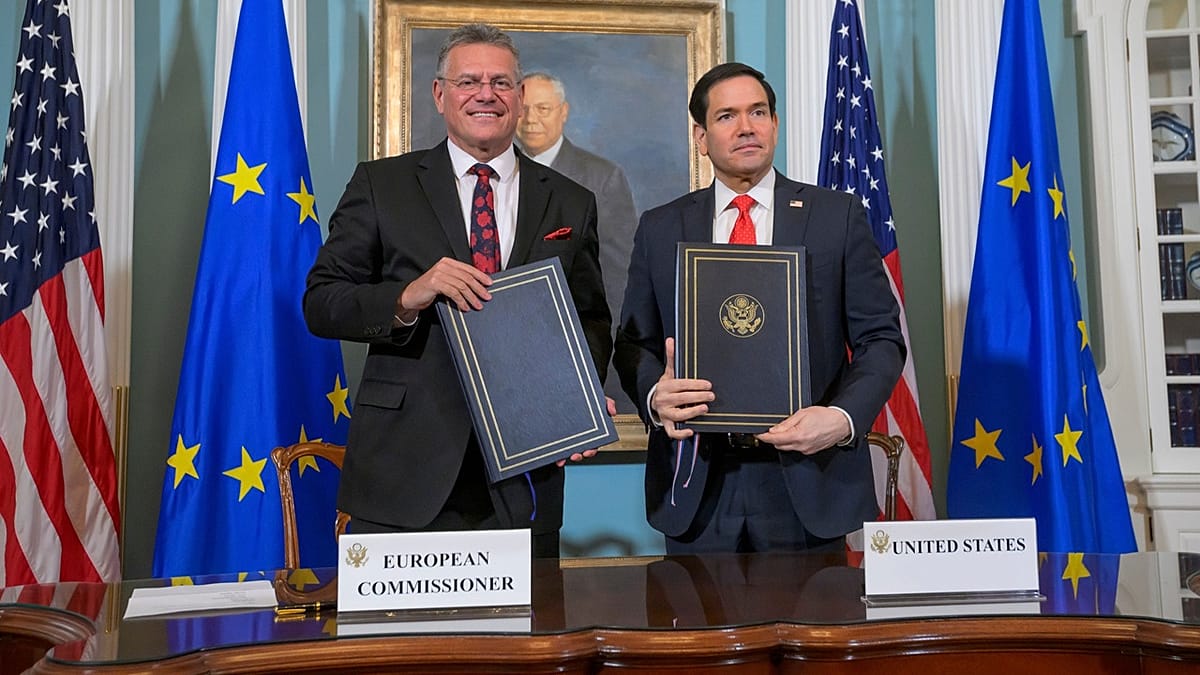
In a move to reduce strategic dependence on Beijing, the European Union and the United States signed a Memorandum of Understanding (MOU) on Friday to deepen cooperation on critical minerals. The agreement, signed by US Secretary of State Marco Rubio and EU Trade Commissioner Maroš Šefčovič at the State Department in Washington, aims to secure supply chains for materials essential to defence, semiconductors, and electric vehicle batteries.
Rubio underscored the geopolitical stakes, noting that the over-concentration of these resources in a handful of countries poses an unacceptable risk. “We need diversity in our supply chains. Diversity in the places where they're critical in the world,” he said. The MOU is part of a broader US strategy that has already seen similar pacts with Mexico, Japan, and a supply framework with Australia and others.
Šefčovič expressed confidence that the partnership would accelerate progress. “I believe that we will be even more strategic together. We will be delivering on our goals much faster than before,” he stated. The agreement is a rare instance of cooperation between the Trump administration and the EU, which the White House has often criticised while championing right-wing populists within Europe.
Countering China's Grip on Critical Minerals
Beijing has increasingly used export restrictions on critical minerals as a lever in trade and geopolitical disputes, affecting industries from semiconductors to weapons systems. The EU and US aim to coordinate subsidies, stockpiles, and joint standards to ease trade across the Western world, as well as invest in research. The Trump administration has previously called for a preferential trade zone among allies on critical minerals, a concept that now gains concrete form through this MOU.
The pact also reflects a shared concern over market overcapacity, particularly in steel. Šefčovič noted that both the EU and US face challenges from cheap Chinese exports, and the bloc recently doubled tariffs on foreign steel to protect its industry. “As a next step, we want to launch work with the US on steel ring-fencing, aligning our approaches towards third countries,” he added.
Steel Tariffs Remain a Sticking Point
Despite the positive momentum on critical minerals, transatlantic trade tensions persist. Since returning to the White House, President Trump has imposed a sharp 50-percent tariff on steel and aluminum imports from Europe, hitting manufacturers across the continent. While a deal last summer set US tariffs at 15 percent for most EU goods, steel and aluminum were excluded.
Šefčovič said talks with US Commerce Secretary Howard Lutnick are “going in a positive direction” and that they agreed to accelerate technical-level work. However, he acknowledged that “we still have some issues with the remaining products which are listed” and stressed the importance of “positive traction” on the matter. The EU is seeking to align approaches with the US towards third countries on steel trade, a step that could help stabilise the market.
The agreement on critical minerals marks a significant step in EU-US cooperation, but the unresolved steel tariffs highlight the fragility of the broader trade relationship. As both sides work to reduce reliance on China, the success of this partnership will depend on sustained political will and concrete implementation.



