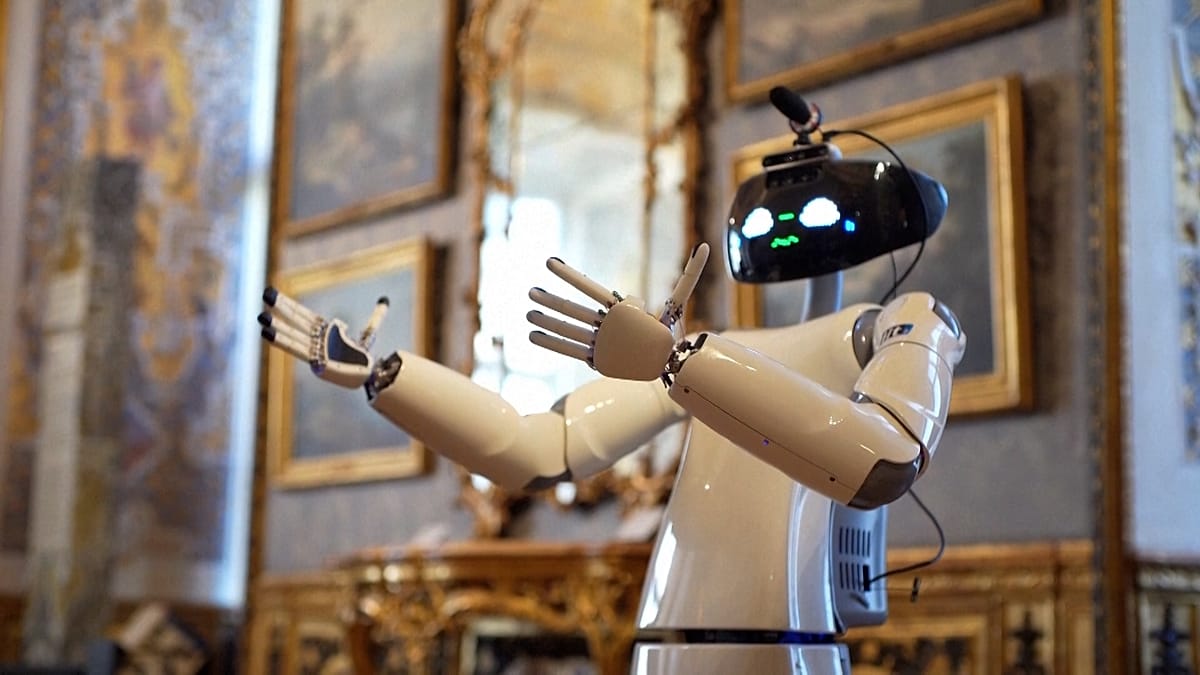
Italy has begun testing the R1 robot guide at Turin's historic Palazzo Madama, a museum housed in a building that spans Roman, medieval, and Baroque eras. The pilot project aims to reduce visitor congestion and enhance accessibility, offering an alternative to traditional human-led tours.
The R1 robot, developed by Italian robotics firm Oversonic, navigates the museum's galleries and provides explanations of artworks and artifacts in multiple languages. It is designed to handle high-traffic periods and offer personalized routes, allowing visitors to explore at their own pace.
Blending Technology with Cultural Heritage
Palazzo Madama, a UNESCO World Heritage site, attracts hundreds of thousands of visitors annually. The museum's director, Giovanni Battista, stated that the robot is not intended to replace human guides but to complement them, particularly during peak hours. "We want to make culture more accessible without sacrificing the human touch," he said.
The R1 robot uses artificial intelligence to answer questions and adapt its commentary based on visitor interest. It can also provide real-time data on crowd density, helping staff manage flow through the museum's narrow corridors and historic staircases.
This initiative is part of a broader trend across Europe, where museums are increasingly adopting robotic guides. For instance, the Louvre in Paris and the Rijksmuseum in Amsterdam have experimented with similar technologies. However, Italy's trial is notable for its focus on a historic building with complex architecture.
The project has drawn attention from other Italian cultural institutions, including the Uffizi Gallery in Florence and the Vatican Museums, which are considering similar deployments. As Spain prepares for a wave of new museums and cultural investments in 2026, the competition to integrate technology into heritage sites is intensifying across the continent.
Critics, however, raise concerns about the potential loss of human interaction and the risk of technical failures. "A robot cannot replicate the passion and nuance of a trained art historian," said Maria Rossi, a cultural commentator based in Milan. "But it can serve as a useful tool for basic orientation and information."
The trial runs through the end of 2025, after which the museum will evaluate visitor feedback and operational data. If successful, the R1 could become a permanent fixture at Palazzo Madama and inspire similar projects elsewhere in Italy.
Italy's experiment with robotic guides also reflects broader challenges in European cultural tourism. As visitor numbers rebound post-pandemic, many museums are grappling with overcrowding and staffing shortages. The R1 robot offers a scalable solution that could help preserve the visitor experience while protecting fragile artworks from the wear and tear of large crowds.
For now, visitors to Palazzo Madama can encounter the R1 robot in the museum's main galleries, where it stands out against the backdrop of centuries-old frescoes and gilded frames. Whether this fusion of technology and tradition will become a model for other European museums remains to be seen, but the trial marks a significant step in the ongoing digital transformation of cultural heritage.



