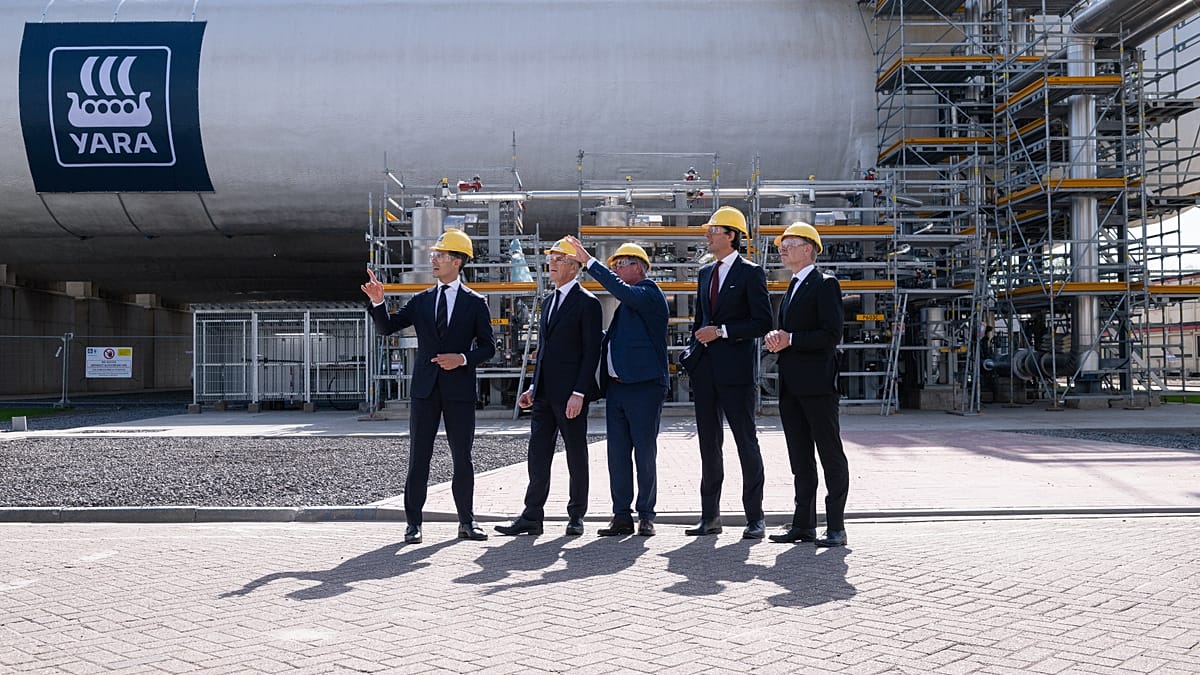
At a ceremony this week, the Dutch fertiliser producer Yara unveiled what it calls the largest commercial carbon capture and storage (CCS) project in Europe. The facility in Sluiskil, in the province of Zeeland, will capture 800,000 tonnes of carbon dioxide annually, liquefy it, and ship it to a storage site beneath the Norwegian seabed. The project received significant financial backing from the European Commission, and the EU's climate commissioner attended the inauguration alongside the prime ministers of the Netherlands and Norway.
The Commission frames the investment as a strategic step toward industrial decarbonisation. But environmental groups and energy analysts are pushing back, arguing that CCS remains technically uncertain, extremely expensive, and reliant on public subsidies. They warn that pouring billions into this technology could delay more effective climate action.
What is carbon capture and storage?
CCS encompasses technologies that either prevent CO2 from entering the atmosphere or remove it after emission. Most projects, including Sluiskil, use a chemical solvent to strip CO2 from industrial exhaust gases. The captured gas is then compressed into a liquid-like state and transported—usually by pipeline or ship—to a geological formation where it is injected deep underground. Some variants, known as CCUS, convert the CO2 into products like building materials or synthetic fuels.
According to Carbon Brief, there were 75 operational CCS projects worldwide as of February 2026, capturing a combined 62.5 million tonnes of CO2 per year—roughly 0.2% of global emissions in 2025. The vast majority of these projects are attached to fossil-fuel extraction and processing sites.
Yara's CEO, Svein Tore Holsether, said the Sluiskil facility proves that large-scale industrial decarbonisation is possible today. Yet the cumulative impact remains minuscule compared to the scale of the climate challenge.
A technology born from oil extraction
CCS has its roots in the early 1970s, when US and Canadian oil companies began injecting CO2 into depleted wells to squeeze out additional crude—a practice known as enhanced oil recovery. Today, about three-quarters of captured CO2 is used for this purpose, meaning the technology often helps the fossil-fuel industry extract and sell more oil and gas.
Andrew Reid, an energy finance analyst at the Institute for Energy Economics and Financial Analysis (IEEFA), said that despite growing political and financial support over the past three to four years, CCS remains “technically uncertain, very high cost, and reliant upon huge subsidies to move from feasibility to construction and operation.”
How did the EU come to fund it?
Critics have long argued that CCS is a way for polluters to continue business as usual. Rachel Kennerley, senior international carbon capture campaigner at the Center for International Environmental Law (CIEL), said: “All capture and storage projects suffer from the same problem: they distract attention and resources from cutting emissions at source and give polluting industries like fertiliser production a pass to keep on polluting.”
Belén Balanyá, a researcher at Corporate Europe Observatory (CEO), has tracked fossil-fuel lobbying for 25 years. She found that around 500 CCS lobbyists attended COP29 in 2024, and that at COP28, CCS proponents secured a significant victory with the endorsement of “abatement and removal technologies” in the final agreement. Balanyá said that for fossil-fuel industries, CCS is an “escape hatch to stay in business,” adding that they turn to it “when they’ve been forced to—when there’s more knowledge and more acceptance about climate change and their role and that they have to decarbonise.”
The European Commission set up the CCUS Forum (now the Industrial Carbon Management Forum) in 2021, with working groups that feed directly into EU policymaking. CEO found that every group has been co-chaired by fossil-fuel industry representatives or associated organisations.
A recent report from the UN Environment Programme (UNEP) assessed carbon dioxide removal technologies and found persistent issues, including whether they can scale sustainably given costs, land and energy use, whether the CO2 would remain stored permanently, and who is responsible for regulation and leaks.
Even some supporters of CCS acknowledge that it is not a silver bullet. The debate is likely to intensify as the EU continues to invest in projects like Sluiskil, which some see as a necessary bridge for hard-to-abate industries, while others view it as a costly distraction from the urgent need to reduce emissions at the source.