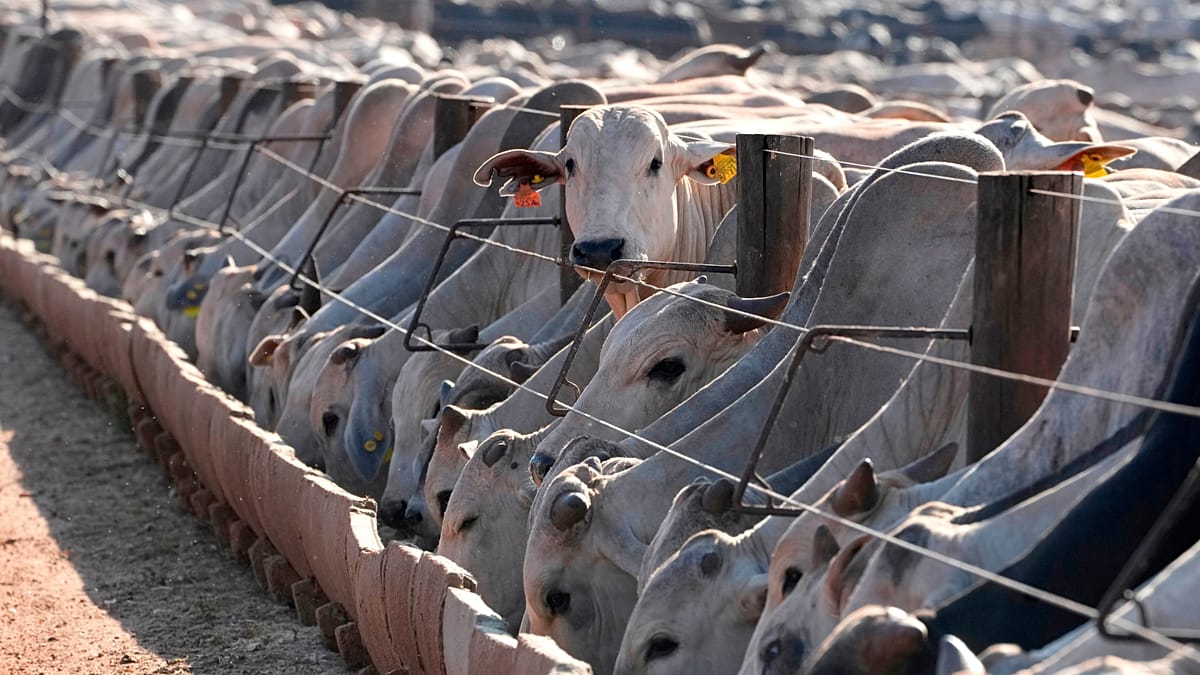
From 3 September, Brazilian meat will be banned from entering the European Union following a unanimous vote by experts from EU member states. The reason: antimicrobial drugs used by Brazilian producers to promote growth and increase profitability. The ban comes despite the EU-Mercosur trade deal, which took provisional effect on 1 May.
Brazil is the world's largest beef exporter, shipping 3.5 million tonnes globally in 2025 and earning a record $18 billion (€15.3 billion) — a 40 per cent increase on the previous year. The EU was the fourth-largest destination, importing 128,900 tonnes worth over €850 million, a 132 per cent surge compared to 2024.
Antimicrobials: A Sticking Plaster for Poor Welfare?
Animal welfare groups argue that the focus on antimicrobials misses a deeper problem. “The problem is not the antibiotics that are available to use in animals, but the systems we put them in and the way we manage those systems,” says Dr Elena Nalon, Scientific Lead at Eurogroup for Animals, which represents more than 100 animal protection organisations. Sabrina Gurtner from the Animal Welfare Foundation adds that antimicrobials might not need to be so widely used if the industry adopted “more humane farming systems where stress is minimised and animals are allowed to perform their natural behaviours”.
The European Food Safety Authority states that good welfare helps keep animals healthy, while stress and poor welfare can increase susceptibility to transmissible diseases. Campaigners argue that antimicrobials are a band-aid for overcrowding, poor housing, and weak breeds — conditions that create disease pressure in the first place.
While growth-promoting antimicrobials are strictly controlled within the EU, they remain allowed or weakly regulated in parts of Latin America, Asia, and some African countries. Brazil recently banned five antimicrobials, but only for meat sold domestically; meat destined for export could still be fed these drugs. According to DatamarNews, the EU ban was based on Brazil failing “to provide the rigorous life-cycle traceability required to meet the EU’s 2019 veterinary standards”.
The Public Health Threat
Antimicrobial resistance (AMR) is a major concern. The World Health Organization classifies it as “one of the top global public health threats”, naming it the direct cause of 1.27 million deaths worldwide in 2019, and contributing to another 4.95 million. The EU estimates around 35,000 deaths per year in Europe are caused by AMR. The European Commission calculates that AMR costs about €1.5 billion annually in healthcare costs and lost productivity.
The WHO identifies “the misuse and overuse of antimicrobials” in animals as a key driver of drug-resistant pathogens. When antimicrobials are overused in livestock, resistant bacteria can spread to humans through the food chain, direct contact, or the environment, making common infections harder or impossible to treat.
Responding to the ban, the Brazilian government said it will “promptly take all necessary measures to reverse this decision”, in a joint statement from its Agriculture, Trade and Foreign Relations ministries.
The EU-Mercosur deal, negotiated for over 25 years, cuts South American tariffs on European cars, clothes, food, fine wines, and medicines. In exchange, the EU opens its markets to South American agricultural exports, with limits on beef, pork, ethanol, honey, and sugar — an additional 99,000 tonnes of beef per year. Many EU farmers have protested the deal, viewing it as unfair competition. For more on the trade tensions, see our coverage of the EU ban on Brazilian meat imports.
Animal welfare groups are now calling for a fundamental shift in farming systems. As Dr Nalon puts it, “The problem is that this practice can help normalise systems where animals are kept under conditions that create disease pressure in the first place.” The debate highlights a broader question: whether the EU's strict food standards can be reconciled with trade deals that open the door to products from countries with weaker regulations.