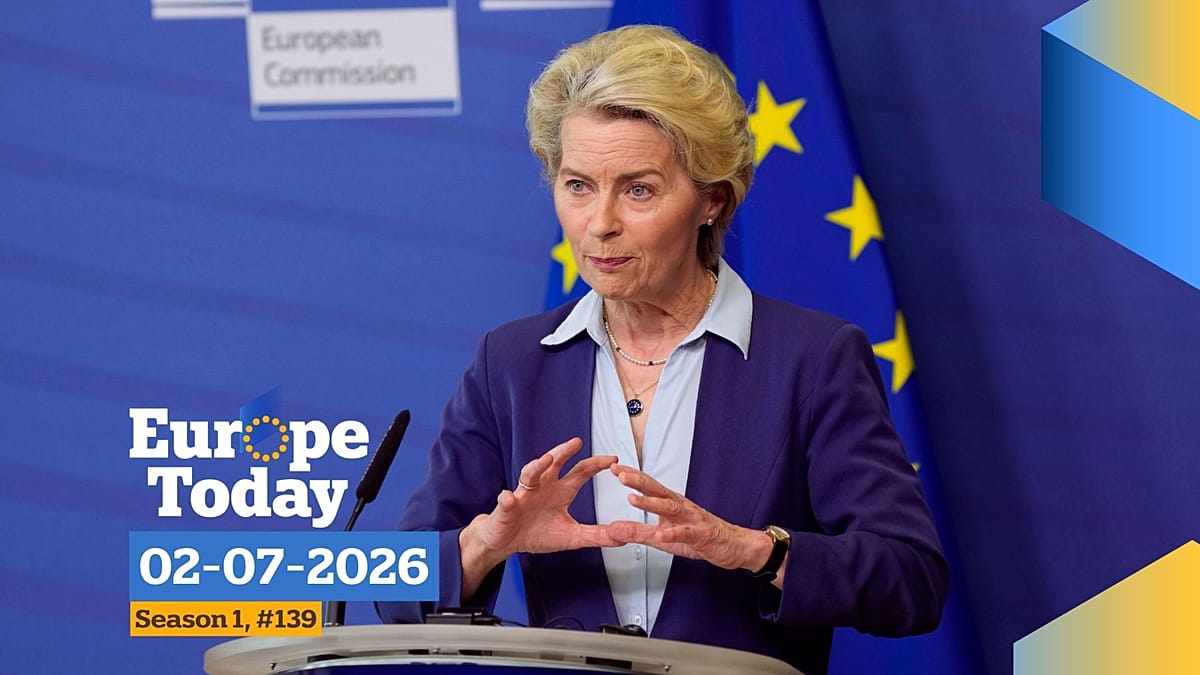
The European Union's internal tug-of-war over its next multi-year budget will be on full display today at the Annual EU Budget Conference in Brussels. The gathering brings together finance ministers, European commissioners, and MEPs to debate the bloc's spending priorities for the 2028–2034 period, a negotiation that traditionally pits net contributors against net beneficiaries and pits traditional policy areas against newer ambitions.
Euronews correspondent Angela Skujins reports from the conference that the central fault line runs between member states demanding fiscal restraint — led by Germany, the Netherlands, and Austria — and those in southern and eastern Europe pushing for increased cohesion funds and agricultural subsidies. The conference is the first major public debate since the European Commission presented its preliminary proposals in June, which called for a budget of roughly €1.3 trillion, including new dedicated funds for defence, climate adaptation, and digital sovereignty.
Bulgarian Deputy Prime Minister Atanas Pekanov, who oversees EU funds management in Sofia, told Euronews that Sofia sees the next budget as a chance to lock in long-term support for infrastructure and green transition projects. "We cannot afford a repeat of the delays we saw in the 2021–2027 programming period," Pekanov said. "The new budget must be simpler, more flexible, and disbursed faster."
Ireland Takes the Helm
Separately, Ireland formally assumed the rotating presidency of the Council of the European Union today, taking over from Cyprus. The six-month term will see Dublin steer ministerial meetings and mediate between member states on legislative files, with the budget negotiations expected to dominate the agenda through the first half of 2025. Cyprus handed the presidency to Ireland after a term focused on the Middle East crisis and the early stages of the budget talks.
Irish Prime Minister Leo Varadkar, speaking at a ceremony in Dublin Castle, said his government would prioritise "a fair and ambitious budget that supports jobs, peace, and the green transition." Ireland has historically been a net beneficiary of EU funds, but its strong economic growth in recent years has shifted its position closer to that of a net contributor, a change that could influence its negotiating stance.
The presidency also comes at a sensitive time for EU foreign policy. Ireland has maintained a policy of military neutrality, which sometimes puts it at odds with other member states on defence spending. The budget conference will test whether Dublin can reconcile its traditional stance with the bloc's growing emphasis on strategic autonomy and defence investment.
Venezuela Earthquake Response
On the humanitarian front, Euronews' Lauren Walker spoke to João Almeida da Silva, the EU's head of aid operations in Venezuela, about the aftermath of the devastating earthquakes that struck the country last week. Almeida da Silva reported that the EU has released €3 million in emergency funding and is coordinating with local authorities to deliver shelter, clean water, and medical supplies to affected areas. "The situation remains critical, especially in the states of Mérida and Táchira, where infrastructure damage is severe," he said. "We are working around the clock to reach isolated communities."
The EU's humanitarian aid arm, ECHO, has deployed a team of experts to assess needs on the ground. The crisis in Venezuela, already grappling with economic collapse and political instability, has been compounded by the earthquakes, which have killed at least 150 people and displaced thousands.
Eurobarometer: European Sentiment
In a separate development, the latest Eurobarometer survey, analysed by Jakub Janas, reveals that public support for the European Union remains high, with 72% of respondents saying their country has benefited from EU membership. However, the survey also highlights growing concern over the cost of living and climate change, with 68% of Europeans saying the EU should do more to tackle rising prices. The findings come as the European Central Bank signals that interest rates may remain elevated for longer than previously expected.
The survey also shows a slight uptick in support for EU enlargement, particularly in the Western Balkans, where 55% of respondents across the bloc now favour admitting new members. This shift could influence the budget debate, as some member states argue that enlargement would require a larger budget to accommodate new members' needs.
World Cup Knockout Stage
Finally, the FIFA World Cup continues to capture attention across Europe as the knockout stage unfolds. Several European teams remain in contention, with matches drawing large audiences and sparking celebrations — and occasionally tensions — in cities from Amsterdam to Marseille. Morocco's victory earlier in the tournament led to clashes in Dutch cities, underscoring the passionate and sometimes volatile intersection of sport and diaspora identity.
The Europe Today programme airs daily at 19:00 CET on Euronews. Today's episode includes all of the above segments, plus analysis from the studio panel.