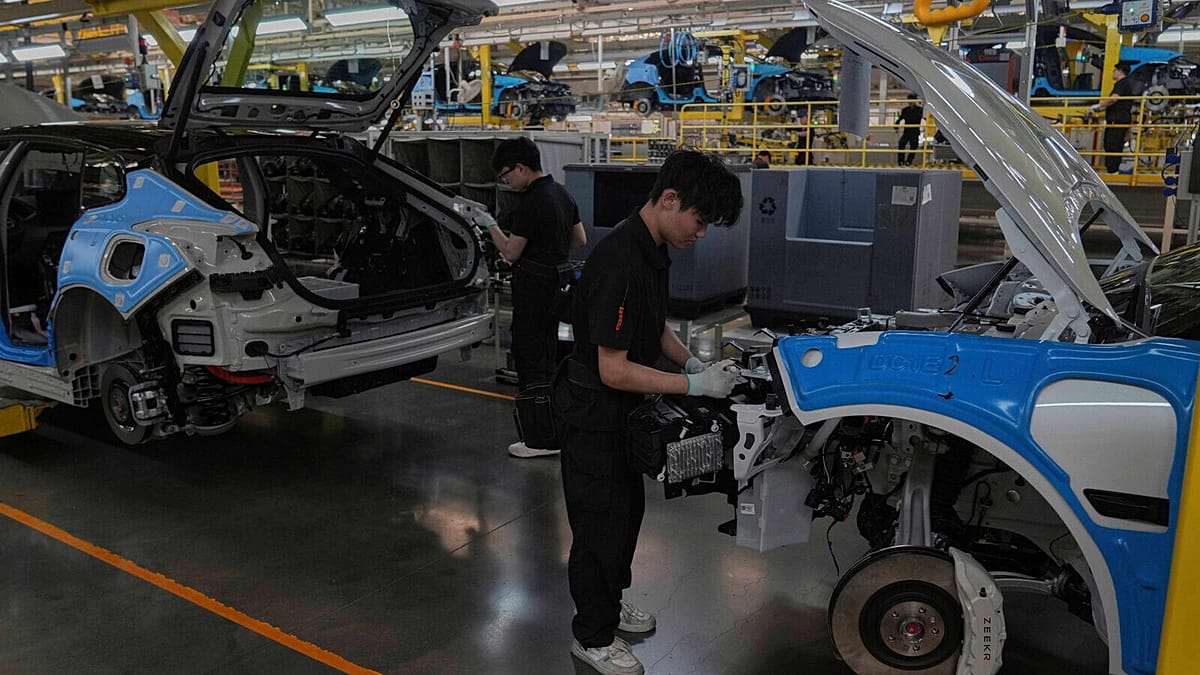
Manfred Weber, the chairman of the centre-right European People’s Party (EPP), has warned that the European Union is heading into a trade conflict with China unless a deal to address the ballooning trade deficit is reached by October. Speaking to Europe Today, Weber called for a “fundamentally changed” approach to Beijing, insisting that “the Chinese must understand … we cannot allow this. We are the continent of trade, the free market, but it must be fair and it must be a level playing field.”
EU Trade Commissioner Maroš Šefčovič confirmed on Monday that Brussels would seek a pact with China by October to tackle the growing trade imbalance, as concerns mount over the impact of Chinese industrial overcapacity on Europe’s struggling industries. The warning comes as the bloc implements new steel quotas and tariffs aimed at curbing global overcapacity entering the EU market, with China particularly targeted as the source of most of the global steel surplus.
New Steel Tariffs and E-Commerce Duties Take Effect
As of today, the EU’s revised steel safeguard measures come into force, allocating 18.3 million tonnes of tariff-free quotas annually. After weeks of lobbying, trading partners with free trade agreements—including India, the United Kingdom, and Switzerland—secured preferential treatment, with 9.15 million tonnes reserved exclusively for them. The remaining 9.15 million tonnes will be available for other foreign countries, with China facing the brunt of the restrictions. Beyond the quota, steel imports to the EU will be subject to a 50% tariff, a protectionist move pushed by the industry as job cuts loom and production capacities are reduced across the bloc.
Simultaneously, a flat €3 customs duty on low-value e-commerce imports takes effect today. Until now, goods imported into the EU worth under €150 were exempt from customs duties. This temporary measure targets small parcels entering the bloc largely through platforms such as Temu, SHEIN, and AliExpress. The European Council describes the move as addressing “unfair competition” for European retailers, as well as concerns over unsafe products, fraud, and the environmental impact of vast volumes of cheap, mainly Chinese, imports. The EU receives over two billion e-commerce packages worth under €150 annually, with up to 65% of parcels entering with misdeclared values or unverified safety profiles.
Ireland Takes Over EU Presidency Amid Scrutiny
In other developments, Ireland has assumed the rotating six-month presidency of the EU Council, succeeding Cyprus. Under the Gaelic slogan “Ní neart go cur le chéile” (“Strength with unity”), Dublin will steer negotiations among the 27 member states and craft compromises on issues ranging from Ukraine’s accession to the next EU budget. President Volodymyr Zelenskyy arrived in Dublin today to join the opening ceremony at Dublin Castle, underscoring the centrality of Ukraine to Ireland’s agenda.
However, Ireland faces intense scrutiny over its alumina sales to Russia, a situation that has drawn criticism given its role as EU president. The government has launched a probe to clarify the allegations and promised to share findings with the European Commission. As one analyst noted, “It’ll be not just about the programme and priorities. Ireland is under intense scrutiny … So it’s possible that, in a few months, Ireland will have to choose between sanctioning alumina and protecting local jobs.”
Von der Leyen in the South Caucasus
European Commission President Ursula von der Leyen is in Baku today for talks with Azerbaijani President Ilham Aliyev, before moving on to Armenia on Thursday to meet re-elected Prime Minister Nikol Pashinyan. This is von der Leyen’s first visit to the South Caucasus since Armenia and Azerbaijan signed their historic peace agreement, with expectations that she will seek to build on the EU’s strategic engagement with the region, formerly in Russia’s orbit.
Ukraine to Buy Gripen Fighter Jets
Ukraine and Sweden have signed an agreement for the purchase of 16 Gripen E fighter jets, covering equipment, maintenance, and support services, President Zelenskyy announced. Delivery is scheduled for early 2029. In addition, under previous agreements with Prime Minister Ulf Kristersson, the first 16 Gripen C/D aircraft will be transferred to Ukraine’s Air Force at the beginning of 2027. The deal comes a day after Poland’s Defence Minister Władysław Kosiniak-Kamysz accused Kyiv of backing out of a promise to share drone technology in exchange for old Polish MiG-29 jets, which Poland had planned to retire as it phases out Soviet-era aircraft in favour of US-designed F-16s and F-35s.
As the EU navigates these trade and geopolitical challenges, the coming months will test the bloc’s ability to balance economic interests with strategic autonomy. For more on the EU’s trade strategy, see our related coverage on EU retaliation plans and the feasibility of the October deadline.