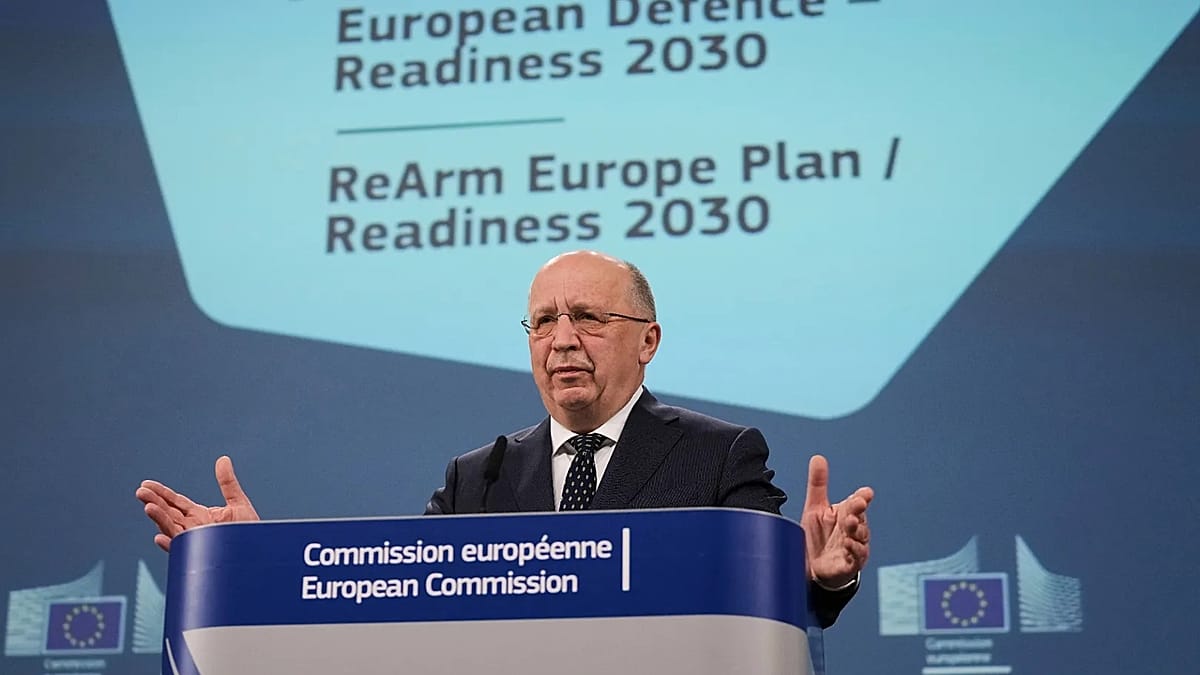
European Commissioner for Defence Andrius Kubilius warned on Tuesday that replacing the military assets the United States is pulling out of Europe will cost the continent approximately €500 billion. Speaking at a public event in Brussels, the Lithuanian commissioner stressed that the European Union must collaborate and start producing the “big items” it needs to defend itself—or face serious consequences.
“We have big defence industrial challenges at the moment for the European Union,” Kubilius said. “German experts just recently calculated that it will cost around €500 billion for Europeans to build those strategic enablers and to replace American strategic enablers now located on the European continent.” He added: “We need a big change of our policies and practices in defence now.”
The figure comes from a paper by the Kiel Institute for the World Economy, which estimates that €500 billion will be needed over the next decade across ten key areas, including air defence, reconnaissance, and strategic airlift. The paper argues that “significant progress toward sovereignty can be achieved within 3-5 years, and a high degree of autonomy can be reached in most areas within 5-10 years—provided these are pursued as a political priority through a concerted European effort.”
US Withdrawal and Rising Threats
Kubilius’s remarks come as the administration of US President Donald Trump continues to reduce America’s military footprint in Europe. Trump recently announced the withdrawal of 5,000 American troops from Germany, part of a broader pullback expected to take six to twelve months. Around 80,000 US troops remain stationed across Europe under NATO auspices, but the cuts have strained transatlantic relations.
Tensions have escalated over Europe’s reluctance to support Washington’s military campaign against Iran. In late April, German Chancellor Friedrich Merz said White House negotiators were being “humiliated” by Iran’s leadership, a comment followed by the announcement of US troop cuts in Germany. US Ambassador to the EU Andrew Puzder told Euronews that Trump is “still disappointed” with Europe over its position, while Trump himself has called NATO allies “cowards” on social media, vowing to “remember” their refusal to assist US forces in the Middle East.
European security agencies have warned that Russia could be ready to attack a NATO ally or EU member state by 2030. The threat has been compounded by the US pullback, making European self-reliance more urgent. Kubilius has repeatedly argued that the EU must produce more defence capabilities faster, and that a “big amount of money” will be required.
FCAS Collapse and European Cooperation
The challenge of European defence cooperation was underscored by the recent collapse of the Franco-German Future Combat Air System (FCAS) programme. Launched in 2017 to replace France’s Rafale jets and the Eurofighter planes used by Germany and Spain, FCAS was meant to include drones, sensors, and digital communications systems for a networked battlespace. It was seen as a key test of European defence integration.
Kubilius’s comments came a day after Merz and French President Emmanuel Macron announced the programme’s abandonment. Asked whether this failure bodes ill for future pan-European projects, European Commission spokesperson Thomas Regnier declined to comment on specific programmes but pointed to the EU’s innovative funding options, particularly the Security Action for Europe (SAFE) programme. “This is a top priority identified by Commissioner Kubilius and also President Ursula von der Leyen herself,” Regnier said.
The European Commission has earmarked roughly €150 billion for loans under SAFE, aiming to ensure national governments spend enough on defence. The goal is to prepare Europe for a scenario where the US continues to retreat and Russia poses a direct threat by 2030. As the EU environment chief recently noted, climate policy is now defence policy, reflecting the broadening scope of security challenges.
Kubilius’s warning is a stark reminder that Europe must act collectively or risk being unable to defend itself. The €500 billion price tag is steep, but the alternative—relying on a withdrawing US and facing a resurgent Russia—could be far costlier.



