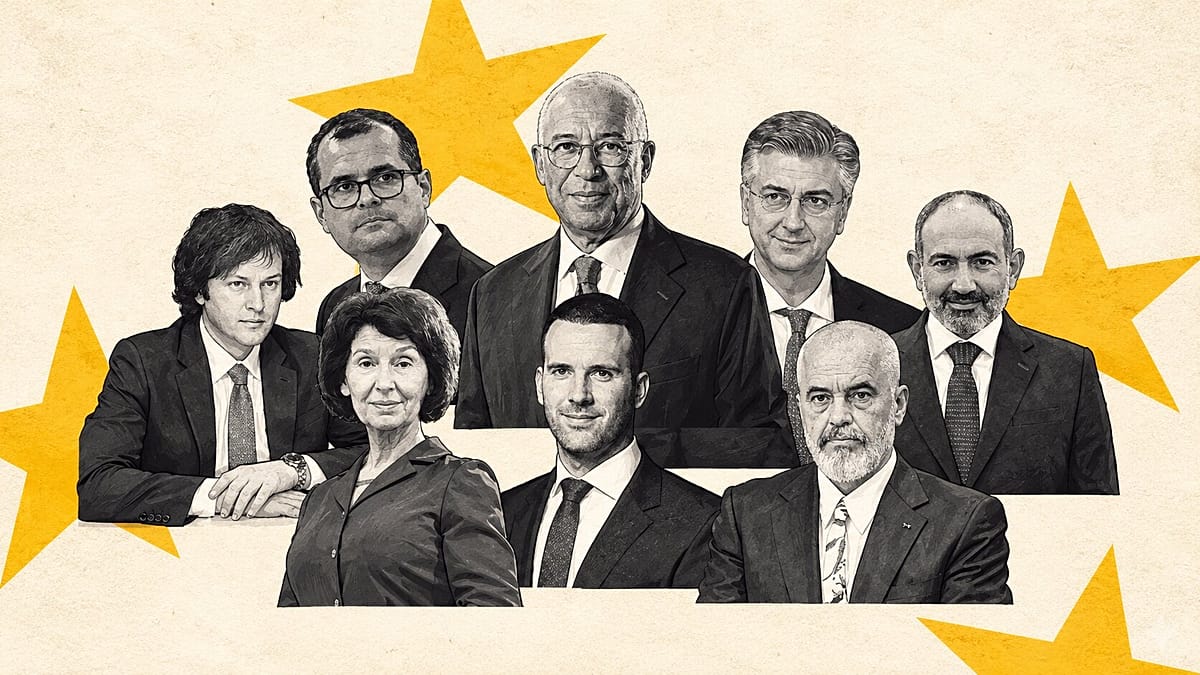
Brussels is hosting the second Enlargement Summit at a critical juncture for the European Union's expansion policy. Ukrainian Prime Minister Serhii Koretskyi, Georgian Prime Minister Irakli Kobakhidze, and European Council President António Costa are among the leaders gathered to translate a decade of post-Brexit momentum into concrete accession progress.
The summit comes as the European Commission prepares detailed roadmaps for the four frontrunners—Montenegro, Albania, Moldova, and Ukraine—outlining the final steps needed to join the bloc. Yet these roadmaps risk deepening the divide between the most advanced candidates and those whose bids have stalled, notably North Macedonia and Georgia.
Montenegro's bilateral hurdles
Montenegro remains the closest to the finish line, but its path is complicated by unresolved bilateral issues with Croatia, rooted in the legacy of the Yugoslav Wars. The EU executive has proposed institutional safeguards for new members, currently under discussion in the context of Montenegro's accession treaty, which is expected to serve as a blueprint for future enlargements. As debates over stricter membership rules intensify, Montenegro's experience will be closely watched.
Albania's protests and Moldova's rapid progress
Albania, generally seen as the second most advanced candidate, has been shaken by large protests over preparatory work for a luxury resort in a protected area, a project linked to Jared Kushner, son-in-law of former US President Donald Trump. The controversy has cast a shadow over Tirana's reform efforts.
Moldova, meanwhile, has been advancing so quickly that the Commission has had to reallocate internal resources to keep pace with Chișinău. The country is close to closing negotiating chapters it only recently opened, a sign of its determination to align with EU standards.
Ukraine's progress and agricultural sticking point
Ukraine has finally begun to make formal progress, thanks in part to the change of government in Hungary, which had previously blocked key decisions. Kyiv is expected to open all negotiating clusters by the end of the year, though agriculture remains a contentious issue in the talks. The EU's agricultural sector is wary of the potential impact of Ukrainian grain and other products on the single market.
Western Balkans and Caucasus lag behind
In the Western Balkans, Serbia—the region's largest country—has seen a change of government that has raised hopes in Brussels of a reset in relations and renewed enlargement momentum. However, other countries in the region, including North Macedonia, Bosnia and Herzegovina, and Kosovo, have seen their accession bids stall. They are effectively losing access to EU regional funding in favor of the frontrunners, a development that could further entrench their stagnation.
In the Caucasus, Georgia's accession has effectively halted amid democratic backsliding and a diplomatic shift towards Russia. Enlargement Commissioner Marta Kos recently described Georgia as "a candidate country only on paper," underscoring the bloc's frustration. Armenia, though not yet a candidate, is considering applying for EU membership as it seeks to reduce its dependence on Moscow following its conflict with Azerbaijan.
The EU has made enlargement a central pillar of its external relations, offering a membership perspective to draw neighbors into its orbit. But as the summit convenes, Brussels must demonstrate that its ambitions can yield tangible results. The roadmaps for the frontrunners are a step in that direction, yet the widening gap with other hopefuls raises questions about the bloc's credibility and its ability to manage a multi-speed enlargement process.
With the European Parliament elections and the new Commission now in place, the coming months will be crucial. The EU's ability to deliver on its promises will determine whether enlargement remains a genuine strategic priority or becomes a hollow slogan. As geopolitical uncertainties persist, the stakes for the continent's future are high.