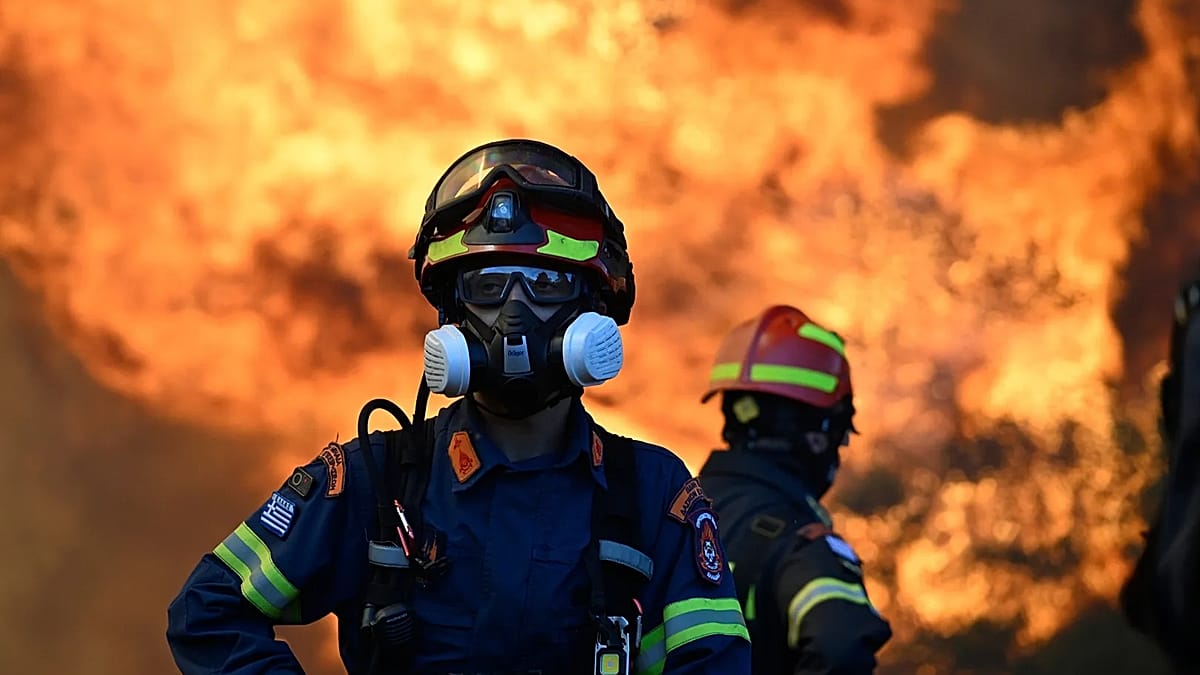
As wildfires become a recurring summer threat across Europe, the capacity of national fire services has come under scrutiny. New Eurostat data for 2025 show that the EU employs 372,400 professional firefighters, a figure that represents 0.18% of total employment in the bloc. The numbers, however, mask significant disparities between member states.
Who has the most firefighters?
Unsurprisingly, the largest economies tend to field the biggest firefighting forces. Germany leads with 57,700 professional firefighters, followed by France with 47,700 and Italy with 43,500. Poland ranks fourth with 40,000, while Spain is close behind with 38,500. Together, the EU's 'Big Four' – Germany, France, Italy, and Spain – account for just over half of the EU total, with 187,400 firefighters.
Romania and Greece each have more than 20,000, while Portugal and Czechia report over 16,000. At the other end of the scale, Cyprus and Estonia have fewer than 2,000 each. Eurostat notes that data are missing for five EU countries, so the full picture is incomplete.
These figures cover all professional firefighters, including those specialised in forest fires, but exclude volunteers. Eurostat defines firefighters as personnel who “prevent, fight and extinguish fires and assist in other emergencies, protect life and property and conduct rescue efforts.”
Employment share tells a different story
When measured against total employment, the ranking shifts dramatically. Greece leads with firefighters making up 0.47% of its workforce, followed closely by Croatia at 0.43%. Portugal is third at 0.33%, well above the EU average of 0.18%. The Big Four all sit at or below that average: Italy at 0.18%, Spain at 0.17%, France at 0.16%, and Germany at 0.14%.
These figures reflect not only the scale of wildfire risk but also the structure of national labour markets. In Greece and Croatia, where tourism and rural economies are significant, firefighting is a more prominent source of employment.
Cross-border solidarity in action
National numbers only tell part of the story. During severe seasons, countries can call on the EU Civil Protection Mechanism (UCPM) to request aircraft, helicopters, and personnel from other member states. “No country should face wildfires alone. Through our civil protection mechanism, Europe is moving aircraft, helicopters and firefighters quickly to where they are needed most,” said Hadja Lahbib, EU Commissioner for Preparedness and Crisis Management, in a statement on 17 August.
The 2026 rescEU fleet and the European civil protection pool include 22 firefighting aeroplanes and 5 helicopters. This shared capacity has been used repeatedly this summer, as wildfires forced mass evacuations in several countries.
Rising costs and expanding risk
The financial burden of fire protection is also growing. In 2024, EU governments spent €43.8 billion on fire-protection services, equivalent to 0.5% of total public expenditure. Germany led with €13.7 billion, followed by France at €7.9 billion. Greece allocated €1 billion, but that represented 0.9% of its government spending – the highest share in the EU.
Climate change is pushing wildfire risk into new territories. The European Commission warns that areas previously unaffected, such as Czechia, Germany, and Sweden, are now exposed. Europe is the fastest-warming continent, and June 2026 was the hottest on record in Western Europe, according to Copernicus. The last three years – 2024, 2023, and 2025 – were the three warmest globally.
By early August 2026, 489,826 hectares had burned across the EU, 13% above the average for the same period over the previous 14 years. That made 2026 the fourth-worst year for cumulative area burnt since 2012, according to Our World in Data.
As the continent braces for more extreme seasons, the debate over firefighting capacity is likely to intensify. The EU's response has been to strengthen coordination, but the data suggest that national disparities remain a challenge. For now, the bloc's firefighters – whether in Athens, Zagreb, or Berlin – are on the front line of a changing climate.