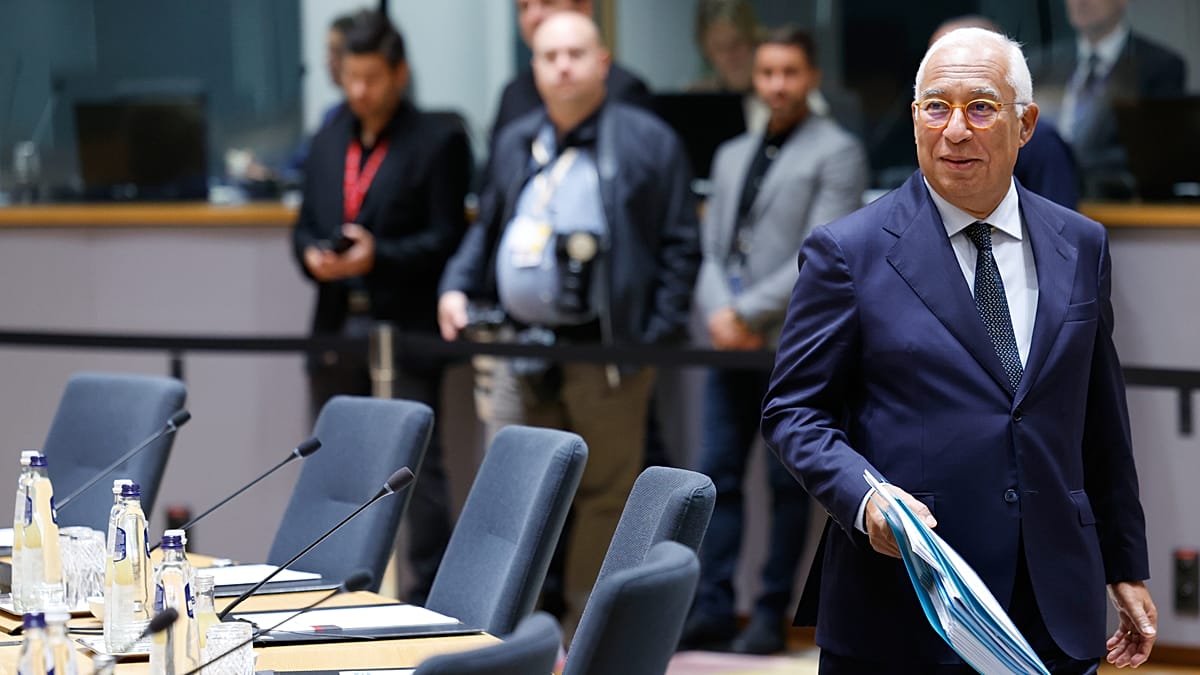
European Union leaders emerged from Thursday's summit in Brussels without a breakthrough on the bloc's next long-term budget, and with a growing number of governments openly questioning whether the end-of-year deadline is worth keeping. Talks ran longer than scheduled and ended with red lines intact on all sides, leaving the Multiannual Financial Framework (MFF) — the seven-year spending plan that funds everything from farming to defence — in limbo.
Sweden's caretaker prime minister, Ulf Kristersson, was blunt about the state of play. "We are not reaching an agreement this month. Not next month. I don't know even if it's possible to reach an agreement before the end of the year," he said. "I think we are not in a hurry."
For months, European Council President António Costa has insisted that leaders must unanimously approve the MFF by December at the latest. His argument has been procedural: if talks drag into 2027, there will not be enough time to complete the legislative work needed to have the budget running by 1 January 2028. That timeline now looks increasingly fragile.
A compromise rejected, a new one pending
The summit's centrepiece was a compromise floated by the Irish presidency that would have trimmed the overall volume of the budget by €141 billion. It was largely rejected. As anticipated, Costa will now take personal charge of the negotiations and is due to table a fresh proposal within weeks, ahead of a special summit called for 26 November.
Costa's approach is expected to follow a different logic from the Irish text. In particular, it is likely to keep national contributions low, introduce a new package of EU-wide taxes to help finance the budget, and preserve sufficient flexibility for unforeseen expenses — a budget line the Irish proposal had significantly reduced.
Even before leaders arrived in Brussels, the draft joint conclusions had been watered down on the deadline. Language that explicitly set out "the aim of reaching a final agreement by the end of the year" was softened. The final text instead notes that "an agreement before the end of 2026 would allow for the adoption of legislative acts in 2027, which is necessary to ensure that EU funding reaches beneficiaries without interruption in January 2028."
Several leaders made clear they do not feel bound by the year-end target. Their reasoning is political as much as fiscal: explaining to voters at home that a bad deal was accepted because of an artificial deadline would be difficult. "The date cannot become more important than the content," Italian Prime Minister Giorgia Meloni told the Senate on Wednesday. "We will not sign an agreement that is not advantageous to us just to meet a deadline. We will sign an agreement only when it is right for Italy."
Dutch Prime Minister Rob Jetten struck a similar note. "In the end, we need a good Multiannual Financial Framework. So, of course, everyone wants to make speed. But it's more important to have a good deal than a bad deal," he said.
Two camps, and plenty of defectors
The structural problem is that there is no shared definition of a good deal. Every government wants to draw as much as possible from the EU budget while paying in as little as possible. The main fault line runs between the so-called "frugals" — a German-led coalition of six net contributors pushing for steep cuts to the overall volume — and the Friends of Cohesion, a 17-strong bloc of southern and eastern member states fighting to preserve traditional funding for the poorest regions.
Neither camp is monolithic. Within the Friends of Cohesion, Spain and Italy have a strong stake in agricultural funds, while the Baltic states want more defence spending given their proximity to Russia. Among the frugals, Germany and Sweden are seen as the most hardline, whereas Finland is protective of farming subsidies. France, the bloc's second-largest economy, has yet to pick a side, caught between its European ambitions and a runaway budget deficit. Belgium and Luxembourg sit somewhere in between.
With red lines this entrenched and the room for compromise so narrow, a landing zone currently looks like a mirage. In Brussels, deals on sensitive files are typically struck only under intense time pressure, because neither side feels compelled to move until the last moment. Signalling that a deadline is not binding can therefore be a negotiating tactic as much as a genuine position.
What worries EU officials even more than a delay to funding programmes is the string of national elections due in 2027 — in France, Italy, Poland, Finland, Estonia, Slovakia and Greece. Some fear that if no deal is reached by the end of this year, the whole process could slip to autumn 2027.
Paris is the sharpest concern. Far-right candidate Marine Le Pen is currently the favourite to win the presidential race, and she has promised to cap France's contribution at €5 billion a year — a steep cut from the current level of around €8 billion. Elections in Spain, where voters go to the polls on 29 November, and in Sweden, which voted in September, "are likely to create some issues", said Cypriot President Nikos Christodoulides.
The wider context is hardly reassuring. Leaders also used the summit to confront energy prices and trade tensions with China, while the Irish presidency has been defending its proposed cuts as a realistic compromise. With Costa now holding the pen, the next few weeks will determine whether the December deadline survives — or whether the EU's next budget drifts into a year of elections and uncertainty.