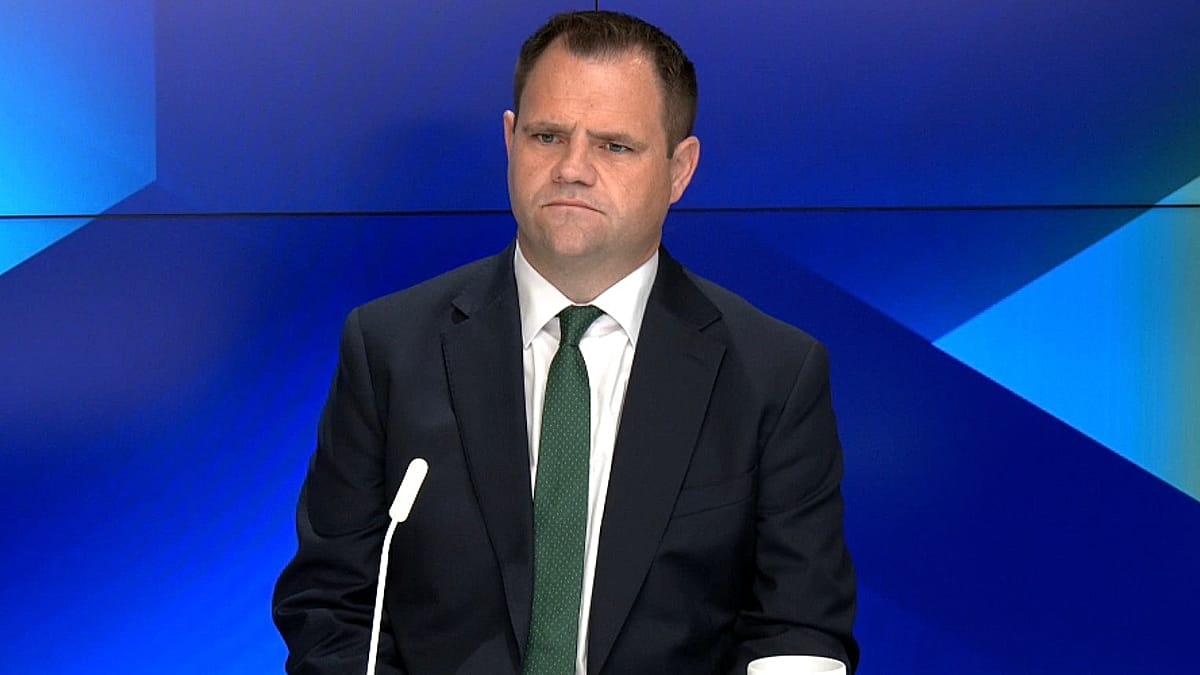
Ireland has pushed back against criticism of its proposed compromise for the European Union's next seven-year budget, with the minister responsible for international development insisting the plan has no weak points. Neale Richmond, who holds the Irish presidency's brief on the matter, described the proposal as a “demonstration of what is actually realistic” in the face of divergent demands from member states.
The Irish government, which currently holds the rotating presidency of the Council of the EU, presented its compromise on the size of the bloc's 2028–2034 budget ahead of tomorrow's summit in Brussels. The proposal would trim €141 billion from the €1.7 trillion draft that was already on the table, a reduction that has drawn sharp reactions from several capitals.
Richmond defended the plan in an interview with European Pulse, arguing that the proposed figure still represents a real increase over the current multiannual financial framework. “This is still an increase on the last budget,” he said, “and it reflects the fiscal realities that many member states are facing.”
The Irish proposal comes at a delicate moment for EU finances. The bloc is juggling new priorities such as defence, migration, and competitiveness, while net contributors like Germany and the Netherlands have been vocal about keeping spending in check. Germany's net-payer revolt has already complicated negotiations, and the Irish compromise is seen as an attempt to bridge the gap between the frugal north and the spending-minded south.
A balancing act
Richmond acknowledged the difficulty of satisfying all 27 member states, but insisted that the Irish presidency's role is to find a workable middle ground. “We are not trying to please everyone,” he said. “We are trying to put forward a package that can actually be agreed, and that means making tough choices.”
The proposed cuts would affect several areas, though Richmond declined to specify which programmes would bear the brunt. He stressed that the overall envelope remains substantial and that the EU's core policies—cohesion, agriculture, and research—would continue to be funded at meaningful levels.
However, critics argue that the cuts would undermine the EU's ambitions in areas like satellite sovereignty, where the bloc is trying to reduce its dependence on non-European providers. The European Commission had originally proposed a larger budget to fund such strategic projects, and some member states fear that the Irish compromise would force them to scale back.
Others point to the broader geopolitical context. With the war in Ukraine ongoing and the United States' commitment to European security under question, some leaders argue that now is not the time for austerity. The stalled budget talks have already been complicated by external pressures, and the Irish proposal may not be enough to break the deadlock.
Richmond, however, remains confident. “We have listened to all member states, and we believe this is a balanced proposal,” he said. “It is not a weak proposal; it is a realistic one.”
The summit tomorrow will be the first real test of whether the Irish compromise can hold. If it fails, the EU could face a prolonged budget crisis, with implications for everything from farm subsidies to border security. For now, the Irish presidency is betting that its middle-of-the-road approach will ultimately prevail.