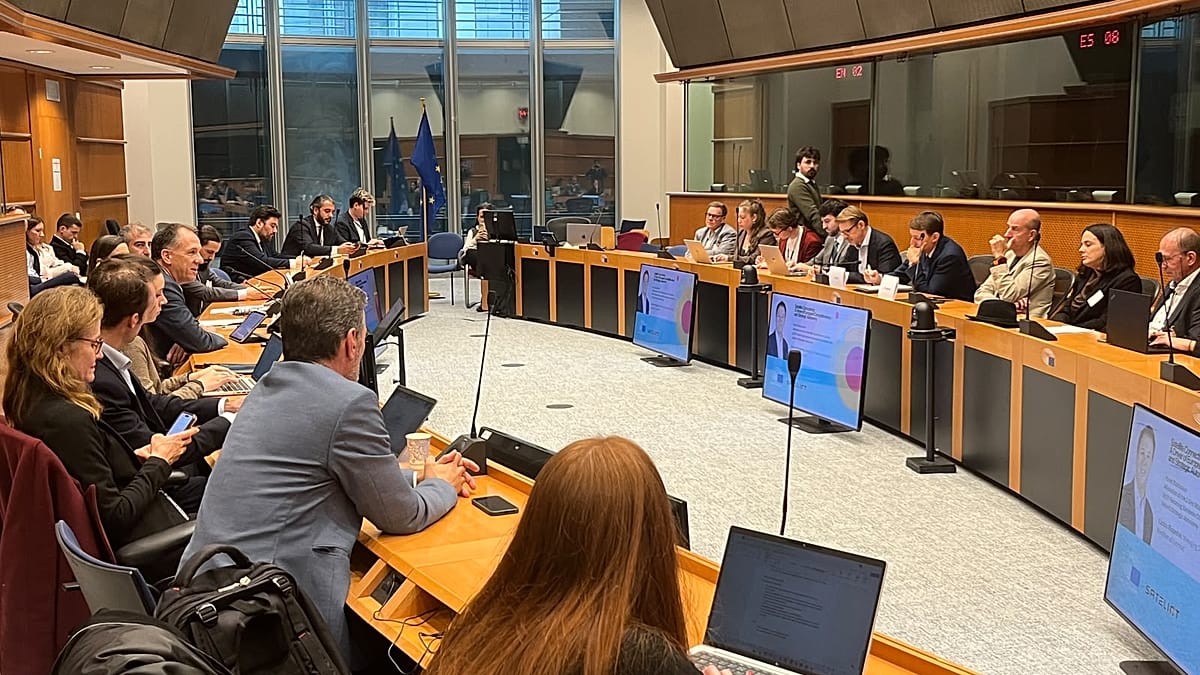
As the European Union approaches the end of its current seven-year budget cycle, the bloc's ambitions for satellite sovereignty are colliding with the realities of funding and industrial capacity. At a European Parliament event in Brussels on Tuesday, regulators, EU officials, and industry leaders gathered to discuss how spectrum allocation and investment will shape the future of Europe's orbital infrastructure.
The EU's €14.8 billion space programme for 2021-2027, which funds the Galileo navigation system and the Copernicus Earth observation network, is set to expire next year alongside the Multiannual Financial Framework (MFF). For the 2028-2034 period, the European Commission has proposed shifting space funding into a new European Competitiveness Fund, a single pot for strategic industries that would allocate €131 billion for defence and space. EU leaders are expected to debate the next budget at the European Council meeting on Thursday and Friday.
Meanwhile, the Commission's defence and space department (DG DEFIS) closed bids on 29 September for a four-year, €55 million framework contract covering management and legal support for IRIS², the EU's planned secure satellite constellation, as well as space surveillance and tracking and analysis of the space economy. Further calls under Horizon Europe, the EU's research and innovation programme, are slated for 2027, while EUSPA and the European Space Agency (ESA) continue to run their own tenders.
Spectrum and sovereignty
A central theme of the debate was spectrum—the radio frequencies that satellites and mobile networks rely on to transmit data. In May, the Commission proposed a single EU-wide licence for mobile satellite services in the 2 GHz band, whose current rights expire in May 2027. The proposal would reserve part of the band for European operators and a secure system linked to IRIS².
European Parliament Vice-President Javier López, who hosted the meeting, stressed the geopolitical urgency. "This discussion could not come at a better moment considering the current geopolitical tensions and the debate surrounding technological competition," he said. "A Europe that controls its own network and data is a Europe that can act independently and make its own decisions... satellite connectivity is a perfect example of an area where we must achieve strategic control."
Jaume Sanpera, CEO and co-founder of Barcelona-based Sateliot, echoed that sentiment. "We have to build and support European champions that can compete globally in the space sector," he told Euronews, adding that "today half the world wants to work with European companies in defence and space because we are more predictable."
The debate comes as the EU's budget negotiations face headwinds from net-payer states, with Germany leading a revolt against compromise proposals. The outcome will determine whether the bloc can sustain its space ambitions.
From SpaceX to PLD Space
For small satellites, reaching orbit still largely means flying American. On 1 October, Sateliot sent five satellites built by Spanish small-satellite maker Alén Space into orbit on Transporter-18, a rideshare mission by Elon Musk's SpaceX, bringing its total launched to 11. The additional satellites double its daily passes over any given point, the company says.
Asked whether Europe can expand its fleets without relying on non-European launchers, Sanpera expressed optimism, noting that four or five companies are in the race to fill that gap. Sateliot's next launch, scheduled for July 2027, will again use SpaceX, but the one after that will be with PLD Space, a Spanish launch company based in Elche. That late-2027 launch will be entirely European and will carry Sateliot's first two Tritó satellites, a larger next-generation design offering 5G direct-to-device services to ordinary phones. They will fly on Miura 5, a small orbital rocket built by PLD Space that has yet to fly.
In August, PLD won a conditional €158.9 million contract under ESA's European Launcher Challenge, which backs new European rockets, and it plans a debut launch from Europe's spaceport in French Guiana by the end of this year. Sateliot, which is raising €150 million from investors—comprising €100 million in equity and up to €50 million in debt—aims to grow its constellation to more than 500 satellites by 2028.
The push for European launch capability is part of a broader effort to reduce dependence on foreign providers, a concern that also resonates in other sectors, as seen in the UK's dominance in European tech funding. The ESA has also selected Sateliot to contribute to IRIS²'s Low-LEO layer, a testing ground for new government services, with in-orbit test missions planned from 2027 to 2029. Through its RESCUE-NET project, Sateliot will study how 5G connectivity from space can keep public authorities connected when ground networks fail. The ESA signed 18 contracts worth €20 million in total with nearly 80 companies for this phase.
As the EU's budget cycle winds down, the question of how to fund these ambitions remains unresolved. The upcoming European Council meeting will be a critical test of whether member states can agree on a framework that supports Europe's satellite sovereignty without breaking the bank.