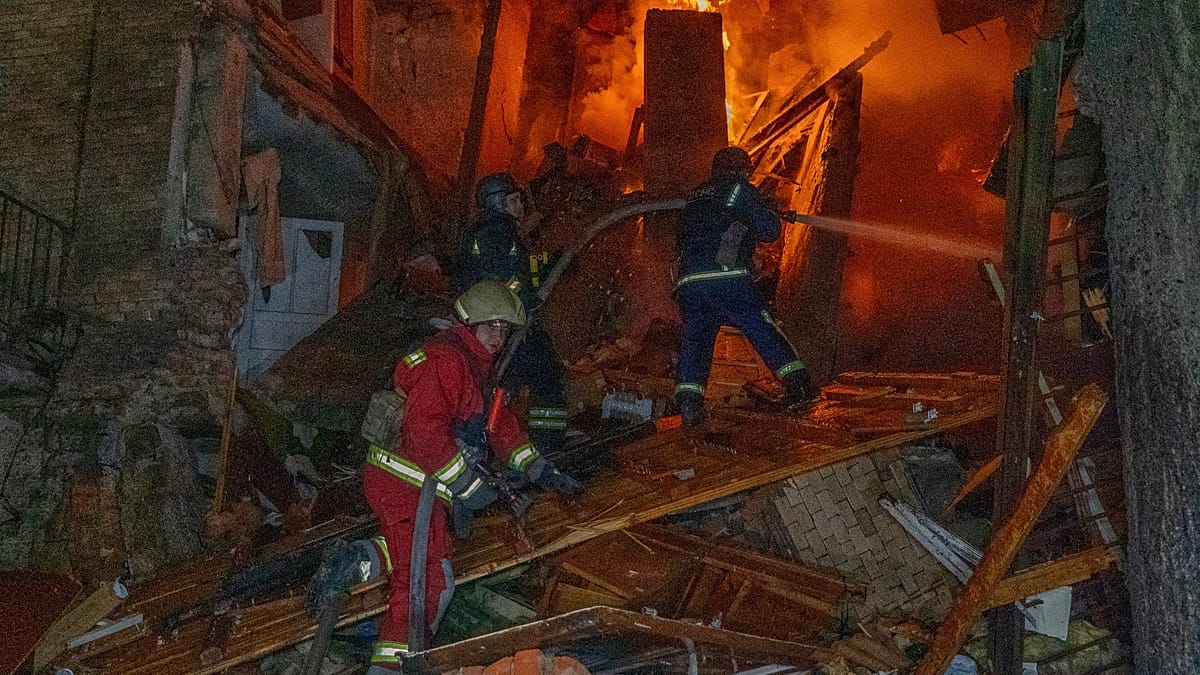
Russian forces carried out a wave of attacks across Ukraine on Tuesday, striking an educational institution in the western city of Rivne and hitting civilian infrastructure in Kyiv with ballistic missiles, according to Ukrainian authorities. At least 25 people were injured in Rivne, where police said two victims were in serious condition and undergoing surgery, while three others were receiving medical treatment.
President Volodymyr Zelenskyy said five ballistic missiles struck civilian targets in the capital, describing the barrage as particularly vile. He stressed that Ukraine had received no advance warning from its partners about the attack, though he did not assign blame for the intelligence gap.
"This is precisely what helps prevent people from being killed — when there is an early warning about ballistic missiles," Zelenskyy wrote, adding that such intelligence "helps save lives, and this is one of the most critical issues."
The strikes came amid a broader escalation that has seen Moscow intensify its use of fast-moving ballistic missiles and high-flying jet-powered drones against Ukrainian cities. Zelenskyy said Russia had launched more than 100 weapons at Ukraine since Monday evening.
Kharkiv and other regions hit hard
In the northeastern city of Kharkiv, a Russian strike destroyed a residential building, killing four people despite an all-night rescue operation. A further 41 people were wounded in the city in a single evening, according to the president. The attacks on civilian infrastructure, including energy facilities, form part of a sustained Russian campaign to deprive Ukrainians of power, heat and running water — a strategy that has persisted throughout the 4½-year war.
Elsewhere, a woman was wounded when a Russian strike hit a private home in Kyiv's Darnytskyi district, the city's military administration said. In the village of Murovane near Lviv in western Ukraine, a Russian drone struck a residential building during a morning attack, according to Lviv Mayor Andrii Sadovyi. One person was killed and at least two others were hurt in the Fastiv district of the Kyiv region, said Tymur Tkachenko, head of the regional military administration.
The assault on the capital has renewed scrutiny of Western intelligence-sharing arrangements with Kyiv. A recent report examined how US intelligence leverage over Ukraine has resurfaced as a contentious issue following earlier missile strikes on Kyiv. The question of timely warnings for ballistic threats has become a recurring point of friction between Kyiv and its allies.
Ceasefire efforts under strain
The latest attacks also complicate diplomatic efforts to halt the violence. An earlier energy ceasefire announcement left Kyiv puzzled as Russian strikes continued unabated, underscoring the fragility of any partial truce. Meanwhile, Ukrainian forces have struck back at Russian digital infrastructure, with Ukrainian strikes on Yandex data centres linked to a sharp drop in bot activity.
Tuesday's attacks occurred just days before a key summit of the European Council in Brussels on Friday, 16 October, where Zelenskyy is expected to attend. The meeting is likely to focus on further military and financial support for Ukraine, as well as the country's path toward EU accession. European leaders have repeatedly condemned Russia's targeting of civilian infrastructure, but the delivery of advanced air-defence systems and real-time intelligence remains a subject of intense negotiation.
On the ground, the front lines have seen little significant movement since last year, but Ukraine is struggling to repel Moscow's intensified aerial assaults. The use of ballistic missiles — which travel at several times the speed of sound and can reach targets within minutes — leaves civilians with virtually no time to seek shelter once a launch is detected. That reality has made early-warning intelligence not merely a tactical advantage but a matter of survival.
As rescue teams in Rivne, Kharkiv and the Kyiv region continue to clear debris and treat the wounded, the human cost of the war continues to mount. For the communities affected, each new barrage reinforces the urgency of air-defence supplies and the need for faster, more reliable warnings from Ukraine's partners.