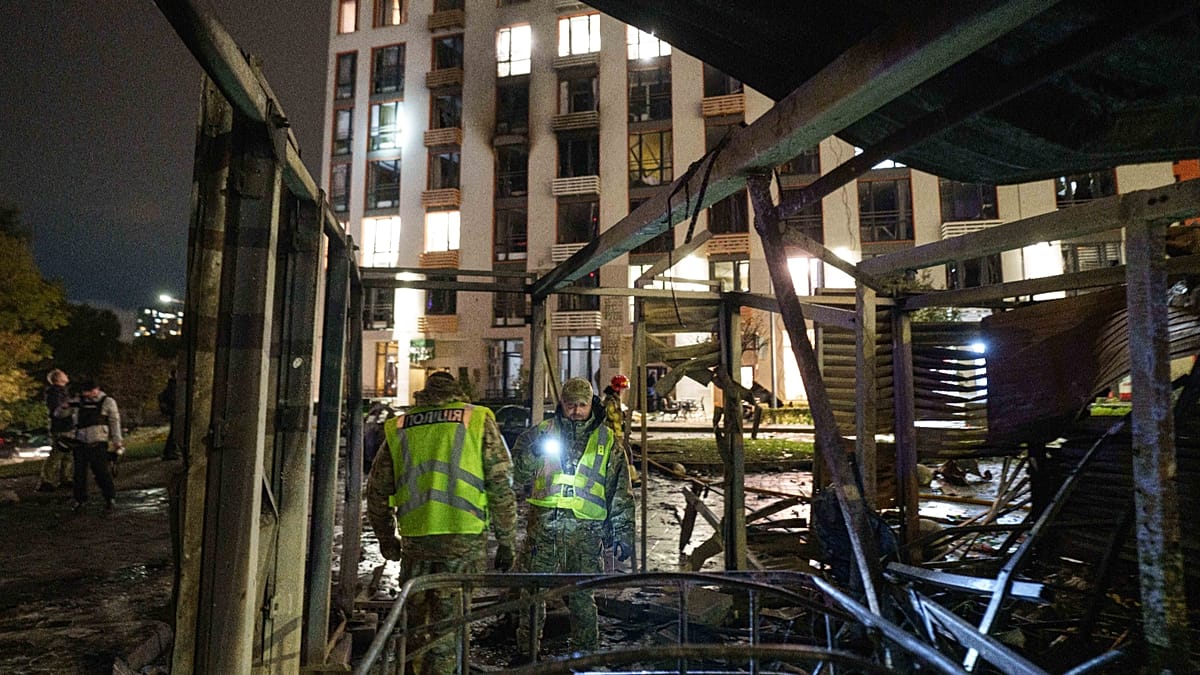
When Russian ballistic missiles struck Kyiv late on Monday, residents had no advance warning. The first indication of danger came as explosions echoed across the capital, leaving people scrambling for shelter. The lack of alert immediately raised a troubling question: had Washington quietly switched off the intelligence tap again?
President Volodymyr Zelenskyy confirmed on Tuesday that Ukraine had received no prior notice from its partners about the incoming missiles, calling the attack "particularly vile" and stressing that early warning is "one of the most critical issues" for saving civilian lives. Ukraine's Air Force said its own radar detected the missiles only as they were incoming, and that it had received no information about their launch from Russian territory.
The episode inevitably evoked memories of March 2025, when the Trump administration briefly suspended intelligence-sharing and military assistance to Ukraine during a diplomatic confrontation. That interruption, resolved after talks in Saudi Arabia, demonstrated how quickly Washington can turn security cooperation into political leverage. It also laid bare Ukraine's reliance on American satellite-based detection systems, which can spot missile launches far earlier than ground radar.
Yet Ukrainian officials have been careful not to jump to conclusions. Presidential adviser Serhii Beskrestnov, known as "Flash," noted on Facebook that this was not the first time an S-400 launch had gone undetected by partner intelligence. "There are certain technical nuances involved," he wrote. Air Force spokesperson Yurii Ihnat echoed that sentiment, pointing out that the US is not Ukraine's only intelligence partner, with other NATO countries also providing data on Russian strategic aviation, naval movements, and ballistic missile launches. "There are moments when this information fails to arrive," he said.
Foreign Minister Andrii Sybiha, speaking at the Warsaw Security Forum, dismissed the idea of a deliberate US cutoff, attributing the missed warning to a "special type of weaponry" used by Russia. The European Commission also said it had no indication that Washington had threatened to suspend intelligence-sharing or weapons sales.
A recurring source of leverage
The uncertainty comes amid reports that Washington has threatened to halt intelligence-sharing and weapons supplies, including those purchased by European allies for Ukraine, unless Kyiv stops targeting Russian oil refineries. Ukraine considers these facilities legitimate military targets, arguing that their revenues fund Moscow's war effort. The threat is not hypothetical; the March 2025 suspension showed how quickly the US can use such cooperation as a bargaining chip.
For now, Ukrainian officials insist that cooperation with Washington continues. But the incident has reignited a broader debate in Europe about the continent's ability to fill the gap if the US ever pulls the plug for good. European allies share intelligence with Kyiv, but their capabilities are not a perfect substitute for American satellite coverage and processing power.
The broader context is one of Europe closing ranks behind Ukraine amid shifting US policy. The EU has been working to strengthen its own defence and intelligence integration, but progress is slow. As Zelenskyy has repeatedly noted, Russia has continued striking Ukrainian cities despite ceasefire announcements, underscoring the need for reliable early warning systems.
Monday's attack also highlighted the human cost of intelligence gaps. Five missiles struck civilian infrastructure, and the lack of warning meant many residents had no time to reach shelters. The Ukrainian Air Force is investigating why the alert failed to arrive, but the answer may be technical rather than political.
Still, the episode serves as a reminder of Ukraine's fragile dependence on external support. As European leaders push for closer EU integration, the question of strategic autonomy looms larger. Can Europe provide the intelligence umbrella that Ukraine needs, or will it always rely on Washington's satellites?
For now, the immediate crisis appears to have passed. But the underlying vulnerability remains, and the next missile could come without warning again.