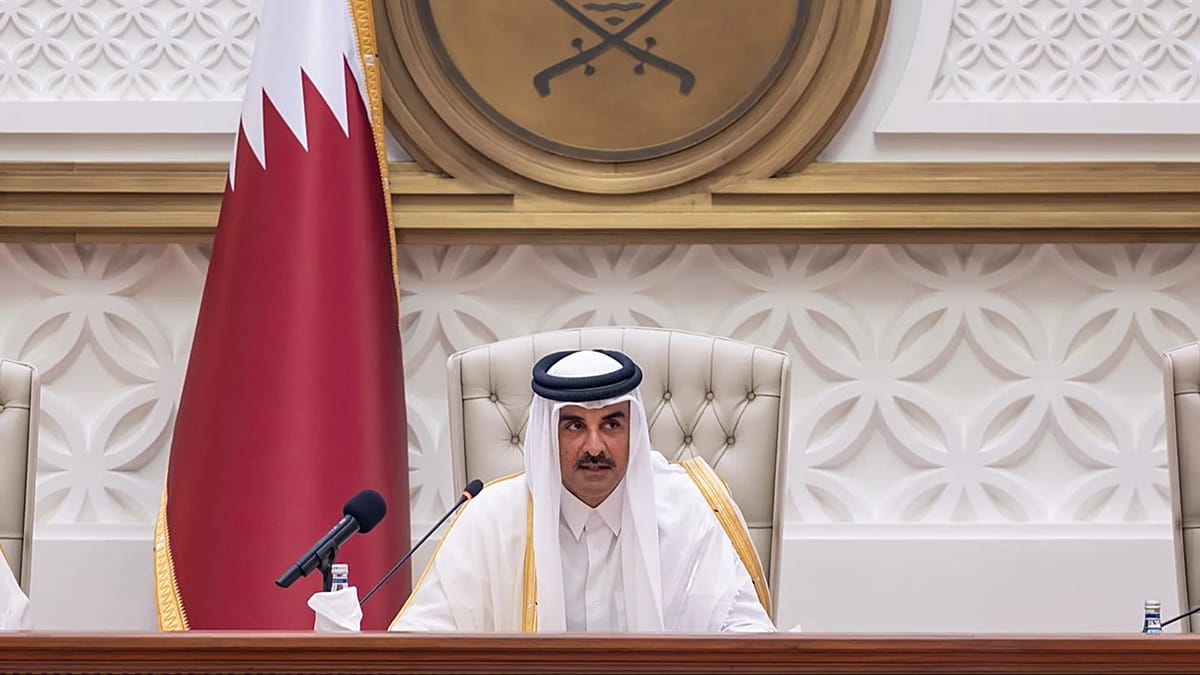
In a nationally televised address opening the Shura Council's annual session in Doha on Tuesday, Qatar's Emir Sheikh Tamim bin Hamad Al Thani declared that his country would emerge from the recent conflict with Iran "more resilient and better equipped to adapt to global changes." The speech laid out a post-war strategy that prioritizes diversifying the economy beyond hydrocarbons while maintaining Qatar's central role in global energy markets.
Sheikh Tamim directly addressed the Iranian attacks on Qatari territory, calling them "a blatant violation of its sovereignty, the provisions of international law, and the principles of good-neighborly relations." He reiterated Qatar's longstanding preference for resolving disputes through negotiation and peaceful means, but stressed that "our commitment to dialogue and peaceful solutions does not mean being complacent about defending our country." He added, "Our right to defend our sovereignty does not conflict with our determination to prevent a wider war."
Regional security and Gulf cooperation
Against the backdrop of widening conflicts across the Middle East, the Emir called for closer cooperation among Gulf Cooperation Council (GCC) states, stating that "the security of the GCC states and the protection of their sovereignty and stability are non-negotiable." He urged member states to "redouble our efforts to secure navigation in the Gulf and the Strait of Hormuz, and to protect energy and water facilities, as well as civil infrastructure."
Sheikh Tamim acknowledged that the closure of the Strait of Hormuz, combined with direct damage to energy facilities in Ras Laffan Industrial City, had disrupted a significant portion of Qatar's exports. He emphasized that any disruption to Qatar's LNG supply—which accounts for about one-fifth of global liquefied natural gas—would be "quickly reflected in markets and consumers everywhere."
The Emir outlined what he called "four key elements" of Qatar's crisis strategy: "first, defending the homeland firmly without being drawn into war; second, maintaining essential services, supply chains, and economic activity; third, contributing to efforts to secure a ceasefire and reopen waterways; and fourth, urging negotiations and seeking opportunities to return to talks to reach peaceful resolutions to the conflict."
Economic resilience and diversification
Sheikh Tamim highlighted the performance of Qatar's non-hydrocarbon sectors, which "continued to grow with their contribution reaching approximately 80% of real GDP." He noted that total revenues declined by 42% during the first half of the year, while public expenditure fell by 14%, "without compromising essential services or development priorities." He insisted that "the state did not succumb to panic" and instead "continued to look to the future with confidence in the national economy."
The Emir credited pre-crisis policies—such as strengthening reserves, reducing public debt, budgeting based on conservative oil price assumptions, and developing non-oil revenues—for enabling Qatar to absorb the shock. Looking ahead, he said the country's "aim is not to return to the pre-crisis situation, but rather to use the recovery as a springboard to accelerate economic diversification and strengthen national capabilities."
In the energy sector, Qatar plans to expand the North Field Gas project to increase LNG production capacity, progress the Golden Pass project in the United States, and boost QatarEnergy's international partnerships. The strategy also includes developing petrochemical industries, solar energy projects, and strengthening water security. Food security, agriculture, technology, institutional efficiency, education, and digital transformation were also named as priorities.
Sheikh Tamim also addressed the Palestinian cause, declaring that "what has happened in the Gaza Strip is undoubtedly a genocide, and those responsible must not escape accountability." He warned of the dangers from Israeli settler attacks in the West Bank and repeated raids on the Al-Aqsa Mosque.
Qatar's resilience and its pivot toward non-hydrocarbon growth offer lessons for other energy-dependent economies, including those in Europe. As the continent seeks to diversify its own energy sources and reduce reliance on fossil fuels, QatarEnergy's LNG expansion plans remain a key factor in global supply dynamics. Meanwhile, the broader push for economic diversification echoes similar debates within the EU about strengthening capital markets to support innovation and resilience.
As Qatar charts its post-war course, the Emir's message was clear: "Our duty is to always strive for the best, but we must also be prepared for the worst-case scenarios, and everyone—institutions and citizens alike—must take responsibility."