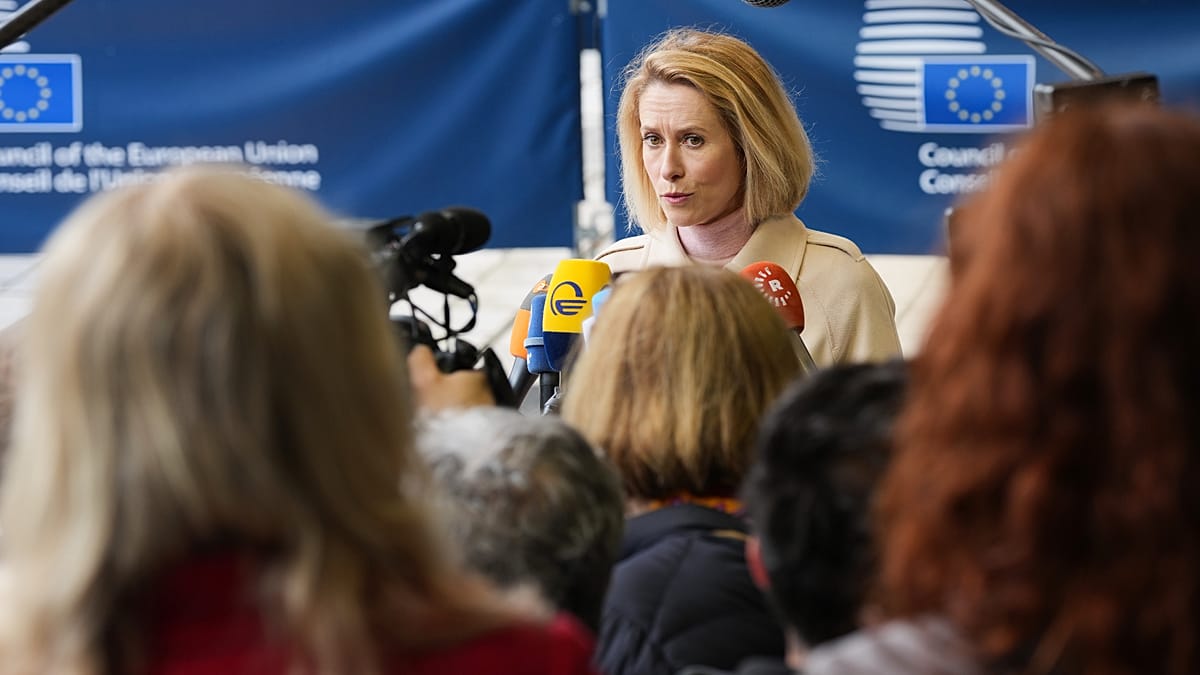
European Union foreign ministers have rejected a push to suspend the EU-Israel Association Agreement, a move that underscores the bloc's persistent divisions over the Middle East conflict. The proposal, put forward by Spain, Ireland, and Slovenia, cited alleged war crimes in Lebanon and Palestine, but failed to gain the necessary backing among member states.
Speaking after the meeting in Luxembourg on Tuesday, EU foreign policy chief Kaja Kallas confirmed that there was insufficient support for either a full or partial suspension of the agreement. A full suspension would require unanimity among all 27 member states, while a partial suspension would need a qualified majority—at least 55% of member states representing 65% of the EU population.
“We cannot lose sight of Gaza and the West Bank,” Kallas told journalists, adding that further discussions would take place. She noted that a separate proposal from France and Sweden to impose tariffs on goods originating from Israeli settlements in the occupied Palestinian territories would be referred to the European Commission.
Divisions Within the Bloc
The outcome was widely anticipated, as larger member states such as Germany and Italy were not expected to support the suspension. However, several EU countries, including Germany, have publicly criticized Israel's continued military operations in the region and recent legislative moves in the Knesset.
A spokesperson for German Chancellor Friedrich Merz said he had “expressed his deep concern about developments in the Palestinian territories” in a recent phone call with Israeli Prime Minister Benjamin Netanyahu. “There must be no de facto partial annexation of the West Bank,” the spokesperson added.
The letter from Spain, Ireland, and Slovenia, addressed to Kallas, argued that the EU must “uphold its moral and political responsibility, and to defend the very core values that have underpinned the European project since its foundation.” It described conditions in Gaza as “unbearable,” citing violations of the ceasefire agreement and insufficient humanitarian aid. The letter also highlighted escalating violence in the West Bank, where “radical settlers are acting with impunity.”
Kallas rejected accusations of double standards, stating that the EU is “among the largest supporters of Palestinians, including in reconstruction efforts.” She emphasized that the bloc remains committed to a two-state solution and to addressing the humanitarian crisis in the region.
The decision to refer the settlement goods proposal to EU trade commissioner Maroš Šefčovič reflects a narrower approach, focusing on goods produced in settlements, which fall outside the scope of the Association Agreement. This move could lead to targeted tariffs, though it remains to be seen whether it will gain broader support.
The debate comes amid broader European tensions over the Middle East, including recent diplomatic efforts by French President Emmanuel Macron, who hosted the Lebanese prime minister to discuss ceasefire strains and rising Israeli tensions. Meanwhile, a major civilian flotilla has set sail for Gaza, bracing for potential interception by Israeli forces.
As the EU grapples with its role in the conflict, the rejection of the trade suspension highlights the difficulty of achieving a unified foreign policy on issues that deeply divide member states. The coming weeks will test whether the bloc can find common ground on settlement goods or other measures, even as the humanitarian situation in Gaza and the West Bank continues to deteriorate.