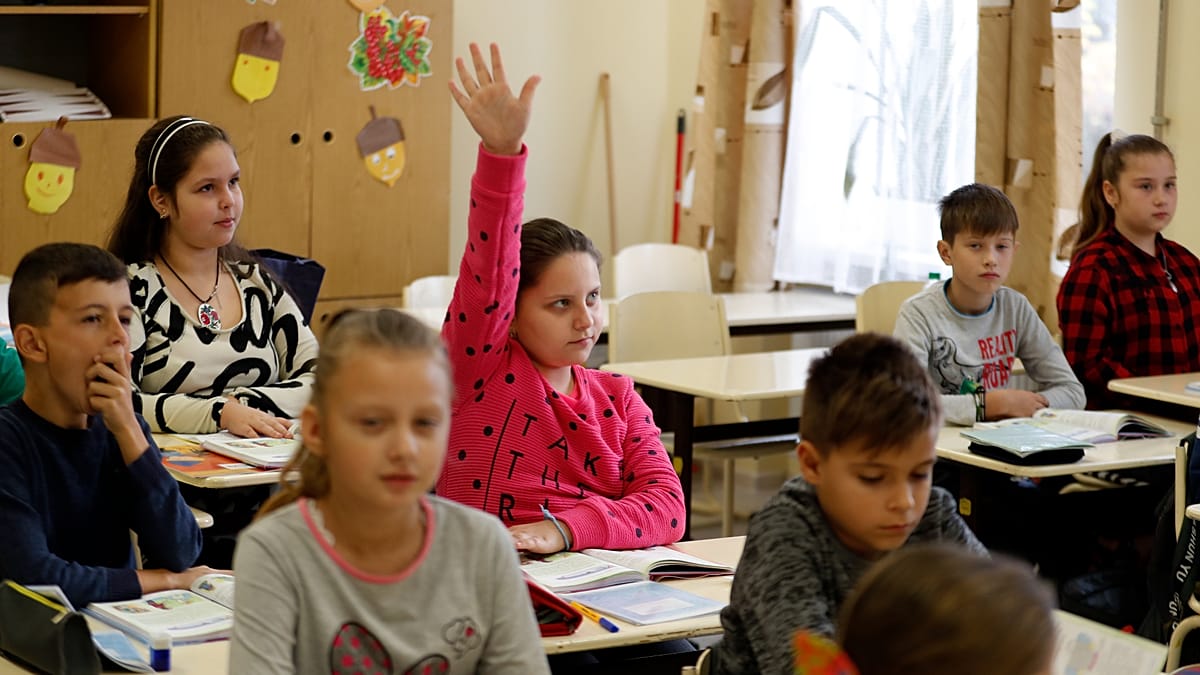
New Eurostat data released for International Literacy Day show that the European Union's primary schools are becoming slightly less crowded, even as overall enrolment numbers have plateaued. In 2024, the EU averaged 13.3 pupils per primary teacher, down from 14.2 in 2014. The improvement reflects a long-term trend of increased teaching resources, though the picture varies considerably across the 27 member states.
The total number of primary students in the EU stood at 23.2 million in 2024, a marginal 0.2% decrease from the previous year (35,153 fewer pupils). Over the past decade, enrolment has grown by 2.9%, adding roughly 659,000 students, but that growth has clearly lost momentum. The stagnation masks stark national differences: while Luxembourg and Slovenia saw increases of 21.4% and 18.2% respectively, Poland, Croatia, and Portugal recorded declines of 25.7%, 10.3%, and 10.0%.
Wide disparities in class sizes and teacher numbers
France remains the EU's largest primary education system, with 4.1 million pupils in 2024, followed by Germany (3.3 million), Spain (2.8 million), and Italy (2.6 million). At the other end, Malta has just 27,537 primary students, Luxembourg 43,020, and Cyprus 60,596. These figures are influenced by both population size and the age at which children start school, which varies by country.
The student-teacher ratio, a key indicator of educational investment, shows that Greece (7.4) and Luxembourg (8.2) are the only countries with fewer than 10 pupils per teacher. At the opposite end, Romania (18.2), Czechia and France (both 17.9), the Netherlands (16.3), and Germany (15.2) all exceed 15. Between 2014 and 2024, 23 of the 27 member states saw their ratios improve, with Bulgaria (from 17.8 to 10.4) and Slovenia (from 15.9 to 10.8) making the most dramatic progress. Austria's ratio remained unchanged at 12.0, while Lithuania bucked the trend, rising from 10.2 to 13.7.
Behind these numbers are nearly 1.9 million primary teachers across the EU. Germany employs the most (284,000), followed by Italy (251,000), Spain (248,000), and France (242,000, though this figure excludes independent private schools). The profession remains heavily female-dominated: 85.6% of primary teachers are women. In nine countries, men make up less than 10% of the teaching force, with Lithuania the most extreme at just 3.9%. Denmark has the highest male share at 32.8%, though still a minority.
Age demographics also reveal challenges. Across the EU, 42.1% of primary teachers are aged 35-49, 38.1% are over 50, and only 19.7% are under 35. Italy (58.2%) and Lithuania (57.3%) have the oldest teaching staff, while Malta and Luxembourg boast more than double the EU average share of young teachers, suggesting a more sustainable pipeline for the future.
The data come as the EU grapples with broader demographic and economic pressures. While the overall student-teacher ratio has improved, the uneven distribution of resources and the aging teacher workforce remain concerns for policymakers. As Italy's structural challenges illustrate, education systems are often a reflection of deeper economic trends. The decline in enrolment in several member states could ease pressure on class sizes, but it also raises questions about school closures and the efficient allocation of resources.
For now, the EU's primary education sector appears to be in a period of adjustment, with modest improvements in staffing but significant national variations that will require tailored responses.