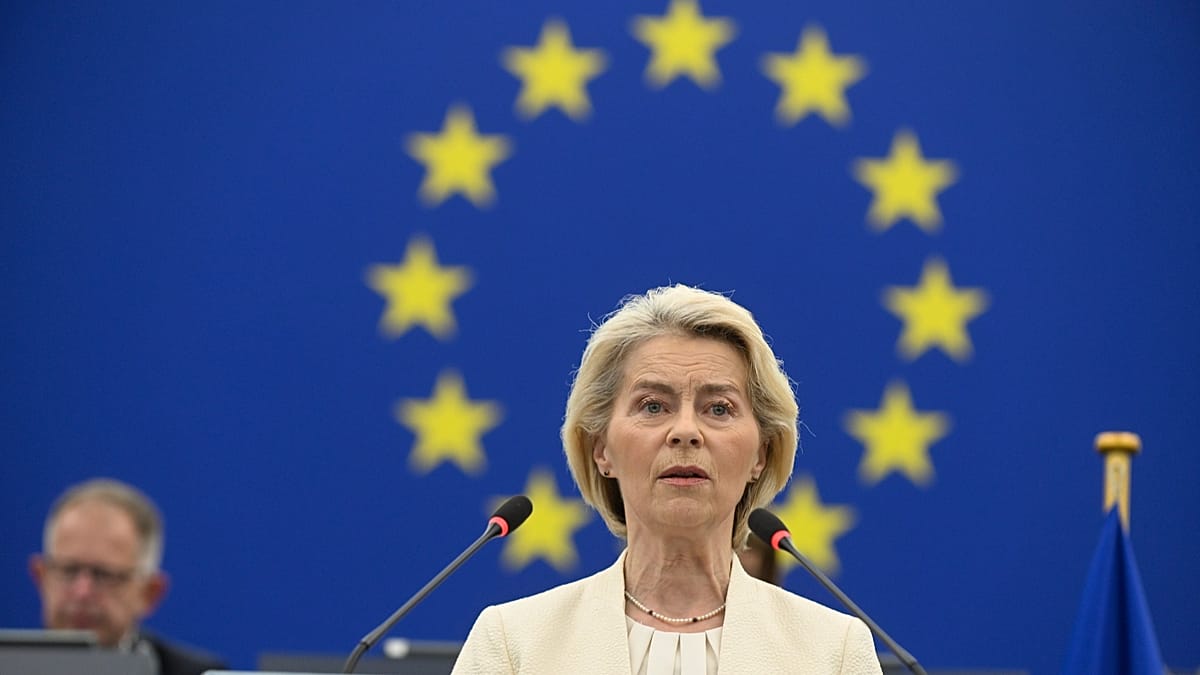
Ursula von der Leyen wants to convince the world that Brussels will set the tempo for artificial intelligence development, even as the technology races ahead of regulators. In her State of the European Union address, the European Commission president insisted Europe would help write the global rulebook for AI, positioning the bloc alongside Washington and Beijing. But the gap between rhetoric and reality is hard to ignore.
The EU has no dominant AI model, no counterpart to OpenAI's ChatGPT, Anthropic's Claude, or China's DeepSeek. Its most prominent startup, Mistral AI, is valued at roughly $24 billion (€20.9bn) — a fraction of the $852 billion (€741.2bn) and $965 billion (€839.6bn) attached to OpenAI and Anthropic. Even China's more fragmented AI sector boasts players like DeepSeek ($52bn), Moonshot AI ($31.5bn), and Zhipu AI ($141bn). Europe captures less than 5% of the estimated $1 trillion (€871.6tn) global AI investment, while the US takes 75-80% and China 10-14%.
Mixed reactions from MEPs
Michael McNamara, an independent Irish MEP from the Renew group and co-chair of Parliament's AI working group, dismissed the pledge as "lip-service." He noted that "many of the most significant AI developers are outside of Europe, and will have little regard whatsoever to her comments." McNamara also pointed to what he called a "wildly inconsistent record" on AI safety: the Commission championed the AI Act and an AI Liability Directive in its last mandate, then withdrew the liability proposal and pushed to weaken safeguards during the recent Omnibus trilogues, only to reverse course again in the speech.
"Given the contradictory positions she has advanced in quick step, it’s hard to expect AI developers to pay much regard to her latest position," McNamara said. He did, however, welcome von der Leyen's call to work with "like-minded partners like Canada, the United Kingdom and others, particularly on model evaluation, verification and security."
Italian MEP Brando Benifei, co-rapporteur of the AI Act and co-chair of the working group, took a more positive view. He argued that "the AI Act positions Europe to lead on AI safety" and that it "binds every frontier model offered here, American or Chinese." Benifei stressed the need for "sovereign capacity: European cloud, chips, unified capital, and a public CERN for AI to turn regulatory leadership into technological power."
Von der Leyen's call to "pace the frontier" echoes an essay by Anthropic's Dario Amodei, and she told the European Parliament: "If the people developing the technology are clear, then we should be too." The Commission president believes the AI Act is "a crucial piece to putting guardrails in place" that "puts Europe in the position to shape global efforts on how to tackle this." She also announced plans for November talks with industry leaders and officials on applying AI in health, transport, agri-food, advanced manufacturing, defence, and space.
Yet the EU's only clear lead is in regulation, with the AI Act's transparency and governance rules taking effect in August. Whether that translates into global influence remains an open question. As promises versus deliverables become a recurring theme, sceptics argue that without a homegrown tech ecosystem, Europe's regulatory ambitions may ring hollow. The bloc's security blueprint faces similar scrutiny, and the broader leadership style has drawn criticism for lacking urgency. For now, the EU's AI strategy is a bet on rules over innovation — a gamble that may not pay off in a race dominated by others.