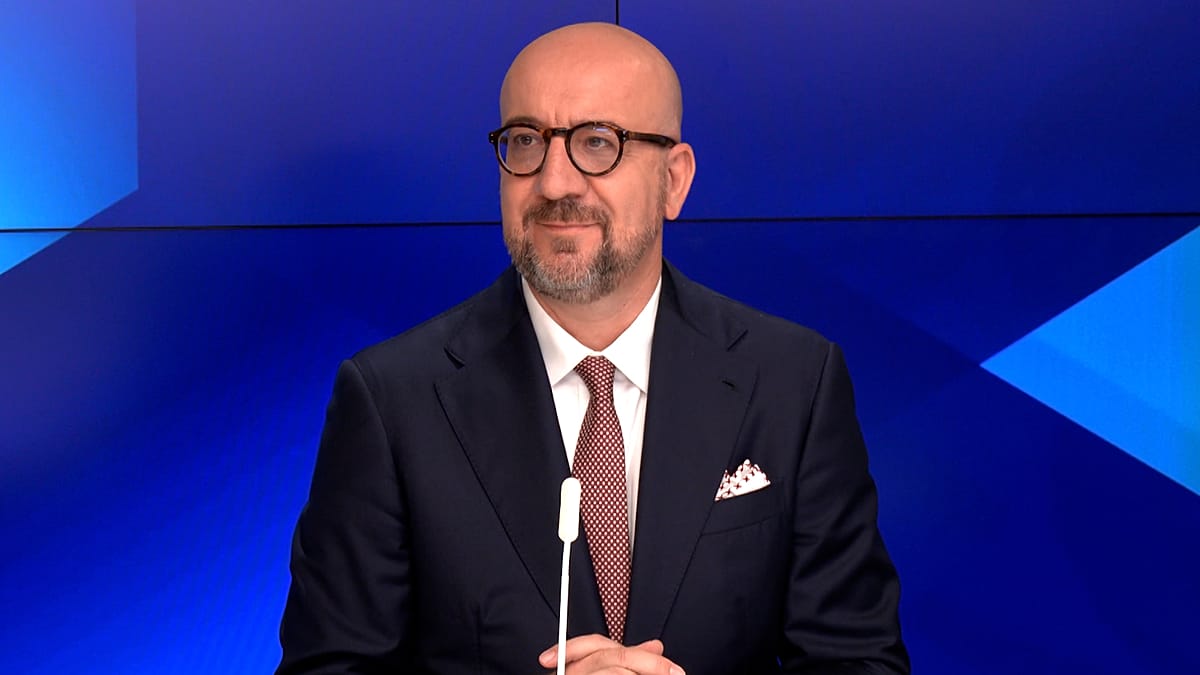
Charles Michel, who led the European Council during Ursula von der Leyen's first term as Commission president, has accused her of moving too slowly on the bloc's most pressing challenges. In an interview with Euronews ahead of her annual State of the European Union address in Strasbourg, Michel said the Commission has lost sight of what matters.
"I'm observing that, today, the EU is facing complicated challenges because there are more and more conflicts; there is a war on European soil, and we are in a difficult position in terms of competition with China and the United States," Michel told the programme Europe Today. "We should focus on the core issues, and the core issue is not about communication; it's not about more initiatives."
The former Belgian prime minister pointed to the sheer volume of proposals coming out of Brussels. "The Commission over the last years launched 400 initiatives. But where are the deliveries? Where is the improvement? When I meet entrepreneurs, they are disappointed because they don't feel a sense of urgency."
Over-regulation and the competitiveness deadlock
Michel argued that the EU's competitiveness—which he identifies as the top priority—is being undermined by excessive rule-making. "There is a question, a very simple question: 'Is the EU a better place to invest? Is the EU a better place to innovate?' We've seen a lot of regulations, over-regulation," he said.
He singled out the capital markets union, a long-promised single market for capital across the 27 member states, as a key example of stalled progress. "It makes us weaker, too weak in the current context." While conceding that von der Leyen is not solely responsible, Michel stressed that "she has a responsibility" and added: "There is no doubt that she is very slow in making her decisions. I have the impression there is a lack of focus on what matters."
In her speech on Wednesday, von der Leyen pushed back, arguing that the EU has the foundations to compete with the US and China. "We now have the political agreement on the One Europe, One Market Roadmap. And together, by the end of next year, we can and must complete this historic overhaul of the Single Market," she said.
Blindly following Washington?
Michel also criticised von der Leyen's approach to the United States under Donald Trump, particularly the so-called "Turnberry Agreement" on trade, which some MEPs saw as lopsided. "I have the impression that she decided to follow the United States blindly, even when it was against the fundamental interests of the European Union," Michel said.
He recalled that many European leaders, himself included, had long called for greater strategic autonomy. "There was a kind of naivety, I think, and many of the European leaders—a few years ago I was one of them—made it very clear that it was important to build European sovereignty, this European independence that now she is starting to talk about, but a lot of time was lost."
Despite his sharp criticism, Michel said he "remains optimistic" because "there is no Plan B." His remarks come as the EU faces a defining period, with migration, defence, and Ukraine all demanding urgent attention. The Commission's own promises versus deliverables have become a recurring theme in Brussels debates.
Von der Leyen's address also touched on climate and technology, including AI in healthcare and a new EU heatwave plan, but Michel's critique suggests that for many in the European Council, the real test lies in execution, not announcements.