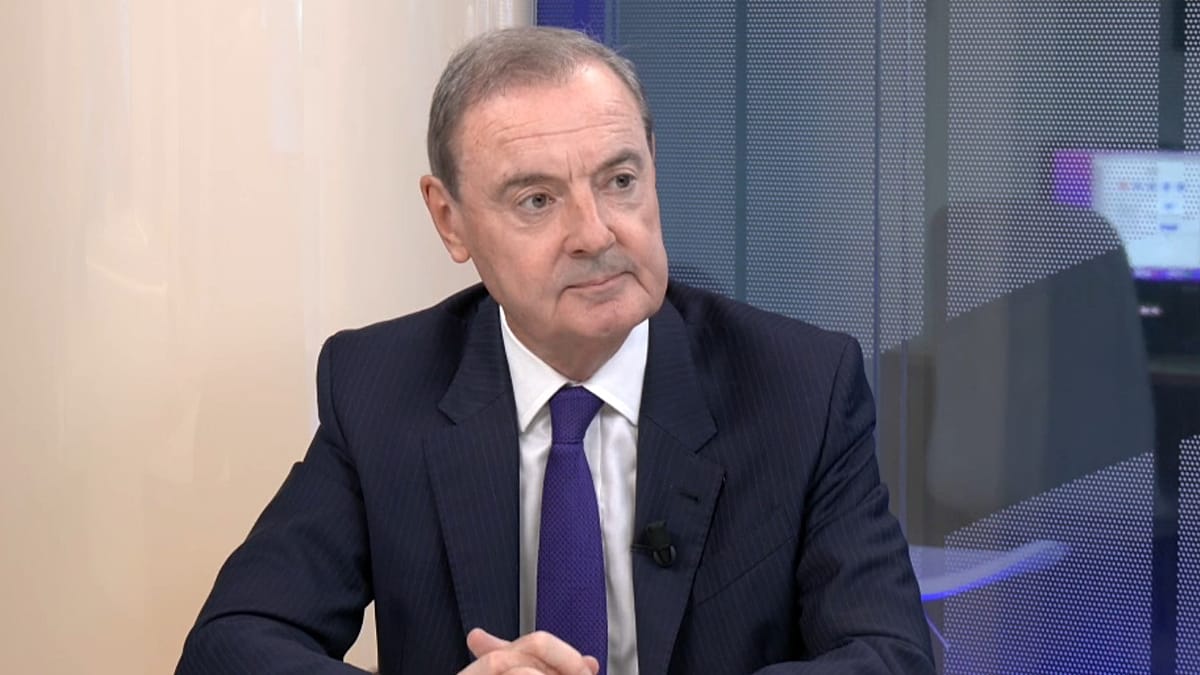
China continues to pose a significant challenge to the European Union's sanctions regime against Russia, according to the bloc's chief sanctions envoy, David O'Sullivan. In exclusive comments to Euronews, O'Sullivan described Beijing as a 'very big problem' due to its role in helping Moscow circumvent the measures, with no signs that the practice is diminishing.
'We raise it regularly at the highest level with the Chinese authorities but you know their answer, which is to say that they don't feel they're doing anything wrong, so we still have to take unilateral action against Chinese companies and financial institutions,' O'Sullivan said.
As Russia's illegal invasion of Ukraine enters its fifth year, the EU is sharpening its tools to inflict maximum damage on Moscow's economy. The bloc is preparing its 21st sanctions package, a process accelerated by recent incidents such as a Russian drone crashing into an apartment complex near Romania's border with Ukraine on Friday, injuring two people. Diplomats in Brussels say this underscores the need to hit the Kremlin where it hurts.
O'Sullivan stated on Euronews' flagship morning programme Europe Today that regardless of the package under development, China is blunting the power of the measures by helping Russia circumvent sanctions. The 20th package listed up to 56 companies involved in developing and manufacturing military goods Russia uses on the battlefield, many of which are Chinese. These firms were targeted for providing critical high-tech items used in Russian weapons, such as drones.
China's 'Backfilling' and Retaliation
O'Sullivan described China as a master of 'backfilling,' a process where local producers replace goods previously supplied by international partners, covering everything from household products to military-related equipment. The latter predominantly includes electronic components found in drones, missiles, and artillery shields—increasingly seen on the battlefield in Ukraine.
Beijing did not take the listings in the EU's 20th sanctions package lightly. In response, it retaliated by banning seven European defence companies from receiving Chinese-made products. This tit-for-tat has become a recurring pattern since the EU began adding Chinese entities to its blacklist. 'The Chinese play hardball,' O'Sullivan said. 'If we want to take action, they will also take equal action, but I think it is very important nonetheless that we continue to be able to send a strong message that we are vigilant about efforts to circumvent our sanctions and that where we see the evidence, we will take action.'
The EU's tech sovereignty efforts, as outlined in a recent sweeping package to reduce dependence on the US and China, are part of a broader strategy to counter such dependencies.
Russian Oil and the G7 Price Cap
Another critical issue looming over the next sanctions package is the full ban on maritime services for Russian oil tankers, approved in the previous package but left on hold pending G7 agreement. Greece and Malta, two coastal member states with powerful shipping and flagging sectors, remain firmly opposed. G7 allies have shown little enthusiasm amid energy turmoil following the closure of the Strait of Hormuz.
G7 leaders are set to meet in Évian, France, later this month, but O'Sullivan sounded pessimistic about a breakthrough, citing the conflict in the Middle East and rising global oil prices. 'At this point, there is no appetite to take additional measures which might aggravate that situation,' he said. 'We are in a new world.'
The full ban is meant to replace the G7 price cap on Russian oil, established in late 2022 to weaken Moscow's energy revenues. The cap is challenged by the Hormuz blockade because EU law requires it to be periodically adjusted to remain 15% below the average market price for Russian crude. This means the next revision should be upward, not downward. O'Sullivan said the bloc would need to reconsider the cap. 'We should not increase the price cap to a point where it becomes unduly generous towards Russia,' he clarified. 'I think that the objective is to keep it in or around the boundaries of where it is now to what was previously the maximum of $60 (€51.69).'
The White House has granted three exemptions on Russian oil sanctions due to the war in the Middle East, a move O'Sullivan said he would have preferred 'had not been granted,' though he insisted it should not affect the bottom line that Russia faces major challenges exporting its oil at attractive prices.



