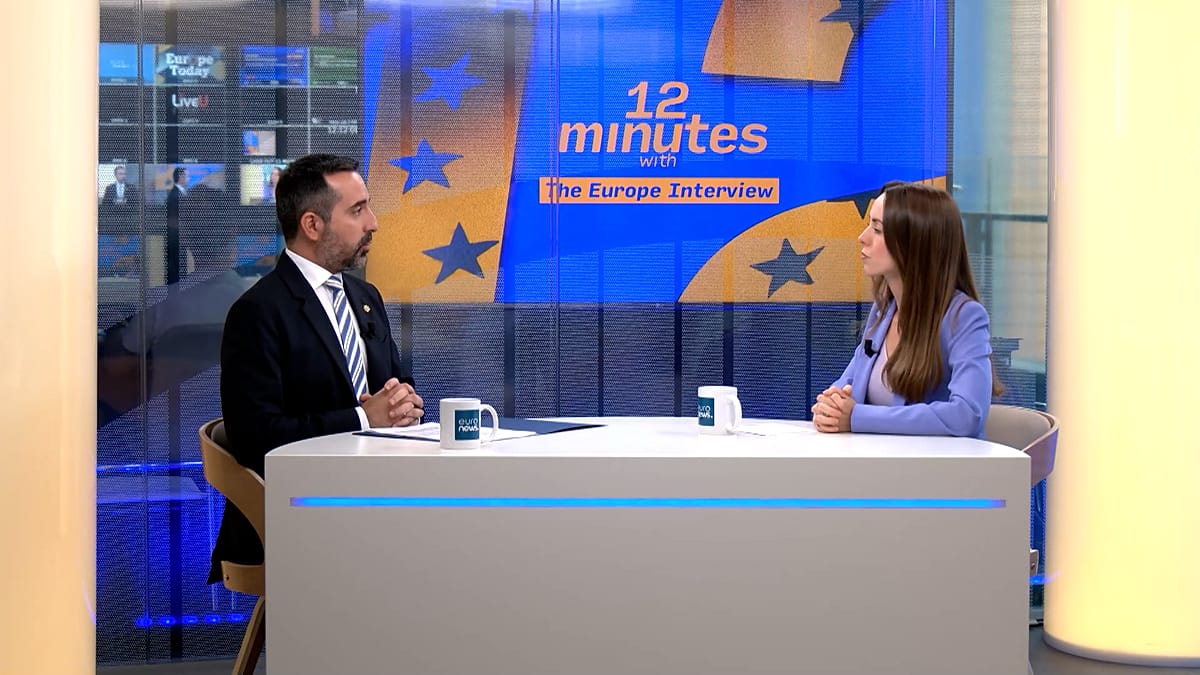
European Union member states that transfer rejected asylum seekers to deportation centres in third countries will need to develop more concrete human rights protections, Cyprus' Deputy Minister for Migration, Nicholas Ioannides, has told Euronews.
His remarks come days after the EU approved sweeping new measures to speed up migrant returns, a shift widely described as the bloc's most significant migration policy change in decades. The rules allow member states to strike bilateral agreements with non-EU countries to host so-called return hubs on their territory for individuals whose asylum claims have been denied.
Human Rights as a Red Line
“We don't want to punish these people,” Ioannides said in an interview with Euronews’ programme 12 Minutes With. “We just want to make sure that those who have no right to remain in the European Union will depart.”
Critics have condemned the return hub model as a threat to fundamental rights. Ioannides pushed back, insisting that “upholding human rights is a red line for everyone. We don't want any violations of EU and international law.” He noted that international organisations, including the UN refugee and migration agencies, would monitor conditions in the hubs.
When asked about contingency plans if rights are breached, the minister said safeguards would be written into the bilateral agreements. “There will be safeguards in the agreements concluded between member states and the third countries hosting such centres, which will stipulate the details of what should happen in case there's a human rights violation,” he explained.
Still, Ioannides acknowledged that EU countries are only at the discussion stage. “Now that the regulation has been agreed, we will start delving into the matter to adopt more tangible measures,” he added.
Protecting Children in Return Hubs
Under the new rules, unaccompanied minors will not be sent to return hubs, but children accompanied by their families may be transferred. Asked how the EU would protect these minors, Ioannides said the “best interests of the child” would be assessed before any decision to send a family with young children to a hub.
The rate of irregular migrants who receive an EU return order but do not leave stands at an average of 27% across the bloc. Ioannides attributed part of the problem to countries of origin refusing to take back their nationals, but also said some third-country nationals “do not cooperate with member states” on repatriation.
“The new regulation envisages measures that would exert pressure on individuals to collaborate with member states,” he said. “For instance, there will be strict detention rules and longer entry bans that will actually push third-country nationals to work with member states and accept their repatriation.”
The Cypriot government, which holds the six-month rotating presidency of the Council of the EU, has made tightening migration laws a priority. Ioannides described the return rules as the “missing piece” of the EU Pact on Migration and Asylum, which enters into force next week.
For more context on why these hubs are being established and the controversy surrounding them, read our explainer: EU Return Hubs: Why They Are Being Established and Why They Spark Controversy. The broader shift in EU migration policy also follows the approval of the toughest deportation rules in decades, as detailed in EU Approves Controversial Return Hubs and Toughest Deportation Rules in Decades.